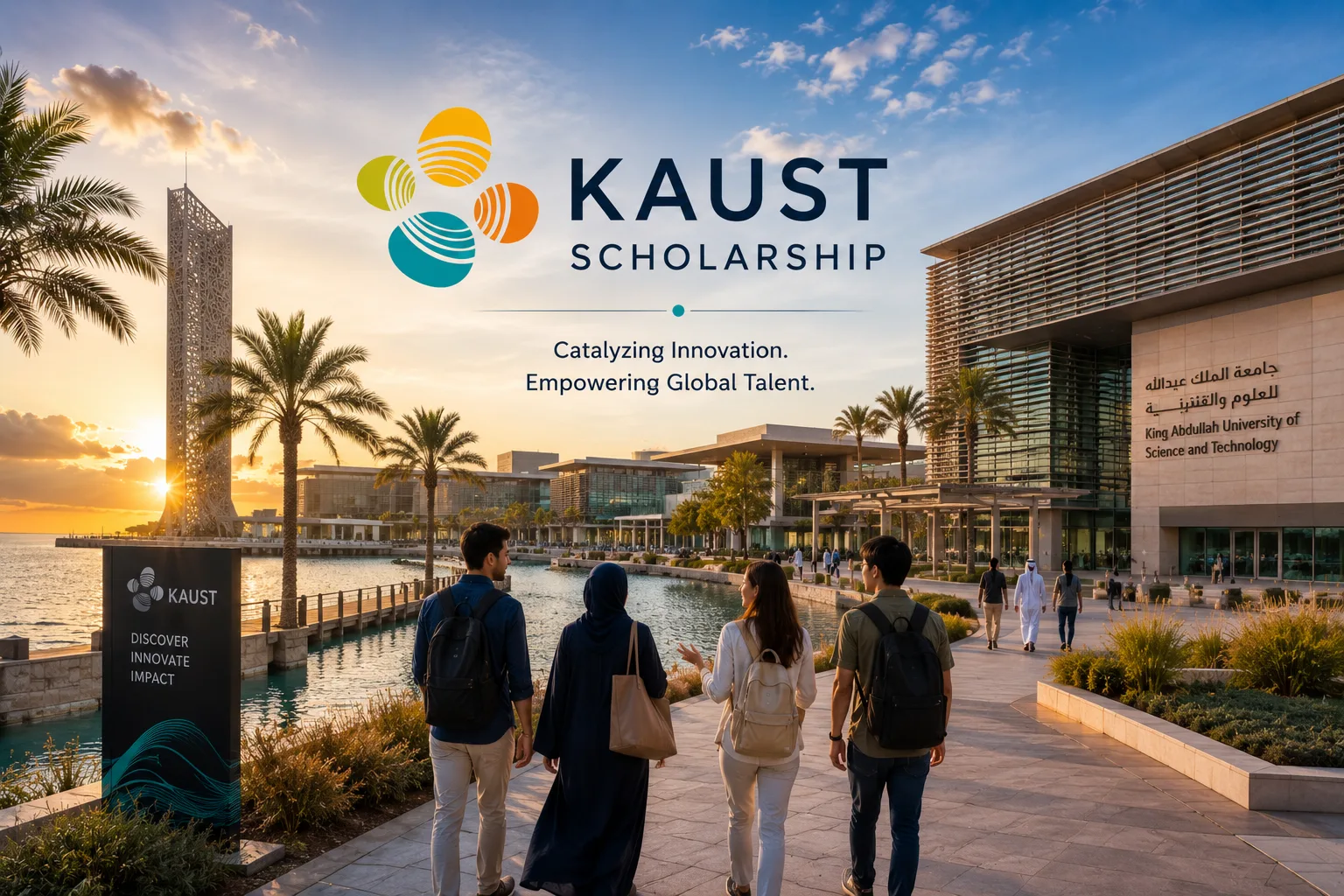
This article provides a detailed guide for Nigerian students who want to understand the KAUST scholarship 2027, including eligibility requirements, available programmes, financial benefits, documents, English-language requirements, application procedures, selection process and frequently asked questions.
The opportunity to study at a world-class university without worrying about tuition fees and major living expenses is one of the reasons international scholarships attract thousands of applicants every year. For Nigerian graduates interested in science, technology, engineering, mathematics and other research-focused disciplines, King Abdullah University of Science and Technology (KAUST) in Saudi Arabia is one institution worth considering.
The KAUST scholarship is commonly used to describe the financial support available to students admitted into KAUST graduate programmes. Unlike some scholarship schemes where students have to submit a separate scholarship application, KAUST states that admitted graduate students automatically receive the KAUST Fellowship, except students covered by certain external sponsorship or partnership arrangements.
For the 2027 entry cycle, KAUST has opened applications and is inviting qualified students from around the world to apply for its graduate programmes. The university currently describes its master’s and PhD programmes as fully funded and encourages strong applicants to apply early because admission is competitive.
What Is the KAUST Scholarship?
The KAUST scholarship refers primarily to the KAUST Fellowship attached to admission into eligible graduate programmes at King Abdullah University of Science and Technology.
KAUST is a graduate-level research university located in Thuwal, Saudi Arabia. The university focuses strongly on scientific research and provides students with access to advanced laboratories, researchers and an international academic environment.
The important thing for prospective applicants to understand is that this is not simply a scholarship competition where applicants apply for funding separately. KAUST’s official admissions FAQ says there is no separate application for the KAUST Fellowship. Students admitted to eligible graduate programmes automatically receive the fellowship, subject to applicable conditions.
This makes the admission application itself extremely important.
Rather than focusing only on the funding, applicants should concentrate on presenting a strong academic and research profile.
KAUST Scholarship 2027 Application Status
Applications for 2027 entry are open according to KAUST’s official admissions information. The university states that applications for 2026 are closed and applications for 2027 entry opened in mid-August.
Prospective applicants should check the official KAUST admissions portal for the exact programme deadline applicable to their intended programme.
This is important because application deadlines can differ depending on the programme and intake. Students should avoid waiting until the last day before submitting their applications.
| Information | Details |
|---|---|
| University | King Abdullah University of Science and Technology |
| Location | Thuwal, Saudi Arabia |
| Study level | Graduate |
| Main programmes | Master’s and PhD |
| 2027 entry | Applications open |
| Funding | KAUST Fellowship |
| Tuition | Fully supported for admitted eligible students |
| Monthly stipend | Provided |
| Accommodation | Provided under fellowship conditions |
| Health coverage | Provided |
| Relocation support | Provided |
| GRE | Not required |
| English test | Required in most cases |
| Application route | Online KAUST admissions portal |
The details above are based primarily on KAUST’s current official admissions information.
Who Can Apply for the KAUST Scholarship 2027?
The programme is designed for international students seeking graduate-level education.
For Nigerian applicants, the most relevant routes are generally the master’s and PhD programmes.
KAUST says it is looking for exceptional students from around the world who are interested in helping address major global challenges. Applicants are therefore expected to demonstrate strong academic ability and motivation for research.
A prospective applicant should first determine whether their academic background matches the requirements of the programme they intend to study.
For example, a student applying for a programme related to computer science should normally have an academic background that demonstrates sufficient preparation for advanced study in that area.
Similarly, an applicant interested in environmental science, marine science or engineering should demonstrate relevant academic preparation and a genuine interest in the proposed area.
KAUST Scholarship 2027 Academic Requirements
KAUST’s graduate admissions process is competitive. Academic qualifications are therefore an important part of the application.
Applicants should have an appropriate bachelor’s degree for master’s-level admission or an appropriate master’s degree where required for a PhD pathway.
However, academic qualification alone does not guarantee admission.
KAUST assesses applications as a whole, meaning applicants should also pay attention to their research experience, recommendation letters, statement of purpose, CV and other parts of the application.
For students who have recently completed a bachelor’s degree and are interested in research, KAUST offers an MS/PhD pathway in programmes where the pathway is available. The university explains that students can progress from the master’s stage towards a PhD without making a separate PhD application, provided they meet progression requirements.
Basic Academic Preparation
Before applying, Nigerian students should consider the following:
- Degree certificate or evidence of expected graduation.
- Academic transcript.
- Strong performance in relevant subjects.
- Research or project experience where available.
- Academic references.
- A clear statement of purpose.
- A well-prepared CV.
- Evidence of English-language proficiency where required.
Applicants should always read the requirements for their particular programme before submitting an application.
English Language Requirement
English proficiency is an important part of the KAUST application process.
KAUST currently requires a minimum TOEFL iBT score of 81 or IELTS score of 6.5 for applicants who need to provide an English-language test. The university states that official TOEFL or IELTS scores are accepted and gives exemptions for applicants who received a degree from accredited institutions in certain English-speaking countries, including the United States, Canada, United Kingdom, Ireland, Australia and New Zealand.
For many Nigerian applicants, this means that an IELTS or TOEFL examination may be necessary.
Applicants should therefore plan for the examination early rather than waiting until the application deadline is approaching.
| Test | KAUST minimum stated requirement |
|---|---|
| TOEFL iBT | 81 |
| IELTS | 6.5 |
| GRE | Not required |
KAUST explicitly states that the GRE is not required for admission.
Applicants should confirm the current requirement before submitting because university policies can change.
What Does the KAUST Scholarship Cover?
One of the biggest attractions of the KAUST scholarship is the level of financial support available to admitted graduate students.
KAUST states that admitted master’s and PhD students receive the fully funded KAUST Fellowship, which covers tuition, housing, health insurance, relocation support and other benefits.
The university’s fees and funding page gives further details about the fellowship.
The fellowship includes:
- Full tuition and bench fee coverage.
- Monthly living allowance.
- Accommodation.
- Medical coverage.
- Dental coverage where applicable.
- Relocation support.
- Other support according to university policies.
KAUST currently states that tuition and bench fee coverage can be worth up to US$35,000 per year. It lists a monthly stipend equivalent to about US$20,000 annually for master’s students and approximately US$25,000 to US$30,000 annually for PhD students, depending on qualifications and academic progress.
These figures should not be treated as a guaranteed cash payment because the fellowship structure includes different components and the applicable amount depends on the student’s programme and circumstances.
KAUST Fellowship Benefits
| Benefit | What it means |
|---|---|
| Tuition | Full tuition support |
| Bench fees | Covered under fellowship conditions |
| Monthly stipend | Living allowance |
| Accommodation | Base housing provided |
| Health insurance | Provided |
| Relocation | Support provided |
| Research environment | Access to KAUST facilities |
| Academic support | Graduate research and learning environment |
The university also explains that base accommodation is included, with housing arrangements depending on the student’s circumstances.
How Much Is the Monthly KAUST Stipend?
The amount depends on the student’s degree level and progression.
KAUST’s current onboarding information lists the following monthly stipend figures:
| Degree classification | Monthly stipend |
|---|---|
| MS | US$1,667 / SAR 6,250 |
| PhD below 30 credits | US$2,083 / SAR 7,812 |
| PhD above 30 credits | US$2,500 / SAR 9,375 |
These figures are from KAUST’s current student onboarding information and may be subject to university policy.
Nigerian applicants should therefore avoid relying on old social media posts that quote different amounts.
Does KAUST Provide Accommodation?
Yes.
Accommodation is one of the important components of the KAUST scholarship.
KAUST’s onboarding information states that single students are required to live on campus and are allocated shared accommodation, while married students who confirm that their families are arriving can be assigned family-style housing.
The university also states that accommodation itself does not carry a charge for eligible students, although additional charges may apply if a student requests an upgraded unit beyond their eligibility.
Utilities are also included in housing, according to KAUST’s onboarding information.
This can significantly reduce the financial burden on international students.
Cost of Living at KAUST
Although the fellowship provides substantial financial support, students should still understand the cost of living.
KAUST reports that students surveyed spend approximately US$1,320 per month on average, although individual spending varies considerably depending on lifestyle.
Students may spend money on food, personal items, entertainment, travel and other activities.
However, several campus facilities and activities are available without additional charges, including public transport on campus, access to certain recreational facilities and community activities.
This means applicants should not assume that the stipend is intended solely for tuition or accommodation. Its purpose includes helping students manage their living expenses while studying.
Available KAUST Graduate Programmes
KAUST offers graduate programmes across a range of scientific and technological fields.
The university currently states that its MS and PhD programmes span 17 subjects.
These programmes cover areas related to fields such as:
- Biological sciences.
- Environmental science.
- Marine science.
- Computer science.
- Artificial intelligence.
- Electrical engineering.
- Mechanical engineering.
- Chemical engineering.
- Materials science.
- Energy-related research.
- Applied physics.
- Earth science.
- Plant science.
- Statistics and related disciplines.
Applicants should visit the official programme pages to confirm the exact programme names, available degrees and entry requirements.
Master’s Degree at KAUST
KAUST offers Master of Science programmes for students who want to deepen their academic and research knowledge.
The university currently states that its MS programmes can be completed through either a 1.5-year non-thesis track or a 2-year thesis track, depending on the programme and selected pathway.
The master’s programmes are research-intensive and provide opportunities for students to work on globally relevant research projects.
This makes KAUST particularly suitable for graduates who want more than classroom-based education.
A student interested in research and eventual doctoral study may also consider programmes offering an MS/PhD pathway.
PhD Opportunities at KAUST
The PhD route is designed for students who want to develop advanced research expertise.
Applicants should have a clear interest in research and demonstrate the academic preparation needed for doctoral-level work.
The duration of a PhD can depend on whether the student enters with a bachelor’s or master’s degree and on the specific programme.
KAUST’s programme information shows that its PhD environment is strongly research-oriented, with students expected to develop and defend research work as part of their doctoral progression. (TAJRC)
Documents Required for the KAUST Scholarship 2027
Because the fellowship is connected to graduate admission, applicants should prepare their admission documents carefully.
Common application materials include:
- Academic transcript.
- Degree certificate or equivalent proof of graduation.
- Curriculum Vitae.
- Statement of purpose.
- Letters of recommendation.
- English-language test result where required.
- Passport information.
- Additional programme-specific documents where applicable.
KAUST specifically states that recommendation letters are important and should ideally come from professors or advisers who know the applicant’s academic or research work. The university encourages recommenders to provide meaningful comparative statements and information about the applicant’s research ability.
This means applicants should not select referees simply because they hold senior positions.
Choose lecturers or academic supervisors who genuinely know your work.
How to Apply for KAUST Scholarship 2027
The application is completed online through the KAUST admissions system.
Step 1: Choose Your Programme
Visit the official KAUST graduate admissions website and identify the programme that matches your academic background and career plans.
Do not choose a programme simply because it offers attractive funding.
Your academic background should make sense for the programme.
Step 2: Review the Entry Requirements
Read the programme-specific requirements carefully.
Check the academic qualification, English-language requirements and any additional requirements.
Step 3: Prepare Your CV
Your CV should clearly present your academic history, research experience, projects, publications, internships, awards and relevant technical skills.
Avoid filling your CV with unrelated information.
Step 4: Prepare Your Statement of Purpose
Your statement should explain:
- Your academic background.
- Your research interests.
- Why you chose the programme.
- Why KAUST is suitable for your goals.
- Your relevant research or project experience.
- Your future academic or professional objectives.
Avoid writing a generic statement that could be submitted to any university.
Step 5: Select Your Referees
Choose professors or academic supervisors who can provide detailed information about your academic ability and research potential.
Give them sufficient time to prepare their recommendations.
Step 6: Submit Your English Test
If you are required to provide IELTS or TOEFL, ensure that the result meets the university’s minimum requirement.
Step 7: Review Your Application
Before submitting, check every section.
Make sure your names, dates, degree information and contact details are accurate.
Step 8: Submit Before the Deadline
Do not wait until the final hours.
Technical problems, missing documents or delays from referees can create unnecessary difficulties.
How to Improve Your Chances of Admission
There is no guaranteed formula for admission.
However, applicants can strengthen their profile by presenting evidence of academic ability and research potential.
Maintain a Strong Academic Record
Your grades are important, especially in courses directly related to your intended programme.
Build Research Experience
Research projects, undergraduate dissertations, publications, conference presentations and relevant laboratory experience can strengthen an application.
However, applicants should not invent research experience.
Write a Specific Statement of Purpose
Explain your actual interests and experiences.
Admissions officers should be able to understand why the programme is relevant to you.
Choose Strong Referees
A detailed recommendation from someone familiar with your work can be more useful than a generic letter from a senior person who barely knows you.
Apply Early
KAUST itself encourages strong applicants to apply early because admission is competitive.
Is GRE Required for KAUST?
No.
KAUST states that it does not require the GRE examination for admission.
This is useful for applicants who may otherwise spend additional money preparing for an examination that is not required.
However, applicants should still check the current requirements for their programme before applying.
Is the KAUST Scholarship Fully Funded?
For admitted eligible graduate students, KAUST describes the fellowship as fully funded.
The support includes tuition, housing, health insurance, relocation assistance and a monthly living allowance.
However, “fully funded” should not be interpreted as meaning that every possible personal expense is paid by the university.
For example, KAUST states that the cost of an English-language proficiency test is not covered by the fellowship.
Students should therefore budget for expenses that fall outside the fellowship.
Can Nigerian Students Apply?
Yes.
KAUST welcomes international students, and Nigerian applicants can apply if they meet the requirements of their chosen graduate programme.
The university describes its student population as highly international, with students from more than 120 nationalities according to its current admissions website.
For Nigerian graduates, this provides an opportunity to join a diverse academic community while pursuing advanced research training.
Common Mistakes Nigerian Applicants Should Avoid
Applying for an Unrelated Programme
Your degree should reasonably connect with the programme you select.
Submitting a Generic Statement
Avoid copying statements from scholarship websites.
Your statement should be original and based on your own academic journey.
Choosing Weak Referees
Choose people who understand your academic ability.
Ignoring English Requirements
If you need IELTS or TOEFL, prepare for it early.
Waiting Until the Deadline
Early submission gives you time to correct mistakes.
Paying People Who Promise Admission
Be careful with individuals who claim they can guarantee a KAUST admission or fellowship.
Admission decisions are made by the university, and applicants should use the official application channel.
Providing False Information
Never alter grades, certificates, employment records, publications or research experience.
False information can seriously damage an application.
Frequently Asked Questions About KAUST Scholarship 2027
1. What is the KAUST Scholarship 2027?
The KAUST scholarship generally refers to the KAUST Fellowship available to admitted eligible graduate students. It provides substantial financial support, including tuition, accommodation, living allowance, health coverage and relocation support.
2. Is the KAUST Scholarship 2027 open?
Yes. KAUST’s official admissions page states that applications for 2027 entry opened in mid-August 2026. Applicants should check the official admissions portal for programme-specific deadlines.
3. Is KAUST scholarship fully funded?
KAUST describes its graduate programmes as fully funded for admitted eligible students. The fellowship covers tuition, housing, health insurance, relocation support and a monthly stipend.
4. Do I need to apply separately for the KAUST Fellowship?
No. KAUST states that there is no separate fellowship application. Eligible admitted students automatically receive the fellowship, subject to applicable conditions.
5. Does KAUST accept Nigerian students?
Yes. Nigerian students can apply for eligible graduate programmes provided they meet the university’s admission requirements.
6. What IELTS score does KAUST require?
KAUST currently requires a minimum IELTS score of 6.5 for applicants who need to submit an English-language test.
7. What TOEFL score does KAUST require?
KAUST currently states a minimum TOEFL iBT score of 81.
8. Is GRE required for KAUST?
No. KAUST states that the GRE is not required for admission. (KAUST)
9. How much is the KAUST monthly stipend?
Current KAUST onboarding information lists US$1,667 per month for MS students, US$2,083 for PhD students below 30 credits and US$2,500 for PhD students above 30 credits.
10. Does KAUST provide accommodation?
Yes. Accommodation is included under the fellowship for eligible students. Housing arrangements depend on circumstances such as whether the student is single or bringing eligible dependants.
11. Can I apply for a master’s degree at KAUST?
Yes. KAUST offers master’s programmes across its graduate subject areas, including both non-thesis and thesis pathways depending on the programme.
12. Can I apply for a PhD at KAUST?
Yes. KAUST offers PhD programmes for qualified applicants interested in advanced research.
13. Does KAUST pay for IELTS or TOEFL?
No. KAUST’s FAQ states that the costs of English-language proficiency tests are not covered by the fellowship.
14. Do I need research experience before applying?
Research experience can strengthen an application, particularly for research-intensive programmes, but applicants should check the specific entry requirements for their intended programme.
15. Can I apply through an agent?
Applicants can apply directly through KAUST’s official admissions system. There is no need to pay an agent who claims they can guarantee admission or fellowship selection.
Conclusion
The KAUST scholarship 2027 presents a strong opportunity for Nigerian graduates who want to pursue advanced study in a research-focused international university.
One of the biggest advantages is that eligible admitted graduate students receive the KAUST Fellowship automatically rather than having to compete for a separate scholarship application. The fellowship provides major financial support, including tuition, accommodation, health coverage, relocation assistance and a monthly stipend. (KAUST)
However, applicants should not view the programme as an easy scholarship opportunity. KAUST describes its graduate admissions process as competitive and encourages academically strong applicants to apply early.
Nigerian students who want to apply should therefore concentrate on building a strong and honest academic profile, choosing a suitable programme, preparing a convincing statement of purpose, securing strong academic recommendations and meeting the English-language requirements.
Most importantly, applicants should rely on the official KAUST admissions website for current deadlines and requirements. Scholarship information found on social media, WhatsApp groups or unofficial blogs can become outdated quickly.
With proper preparation and an application that clearly demonstrates academic ability and research potential, qualified Nigerian graduates can position themselves for consideration for graduate study at KAUST in the 2027 entry cycle.