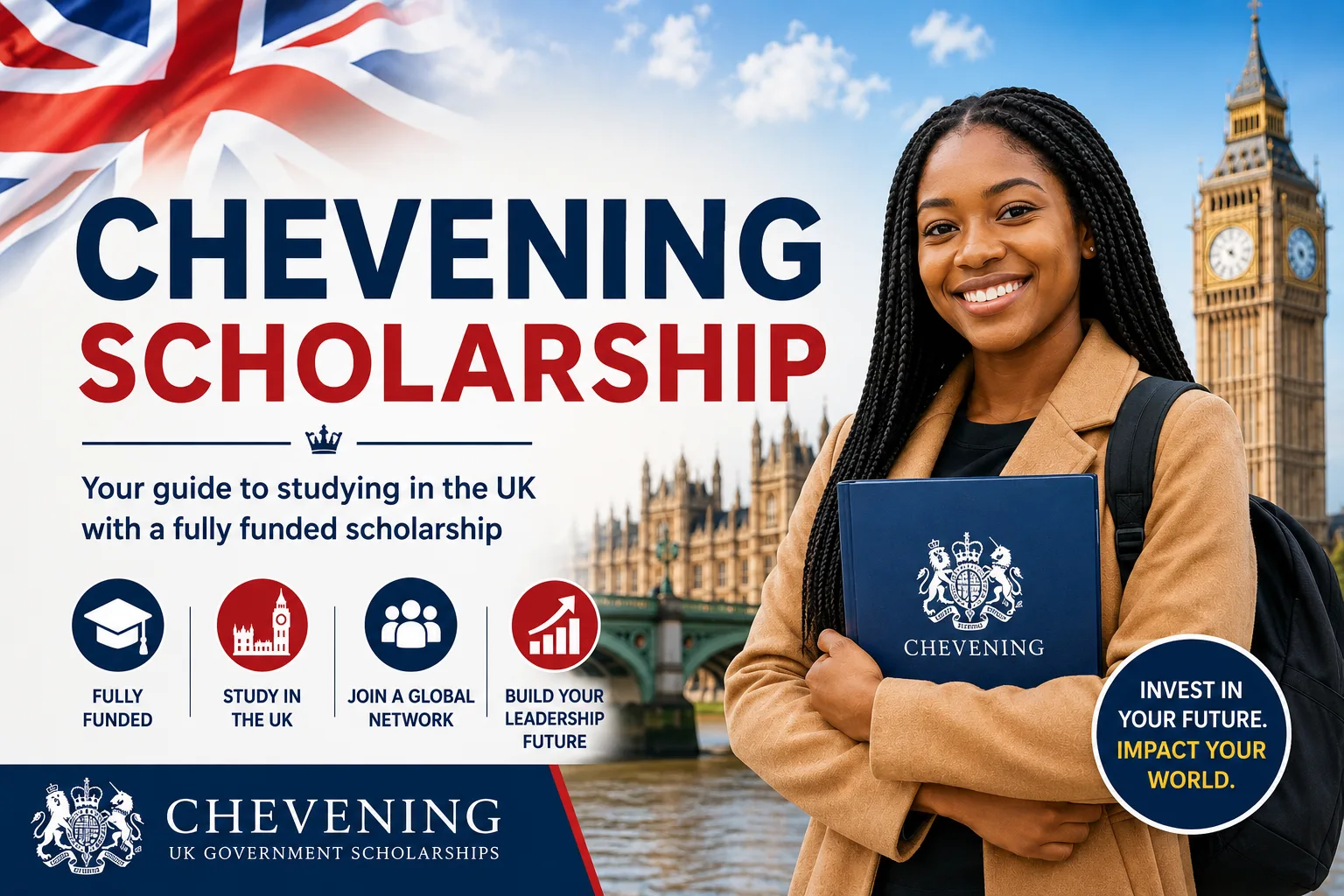
This guide explains what the Chevening Scholarship is, who can apply, the requirements for Nigerian applicants, eligible courses, work experience requirements, the application process, selection criteria, interview stage, common mistakes and frequently asked questions.
The Chevening Scholarship is one of the most respected international scholarship opportunities available to Nigerians and other eligible citizens around the world who want to study for a master’s degree in the United Kingdom.
The scholarship is funded by the UK Government through the Foreign, Commonwealth and Development Office (FCDO), together with partner organizations. It is designed for people who have demonstrated leadership potential, professional experience and a strong desire to make a positive impact in their communities, countries and beyond.
For Nigerians interested in postgraduate study in the UK, the Chevening Scholarship can provide an opportunity to pursue a one-year master’s degree while becoming part of a global network of professionals and future leaders.
For the 2027/2028 academic year, applications opened on 4 August 2026 and will close on 6 October 2026 at 11:00 UTC. Applicants should always confirm deadlines and requirements on the official Chevening website because scholarship information can change between application cycles.
What Is the Chevening Scholarship?
The Chevening Scholarship is a UK Government-funded scholarship programme for emerging and established leaders from eligible countries and territories.
The programme gives successful scholars the opportunity to study a master’s degree in the UK and develop professional networks that can support their long-term career goals.
Chevening scholarship is not simply about academic qualifications. The programme places strong emphasis on leadership, influencing skills, professional relationships, career planning and the applicant’s potential to contribute positively to their home country.
According to Chevening’s official guidance, successful applicants should be able to demonstrate leadership and influencing skills, relationship-building ability and a realistic career plan that can contribute to positive change.
Chevening Scholarship at a glance
| Feature | Details |
|---|---|
| Scholarship name | Chevening Scholarship |
| Funding | UK Government and partner organisations |
| Study destination | United Kingdom |
| Study level | Master’s degree |
| Typical programme length | One year |
| Eligible applicants | Citizens of eligible countries and territories |
| Nigerian applicants | Yes |
| Work experience | At least 2,800 hours |
| Number of course choices | Three eligible UK master’s courses |
| Application method | Online |
| Application fee | Free |
| Return requirement | At least two years in the home country after the award |
| Current cycle | 2027–2028 |
| Current application deadline | 6 October 2026, 11:00 UTC |
Requirements and deadlines should be checked against the official guidance for the specific year in which you are applying.
Is Chevening Scholarship Fully Funded?
Yes. The Chevening Scholarship is generally described as a fully funded scholarship because it is designed to provide substantial financial support for successful scholars during their master’s studies in the UK.
However, applicants should not assume that every possible personal expense will automatically be covered without conditions. The exact financial arrangements, allowances and scholarship conditions should be checked in the official award information for the relevant application cycle.
The main attraction is that successful candidates can undertake a qualifying master’s degree in the UK without having to personally fund the full cost of tuition and living expenses.
This makes Chevening particularly attractive to qualified Nigerian professionals who may otherwise find the cost of studying in the UK difficult to afford.
What Does the Chevening Scholarship Cover?
The scholarship provides financial support connected with the scholar’s approved study programme and time in the UK.
Depending on the applicable award terms, support can include major study and living-related expenses.
Applicants should rely on the official Chevening award documentation rather than information from social media posts or agents because financial arrangements can change.
One important point is that applicants should not pay an individual or organisation claiming to guarantee a Chevening award. Chevening states that applying for the scholarship is free and does not endorse third parties that charge applicants for application support or advice.
Chevening Scholarship Eligibility Requirements
Before starting an application, Nigerian applicants should carefully check whether they satisfy the eligibility requirements.
The major requirements include citizenship, education, work experience, leadership potential and commitment to returning home after the scholarship.
1. You must be a citizen of an eligible country
You must be a citizen of a country or territory that is eligible for Chevening.
Nigeria is included among the countries participating in the Chevening Scholarship programme. The official Chevening Nigeria page confirms that applications are available to Nigerian citizens.
2. You need an undergraduate degree
Applicants must hold an undergraduate degree that qualifies them for admission to a postgraduate master’s programme in the UK.
Your degree does not necessarily have to be in the same field as your proposed master’s course, but you must satisfy the admission requirements of the university and course you select.
For Nigerian applicants, this means you should have appropriate evidence of your undergraduate qualification and carefully check the academic requirements of your selected UK universities.
3. You need at least 2,800 hours of work experience
Work experience is one of the most important Chevening scholarship requirements.
Applicants need at least 2,800 hours of work experience, which is approximately two years.
Chevening’s online application system calculates work experience using the information entered by applicants. The application form allows applicants to enter multiple work-history records.
Work experience should therefore not be guessed. Applicants should accurately record their employment, internships, voluntary activities and other qualifying experiences according to the official rules.
If you are a recent graduate with insufficient qualifying experience, you may need to wait until you meet the requirement before applying.
4. You must demonstrate leadership and influencing skills
Chevening is interested in people who can demonstrate that they have influenced others and contributed to positive change.
Leadership does not necessarily mean that you must have held a very senior job title.
For example, you may demonstrate leadership by:
- Leading a community project
- Coordinating a professional team
- Starting an initiative
- Improving a process at work
- Organising a development programme
- Mentoring other people
- Solving a specific problem
- Influencing decision-making
- Delivering measurable results
The strongest examples usually explain what you did, why you did it, how you influenced others and what changed as a result. Chevening specifically advises applicants to provide evidence of leadership and influencing skills with clear outcomes.
5. You must demonstrate relationship-building skills
Another important part of the Chevening application is networking and relationship building.
The scholarship is designed to create an international network of professionals, so applicants should be able to explain how they have built professional relationships and used those relationships to achieve positive results.
Do not simply write that you are “good at networking”.
Instead, give specific examples.
For instance, explain how you worked with government officials, community leaders, professional colleagues, NGOs, researchers, entrepreneurs or other stakeholders to achieve a particular objective.
6. You must have a clear career plan
Your career plan is another major part of the application.
Chevening wants applicants who have realistic plans for what they intend to do after their studies.
A strong career plan should show:
- Your short-term goal
- Your medium-term goal
- Your long-term ambition
- The problem you want to address
- How your master’s degree will help you
- How you intend to use your knowledge after returning home
- The impact you hope to create
Chevening’s application criteria specifically require candidates to demonstrate short-, medium- and long-term career plans with clear and measurable goals.
7. You must commit to returning home
Successful Chevening Scholars are required to return to their home country for at least two years after completing their scholarship.
This requirement is important because Chevening is intended to develop leaders who can use their knowledge and experience to contribute to their home countries.
Chevening Scholarship Requirements for Nigerians
For Nigerians, the basic eligibility requirements are the same as the general Chevening scholarship requirements.
| Requirement | Nigerian applicant |
|---|---|
| Nigerian citizenship | Required |
| Undergraduate degree | Required |
| Qualifying work experience | At least 2,800 hours |
| Leadership evidence | Required |
| Networking/relationship-building evidence | Required |
| Career plan | Required |
| Eligible UK master’s course | Required |
| Return-home commitment | Required |
| Application | Online |
Nigerian applicants should also check the specific requirements for their chosen university because admission requirements vary between institutions.
What Courses Are Eligible for Chevening?
Chevening scholarship are for eligible master’s degree courses in the UK.
Applicants are required to select three different master’s courses on their Chevening application.
These courses can be at the same university or at different universities, depending on the applicant’s choices and the available eligible courses.
Chevening’s course guidance states that eligible courses must generally:
- Be full-time
- Lead to a master’s degree
- Start in the autumn term, usually September or October
- Last between nine and 12 months
- Not be distance-learning programmes
- Not be part-time programmes
- Not start in January
- Not be research-based programmes
Examples of possible study areas
Depending on the eligible courses available in a particular cycle, applicants may find master’s programmes in areas such as:
- Public policy
- International relations
- Development studies
- Environmental management
- Climate change
- Business
- Economics
- Law
- Agriculture
- Forestry
- Technology
- Data science
- Education
- Public health
- Engineering
- Media and communication
However, the availability of a particular course should always be confirmed using the official Chevening course finder.
How Many Universities Can You Choose?
You are required to select three eligible master’s courses.
These do not necessarily have to be at three different universities. Chevening scholarship explains that applicants can select three different courses at one institution or similar courses across up to three universities.
You should not choose courses simply because the universities are popular.
Instead, your choices should support your academic background, professional experience and career plans.
How to Apply for Chevening Scholarship
The Chevening Scholarship application process is completed online.
The official process includes several important stages.
Step 1: Check your eligibility
Before beginning the application, confirm that you satisfy the Chevening scholarship requirements.
Do not wait until the final day before discovering that you do not meet the work experience or academic requirements.
Step 2: Research your master’s courses
Identify three eligible UK master’s courses that fit your career objectives.
Research:
- Course content
- Modules
- University reputation
- Entry requirements
- Course duration
- Application deadlines
- Career relevance
Chevening recommends applicants research their courses carefully before submitting their application.
Step 3: Register on the Chevening application system
Applications are completed through Chevening’s online application system.
You will provide your email address and phone number and receive information needed to access your application.
The system also provides a unique access code, which applicants should keep safely.
Step 4: Complete the application form
The application includes sections covering areas such as:
- Personal details
- Immigration information
- Education history
- Work experience
- Course choices
- Referees
- Essay questions
- Equal opportunities information
Chevening’s system allows applicants to save their progress and return later, provided they remain within the application period.
Step 5: Write the four application essays
The Chevening application includes four major essay areas covering:
- Leadership and influencing
- Relationship building and networking
- Course choices
- Career goals
These essays are extremely important because they give the selection committee an opportunity to understand your experiences, achievements, motivations and plans.
Important warning about AI-generated applications
Applicants should pay particular attention to this point.
Chevening states that using artificial intelligence software to generate answers to its essay questions is strictly prohibited. Applicants are required to submit their own original work, and Chevening says applications may be checked for plagiarism, fraud and AI-generated content.
Therefore, applicants should not copy essays from websites, previous applicants or AI tools.
You can use general scholarship resources to understand what Chevening expects, but your submitted essays should genuinely represent your own experiences and writing.
Step 6: Submit your application
After completing all required sections, review the information carefully and submit the application through the official system.
Chevening applications cannot be submitted on paper.
Chevening Scholarship Application Deadline 2027/2028
For the current 2027–2028 Chevening Scholarship cycle, applications opened on 4 August 2026 at 11:00 UTC.
The application deadline is 6 October 2026 at 11:00 UTC.
Important Chevening 2027/2028 dates
| Stage | Date |
|---|---|
| Applications open | 4 August 2026 |
| Applications close | 6 October 2026 |
| Application assessment | From October 2026 |
| Reading committee assessments | Mid-October 2026 – January 2027 |
| Interview shortlist | Mid-February 2027 |
| Interviews | March – April 2027 |
| Results | From mid-June 2027 |
| Unconditional university offer deadline | 8 July 2027 |
| Studies begin | September/October 2027 |
These dates are based on Chevening’s official 2027–2028 application timeline.
When Should Nigerian Applicants Apply to UK Universities?
You should not wait until you receive the Chevening scholarship before starting your university applications.
Chevening scholarship recommends that applicants apply to their chosen UK master’s courses as soon as possible.
Importantly, applying to your university courses is separate from submitting your Chevening application. You do not necessarily need to have applied to your university courses before submitting the initial Chevening application.
If you are eventually successful, you must obtain an unconditional offer from at least one of your selected courses by the relevant Chevening deadline.
For the 2027–2028 cycle, the unconditional offer deadline is 8 July 2027 at 17:00 BST.
Chevening Scholarship Interview
Being invited to an interview means that your application has passed earlier stages of the selection process.
For the current cycle, shortlisted applicants are expected to be invited for interviews around mid-February 2027, while interviews are scheduled for March and April 2027.
Interviews take place through British embassies and high commissions.
Candidates should be prepared to discuss:
- Their leadership experience
- Their networking ability
- Their selected courses
- Their career plans
- Their proposed impact
- Current challenges relevant to their professional area
- Why studying in the UK is important for their goals
Do not memorise artificial answers.
The best approach is to understand your application thoroughly and be able to explain your experiences naturally.
What Documents Are Needed?
Applicants should carefully follow the document instructions for their application cycle.
If shortlisted for an interview, applicants are required to provide documents including their undergraduate degree certificate and two reference letters. Chevening’s guidance states that undergraduate transcripts are not accepted in place of the required degree certificate.
Applicants should therefore prepare their documents early.
Common documents include:
- Undergraduate degree certificate
- Two reference letters
- Identification documents
- Passport information
- Education records
- Work experience information
- University application information
The exact document requirements and upload deadlines should be confirmed from the official application instructions.
How to Choose a Strong Chevening Course
Choosing the right course is more than selecting a prestigious university.
Ask yourself:
What problem do I want to solve?
Then ask:
What skills do I need to solve that problem?
Finally:
Which master’s course will give me those skills?
For example, someone working in environmental management who wants to improve climate-resilience policies in Nigeria may consider a master’s programme related to environmental policy, climate change, sustainable development or another relevant field.
Your course should therefore connect naturally with your previous experience and future goals.
How to Write a Strong Chevening Application
A strong application should be specific.
Avoid making statements such as:
“I am a great leader and I want to change Nigeria.”
That statement is too general.
Instead, provide evidence.
Explain:
- What problem existed?
- What was your responsibility?
- What action did you take?
- Who did you influence?
- What challenges did you face?
- What was the measurable result?
- What did you learn?
- How will that experience influence your future leadership?
This makes your application more credible.
Chevening’s own application guidance emphasises evidence of leadership, professional relationships, course research and a realistic career plan.
Common Mistakes to Avoid
1. Using fake experiences
Never invent employment, leadership positions, awards or achievements.
2. Copying another person’s essay
Your application should be original.
3. Using AI to generate your Chevening essays
Chevening explicitly prohibits AI-generated answers to its essay questions.
4. Choosing courses without proper research
Your three course choices should have a clear connection with your career goals.
5. Ignoring the work experience requirement
Make sure your qualifying experience meets the required 2,800 hours.
6. Waiting until the deadline
Technical problems, missing documents and poor planning can affect your application.
7. Paying an agent to guarantee success
Chevening says applying is free and does not endorse third parties that charge for application support or advice.
Is Chevening Scholarship Free to Apply For?
Yes. Applying for a Chevening Scholarship is free.
Applicants should be cautious of individuals who claim that they can guarantee selection in exchange for money.
Chevening states that applicants do not need to pay anyone to apply and that it does not endorse third parties who charge for application support or advice.
Chevening Scholarship for Nigerian Students: Key Tips
If you are applying from Nigeria, consider the following:
- Start preparing before the application window.
- Calculate your work experience carefully.
- Research your three courses properly.
- Apply to universities early.
- Prepare your academic documents.
- Choose referees who know your professional or academic work well.
- Use real leadership examples.
- Quantify your achievements where possible.
- Develop a realistic career plan.
- Proofread your application carefully.
- Never fabricate information.
- Do not use AI-generated answers in the Chevening essays.
- Use only official Chevening information for final deadlines and requirements.
Chevening Scholarship Selection Process
Chevening scholarship applications go through a rigorous selection process.
According to Chevening, applications are first checked for plagiarism and eligibility. Eligible applications are then assessed by independent reading committees against relevant Chevening, FCDO and regional objectives. Candidates who progress are shortlisted for interviews by British embassies or high commissions.
This means that simply meeting the minimum requirements does not guarantee selection.
Thousands of people may meet the basic eligibility requirements, but successful applicants need to demonstrate a strong combination of leadership, networking, career planning and potential impact.
What Makes a Competitive Chevening Applicant?
A competitive applicant usually has more than good academic qualifications.
They can clearly demonstrate:
- Leadership
- Influence
- Professional achievements
- Relationship building
- A strong career direction
- Knowledge of their chosen field
- A realistic plan for positive impact
- A strong reason for studying their selected master’s course
- Commitment to returning home
Academic excellence can strengthen an application, but applicants should not rely on grades alone.
Frequently Asked Questions About Chevening Scholarship
1. What is the Chevening Scholarship?
The Chevening Scholarship is a UK Government-funded international scholarship programme that supports eligible future leaders to study master’s degrees in the United Kingdom.
2. Can Nigerians apply for Chevening Scholarship?
Yes. Nigeria is a participating country, and eligible Nigerian citizens can apply for the Chevening Scholarship. (Chevening)
3. Is Chevening Scholarship fully funded?
Chevening provides substantial financial support for successful scholars studying eligible master’s programmes in the UK. Applicants should check the current award terms for the exact benefits and conditions applicable to their cycle.
4. How much work experience is required for Chevening scholarship?
Applicants need at least 2,800 hours of qualifying work experience, which is approximately two years.
5. Can a fresh graduate apply for Chevening scholarship?
A fresh graduate can apply only if they satisfy the required work-experience condition and all other eligibility requirements. Simply having recently graduated does not remove the work-experience requirement.
6. How many courses can I choose?
You must select three eligible master’s courses on your Chevening scholarship application.
7. Can all three Chevening courses be in one university?
Yes. Chevening allows applicants to select three different courses at the same institution or courses at up to three different universities.
8. Do I need to have admission before applying for Chevening?
No. You do not have to have applied to your selected university courses before submitting the initial Chevening scholarship application. However, if you are successful, you must obtain an unconditional offer from at least one selected course by the relevant deadline.
9. When does the 2027/2028 Chevening application close?
For the current 2027–2028 cycle, applications close on 6 October 2026 at 11:00 UTC.
10. Is there an application fee?
No. Chevening states that applying for the scholarship is free.
11. Can I apply for Chevening without a passport?
Applicants should follow the identification and immigration information requirements in the online application system. You should not enter false information simply because you do not currently have a particular document.
12. Can I apply for more than one master’s course?
Yes. Applicants are required to select three eligible master’s courses on their Chevening scholarship application.
13. Can I use ChatGPT to write my Chevening essays?
No. Chevening scholarship explicitly states that using AI software to generate answers to its essay questions is prohibited. Applicants must submit original work.
14. What happens after submitting the Chevening application?
Applications are assessed against eligibility and selection criteria. Candidates who progress may be shortlisted for an interview at a British embassy or high commission.
15. When will Chevening 2027/2028 results be released?
For the 2027–2028 cycle, results are expected from mid-June 2027 onwards according to the official timeline.
16. When will Chevening scholars start their studies?
Successful 2027–2028 scholars are expected to begin their studies in the UK in September or October 2027.
17. Do I have to return to Nigeria after Chevening?
Successful scholars are required to return to their home country for at least two years after their scholarship ends.
18. Can I apply if my master’s course is part-time?
Chevening’s eligible courses must be full-time, so a part-time course does not meet the standard course requirements.
19. Can I study a distance-learning master’s with Chevening?
No. Chevening’s course requirements exclude distance-learning programmes.
20. Is meeting the eligibility requirements enough to win Chevening?
No. Meeting the minimum requirements only makes you eligible to apply. Chevening scholarship is highly competitive, and applications are assessed for leadership, relationship building, course choice and career plans, among other factors.
Conclusion
The Chevening Scholarship is a major opportunity for Nigerian professionals who want to pursue a master’s degree in the UK and develop the skills, networks and experience needed to contribute to positive change at home.
However, applicants should understand that Chevening scholarship is competitive. Having a university degree and work experience alone does not guarantee selection.
Your application should tell a clear and truthful story about your leadership experiences, professional relationships, chosen course, career direction and the impact you want to create.
For Nigerians applying for the 2027–2028 cycle, preparation should begin immediately. The application deadline is 6 October 2026 at 11:00 UTC, and applicants should not wait until the final days before starting their application.
Most importantly, use official Chevening information when checking eligibility, course requirements, deadlines and application instructions. The official Nigeria page confirms that the 2027–2028 scholarship is open to Nigerian applicants, while Chevening’s application guidance provides the current requirements and procedures.
For the safest application process, avoid scams, do not pay anyone who promises guaranteed selection, do not fabricate achievements, and do not submit AI-generated answers as your Chevening essays.
A well-prepared application should be truthful, specific, evidence-based and connected to a realistic plan for creating positive impact after your studies.