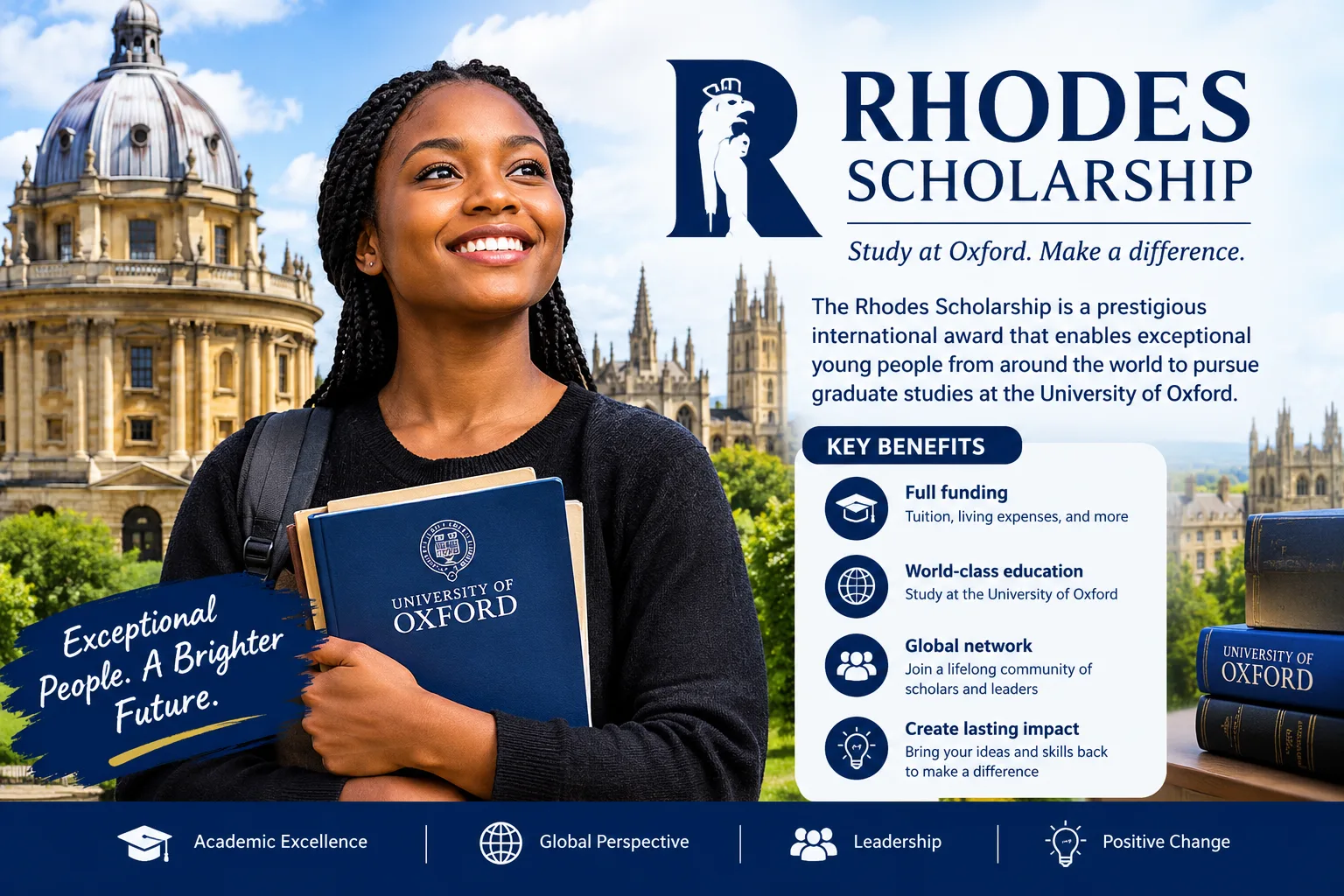
The Rhodes Scholarship is one of the most prestigious international postgraduate scholarship opportunities available to outstanding students who wish to study at the University of Oxford in the United Kingdom. It offers academically talented and service-minded graduates an opportunity to pursue postgraduate studies while developing their leadership abilities, intellectual skills and commitment to making a positive difference in society.
For Nigerian students who want to study abroad but are concerned about the cost of tuition, accommodation and living expenses, this scholarship is an opportunity worth exploring. However, applicants must understand that selection is highly competitive. Strong academic results alone may not be enough; applicants are also expected to demonstrate leadership, integrity, concern for others and a clear sense of purpose.
This guide explains the scholarship’s benefits, eligibility requirements, selection criteria, application documents, application procedure and practical preparation tips. It also answers common questions that Nigerian students may have before applying.
Important note: Application dates, country-specific eligibility rules, course requirements and funding arrangements can change. Applicants should confirm the latest information on the official Rhodes Trust website before submitting an application. Do not assume that an application window is open simply because an online article refers to a particular year.
What Is the Rhodes Scholarship?
The Rhodes Scholarship is an international postgraduate award established in 1902 through the will of Cecil John Rhodes. It enables selected scholars from eligible countries and constituencies to undertake postgraduate study at the University of Oxford.
The programme is administered by the Rhodes Trust and is known for seeking individuals who combine academic excellence with leadership, character and a commitment to serving others.
Unlike scholarships that focus mainly on financial need or examination results, the selection process considers an applicant’s wider achievements, values, experiences and potential contributions to society.
The Rhodes Scholarship is not limited to one academic discipline. Depending on the applicant’s eligibility and Oxford’s admission requirements, scholars may pursue eligible postgraduate programmes across different fields, including law, public policy, economics, medicine, environmental studies, engineering, education and the social sciences.
For Nigerian applicants, it is important to distinguish between meeting the scholarship’s requirements and meeting the admission requirements of the intended Oxford course. Both are essential.
Key Facts About the Rhodes Scholarship
| Scholarship detail | Information |
|---|---|
| Scholarship name | Rhodes Scholarship |
| Host institution | University of Oxford, United Kingdom |
| Administering organisation | Rhodes Trust |
| Level of study | Eligible postgraduate study |
| Fields of study | Multiple disciplines, subject to course and scholarship rules |
| Funding | Generally covers Oxford course fees and provides a living stipend, subject to current terms |
| Additional support | Certain associated costs may be covered under the applicable award terms |
| Eligible applicants | Applicants who meet the requirements of an eligible Rhodes constituency |
| Selection basis | Academic excellence, leadership, character, service and other published criteria |
| Application route | Through the relevant Rhodes constituency’s official application process |
| Official website | Rhodes Trust |
The table provides a general overview. Applicants should use the official scholarship guidance for the exact benefits, application deadlines and eligibility rules that apply to their constituency and intended year of entry.
Benefits of the Rhodes Scholarship
Studying at Oxford can be expensive, particularly for international students paying overseas tuition fees and living costs. The scholarship is designed to reduce this financial burden while supporting scholars throughout their eligible studies.
1. Coverage of Oxford University course fees
One of the major benefits is payment of eligible course fees at the University of Oxford. This can substantially reduce the amount a successful scholar would otherwise need to pay personally.
The precise coverage depends on the scholarship’s terms and the approved course. Applicants should confirm whether any special course charges or additional expenses fall outside the standard award.
2. Living stipend
Scholars receive a stipend intended to support living expenses during their studies. This helps with ordinary costs such as food, accommodation and other day-to-day needs.
The stipend is subject to the applicable scholarship terms and should not be assumed to cover every personal expense. Applicants should review the current financial guidance and plan their budget accordingly.
3. Assistance with travel costs
The scholarship’s published arrangements include support for certain travel costs, subject to the applicable rules. This may include travel connected with beginning and completing the approved period of study.
Applicants should check the current travel policy instead of assuming that every journey, visa-related expense or personal trip will be paid for.
4. Access to Oxford’s academic environment
Oxford offers access to established academic departments, libraries, research facilities, scholars and international networks. The opportunity to study in this environment can help recipients develop specialised knowledge and research skills.
The value of this experience extends beyond obtaining a postgraduate qualification. Scholars can build professional relationships and engage with people working on complex problems across different sectors.
5. Leadership and personal development
The programme places considerable importance on leadership and service. Scholars come from different backgrounds and disciplines, creating opportunities to learn from other people’s experiences and perspectives.
For students interested in public service, research, business, environmental protection, education or community development, this environment can provide useful opportunities for personal and professional growth.
6. An international network
Rhodes Scholars form part of a global community of alumni and current scholars. This network may create opportunities for collaboration, mentorship and professional engagement.
However, receiving the award does not guarantee employment, business success or a particular career outcome. Its long-term value depends partly on how scholars use the opportunities available to them.
Who Is Eligible to Apply?
Eligibility is one of the first things applicants should confirm before preparing a lengthy application.
The Rhodes Trust operates different eligibility routes for applicants associated with different countries and constituencies. Nationality, ordinary residence, education history and other factors may determine the appropriate route.
General eligibility considerations
Applicants should check the official rules concerning the following:
- Nationality or constituency: Confirm that you qualify under an eligible Rhodes constituency and apply through the correct route.
- Age: The scholarship has age-related eligibility rules, which can differ according to the applicable constituency and application cycle.
- Academic achievement: Applicants must demonstrate strong academic performance and the ability to succeed in a demanding postgraduate programme.
- Degree requirements: Your previous qualification and expected graduation date must meet the relevant rules.
- Oxford course admission: You must satisfy the admission requirements of the Oxford course you intend to study.
- Character and leadership: Applicants should be able to demonstrate integrity, initiative, responsibility and meaningful involvement in activities beyond academic work.
- Application deadline: All required materials must be submitted within the applicable application window.
These points are a starting guide, not a substitute for the official eligibility rules. Meeting the general requirements does not guarantee an interview or selection.
Can Nigerian students apply?
Nigerian students should consult the Rhodes Trust’s official constituency information to confirm the appropriate application route and whether they qualify for the intended entry year.
Do not assume that Nigerian citizenship automatically makes an applicant eligible under every Rhodes application route. The applicable constituency rules determine eligibility.
Applicants who have studied outside Nigeria, hold more than one nationality or have an unusual residence or education history should pay particular attention to the official guidance.
Is there a minimum CGPA?
Applicants should review the current constituency requirements and the academic standards of their intended Oxford course. A particular CGPA should not be presented as a universal Rhodes Scholarship cutoff unless the official rules explicitly establish it.
A strong academic record is important, but academic results are only one part of a wider selection process.
Can final-year students apply?
Whether a final-year student can apply depends on the scholarship’s degree-completion rules, expected graduation date and the intended Oxford course. Some application routes may allow applications from students who have not yet completed their first degree, provided they satisfy the stated conditions.
Check the relevant application guidance before deciding when to apply.
Selection Criteria: What Does the Rhodes Trust Look For?
Understanding the selection criteria is essential for anyone planning to apply. The Rhodes Trust evaluates candidates using a combination of academic achievement, personal character, leadership, service and other accomplishments.
According to the official Rhodes Trust selection criteria, the following qualities are central to the selection process.
| Selection criterion | What applicants should demonstrate |
|---|---|
| Academic excellence | Strong academic results, intellectual curiosity and critical thinking |
| Energy to use one’s talents | Outstanding commitment to activities such as sports, arts, research, debate or other pursuits |
| Character and service | Integrity, kindness, courage, responsibility and concern for others |
| Leadership | Initiative, sound judgement and the ability to motivate people towards meaningful goals |
Academic excellence
Applicants should have a strong academic record and demonstrate the ability to succeed in a demanding postgraduate programme.
However, good grades alone may not distinguish a candidate from other applicants. Explain how your academic interests have developed, what you have learnt and how your proposed Oxford course supports your future goals.
Leadership experience
Leadership does not necessarily mean holding the position of a student union president or serving as the head of a large organisation.
You could demonstrate leadership through a community project, a student association, a research initiative, a conservation campaign, a business or a volunteer programme. What matters is the initiative you took, the responsibility you accepted and the results you achieved.
Community service
The selection process values candidates who show concern for other people and a willingness to contribute to society.
For example, a Nigerian applicant may have participated in literacy programmes, environmental awareness campaigns, public health activities, mentoring, rural development or community-based conservation.
Be specific about your contribution. Explain the problem you addressed, the action you took and what changed as a result.
Personal character
The committee wants to understand the person behind the application. Honesty, resilience, responsibility and the ability to work with others are important qualities to demonstrate.
Applicants should use genuine examples from their lives rather than trying to create a perfect image of themselves.
Documents Required for the Rhodes Scholarship
The exact documents depend on the applicant’s constituency and the applicable application cycle. Therefore, always download the current information for candidates and referee guidance from the official website.
Common application materials may include:
- A completed online application form.
- Evidence of academic qualifications and university transcripts.
- A curriculum vitae showing academic, leadership, employment and extracurricular achievements.
- A personal statement.
- An academic statement explaining your proposed course of study and academic interests.
- Letters of reference from suitable referees.
- Evidence of eligibility, such as nationality, age or education history, where required.
- Any additional documents specified in the official application instructions.
Some constituencies may have particular requirements concerning photographs, identification, institutional endorsements or the format and number of references. Do not assume that every constituency follows precisely the same procedure.
How to choose your referees
Choose people who know your academic work, personal qualities or contributions well enough to provide detailed and credible references.
Depending on the applicable instructions, referees might include lecturers, research supervisors, employers or community leaders who have directly observed your work.
A referee who can provide concrete examples of your achievements is generally more helpful than someone who only has an impressive title but knows little about you.
Give your referees adequate time to prepare their references and share the official instructions with them.
How to Apply for the Rhodes Scholarship: Step-by-Step Guide
The application process requires planning, careful attention to detail and an understanding of the relevant deadlines.
Step 1: Check your eligibility
Visit the official Rhodes Trust application page and use the eligibility checker.
For Nigerian applicants, select the relevant West Africa constituency and review the rules on citizenship, residence, age and academic qualifications.
Do not start preparing your final application until you have established that you meet the requirements.
Step 2: Read the official candidate guidance
Download and study the information for candidates, selection criteria, referee guidance and conditions of tenure.
These documents explain what the selection committee expects and which courses are covered. They also help you avoid mistakes that could make an otherwise strong application ineligible.
Step 3: Identify your intended Oxford course
Research the postgraduate courses that match your academic interests and career objectives.
Check the entry requirements, duration, application documents and English-language requirements for each course.
For example, a student interested in environmental management might explore suitable postgraduate programmes related to environmental change, biodiversity, conservation or public policy, provided the selected course is eligible under the applicable scholarship rules.
Your proposed course should have a clear relationship with your previous experience and future plans.
Step 4: Prepare your application statements
Your statements should communicate your academic interests, achievements, values, leadership experience and long-term objectives.
Use specific examples instead of making general claims. Rather than simply stating that you are passionate about community development, explain what you have done to support a community and what you learnt from the experience.
The Rhodes Trust emphasises the importance of authentic, original personal and academic statements. Its official FAQs explain that generative AI should not replace your own voice or substantive analysis. Use writing tools cautiously for limited tasks such as checking grammar or improving the organisation of material you have written yourself.
Step 5: Request your references early
Contact potential referees well before the deadline. Explain your academic goals and provide the official reference instructions.
Make sure all references are submitted through the required process. Do not assume that a referee’s promise to support you means the reference has been received.
Step 6: Complete and submit the online application
Enter your information carefully and upload the required documents in the specified formats.
Before submitting, check your personal details, academic history, statements, referee information and supporting documents.
Where the system permits, save copies of your submitted materials and retain any confirmation of submission.
Step 7: Prepare for selection activities
The selection process varies by constituency, but it generally includes a written application, a social engagement event and a final interview. The relevant official guidance explains which stages apply to you.
Prepare to discuss your achievements, values, academic interests, leadership experiences and proposed contribution to society.
Your answers should be honest, thoughtful and supported by real examples.
Step 8: Apply to the University of Oxford if selected
Winning the scholarship does not automatically mean that you have been admitted to Oxford.
The Rhodes Trust explains that successful candidates must also complete the relevant Oxford admissions process and satisfy the university’s requirements. The scholarship is confirmed subject to successful admission and the applicable conditions.
Rhodes Scholarship 2027: Application Status and Deadline
Applicants should pay close attention to the year of entry and the year in which applications are submitted.
As of 20 October 2026, the official West Africa constituency page lists the application period for entry to Oxford in October 2027 as having opened on 1 June 2026 and closed at 23:59 GMT on 27 August 2026.
| Application detail | Status or information |
|---|---|
| Scholarship cycle | 2027 entry |
| Relevant constituency for eligible Nigerian applicants | West Africa |
| Opening date | 1 June 2026 |
| Closing date | 27 August 2026, 23:59 GMT |
| Current status as of 20 October 2026 | Closed |
| Expected Oxford entry for successful candidates | October 2027 |
| Official constituency page | Rhodes Scholarships for West Africa |
These dates apply to the published West Africa application cycle. Candidates applying through a different eligible constituency must follow that constituency’s instructions.
If you missed the deadline, use the time available to strengthen your academic record, leadership experience and application materials. Monitor the official website for the next application cycle rather than relying on unverified social media announcements.
How to Improve Your Chances of Selection
The Rhodes scholarship is highly competitive, so applicants should focus on building a credible record of achievement instead of searching for shortcuts.
1. Develop a strong academic profile. Work towards excellent results and develop a genuine understanding of your intended field. Read relevant research, participate in academic discussions and seek opportunities to undertake meaningful projects.
2. Take initiative. Identify a real problem in your school or community and develop a practical response. A small project with measurable results may demonstrate more meaningful leadership than a long list of activities in which you played little role.
3. Demonstrate sustained commitment. Long-term involvement in a meaningful activity can show responsibility, perseverance and personal growth.
4. Connect your goals to a real problem. Explain how your proposed course will equip you to address a challenge in Nigeria, Africa or the wider world. Avoid making promises that you cannot realistically support.
5. Prepare for the interview. Practise explaining your decisions, achievements, failures and future plans. Be ready to discuss your field beyond the information contained in your application.
6. Obtain detailed references. Work with referees who can give specific examples of your intellectual ability, integrity, initiative and contribution.
7. Follow the rules carefully. Check eligibility, deadlines, course restrictions and document requirements. A strong application can still fail if it does not meet the formal requirements.
8. Be authentic. Do not invent awards, exaggerate leadership roles or claim responsibility for other people’s achievements. The selection committee needs to understand your actual experience and potential.
Common Mistakes to Avoid
Applicants can weaken their applications by making avoidable mistakes.
- Applying through the wrong constituency.
- Ignoring age or academic eligibility requirements.
- Selecting a course without checking whether it is covered.
- Submitting generic personal statements that lack specific examples.
- Treating volunteer work as a list of activities instead of explaining its impact.
- Asking referees for support too close to the deadline.
- Providing inaccurate academic or employment information.
- Assuming that scholarship selection automatically guarantees Oxford admission.
- Paying an unofficial agent who promises guaranteed selection.
- Missing deadlines because of outdated information on third-party websites.
The safest approach is to rely on official Rhodes Trust information and communicate with the relevant constituency’s National Secretary if you need clarification.
Frequently Asked Questions About the Rhodes Scholarship
1. Is the Rhodes Scholarship fully funded?
Yes. It covers Oxford course fees and provides a stipend for living expenses, subject to the award’s conditions. Certain additional costs, including eligible visa and travel expenses, are also covered under the published arrangements.
2. Can Nigerian students apply?
Yes. Nigeria is included in the Rhodes Scholarships for West Africa constituency. Applicants must still satisfy the relevant nationality, residence, age, academic and other eligibility requirements.
3. Is the Rhodes Scholarship open for 2027 entry?
The West Africa application window for October 2027 entry closed on 27 August 2026. Check the official website for updates and future application cycles.
4. What CGPA is required?
There is no single CGPA that applies universally to every constituency and course. Applicants must satisfy the relevant scholarship rules and the academic entry requirements of their chosen Oxford programme. A strong academic record is important.
5. Can a final-year undergraduate student apply?
Potentially, yes, provided the student meets the applicable degree-completion and other eligibility requirements by the relevant deadline. Check the current candidate guidance.
6. Can I study any course at Oxford?
No. Most full-time postgraduate courses may be eligible, but course combinations, funding duration and other restrictions apply. Confirm eligibility using the official conditions of tenure and course guidance.
7. How long does the scholarship last?
The standard scholarship tenure is two years. Some academic pathways, including eligible doctoral study, may receive funding for longer periods under additional conditions and annual limits.
8. Does the scholarship cover accommodation?
The stipend is intended to cover living expenses, including accommodation. Scholars must manage their living costs within the funding available, and the stipend is not designed to cover partners or dependants.
9. Do I need IELTS?
English-language requirements depend on the applicant’s circumstances and the chosen Oxford course. Check the relevant constituency guidance and Oxford’s official language requirements to determine whether you need a test.
10. Can I apply without leadership experience?
Leadership is an important selection criterion. Applicants should be able to demonstrate initiative, responsibility and the ability to contribute to others. Leadership does not have to come from holding a formal title.
11. Does winning the scholarship guarantee Oxford admission?
No. Scholarship selection and university admission are separate processes. Successful candidates must also meet Oxford’s course admission requirements.
12. Can I apply more than once?
The official FAQs state that unsuccessful candidates may apply once more through the same constituency, subject to eligibility. An individual may not submit more than two applications in total.
13. Are there application fees?
Applicants should consult the official instructions for the applicable cycle. The Rhodes Trust states that it covers the fee required to apply to Oxford following scholarship selection, subject to its published terms. Do not confuse this with a promise that every possible application-related expense is automatically covered.
14. Can I use AI to write my application statements?
The Rhodes Trust expects personal and academic statements to be truthful and original. Its guidance cautions against using generative AI to create substantive content or replace your own analysis and voice. You should present your actual experiences, reasoning and ambitions.
15. Where can I find the official application form?
Start at the Rhodes Trust application page, check your eligibility and select the correct constituency. Application forms are available according to the published opening and closing dates.
Conclusion
The Rhodes Scholarship offers exceptional students an opportunity to undertake postgraduate study at the University of Oxford while developing their academic abilities, leadership skills and commitment to service. For eligible Nigerian students, preparation should begin with a careful review of the West Africa constituency rules, academic requirements, course eligibility and application deadlines.
The most effective preparation combines strong academic performance with genuine leadership, community involvement, integrity and a clear sense of purpose. Applicants should use specific examples to explain their achievements and demonstrate how further study will help them contribute to society.
Since the West Africa application period for October 2027 entry has closed, prospective applicants should monitor the official Rhodes Trust website for the next cycle. Rely on verified information, avoid anyone promising guaranteed selection, and ensure that every part of your application accurately represents your experience and ambitions.