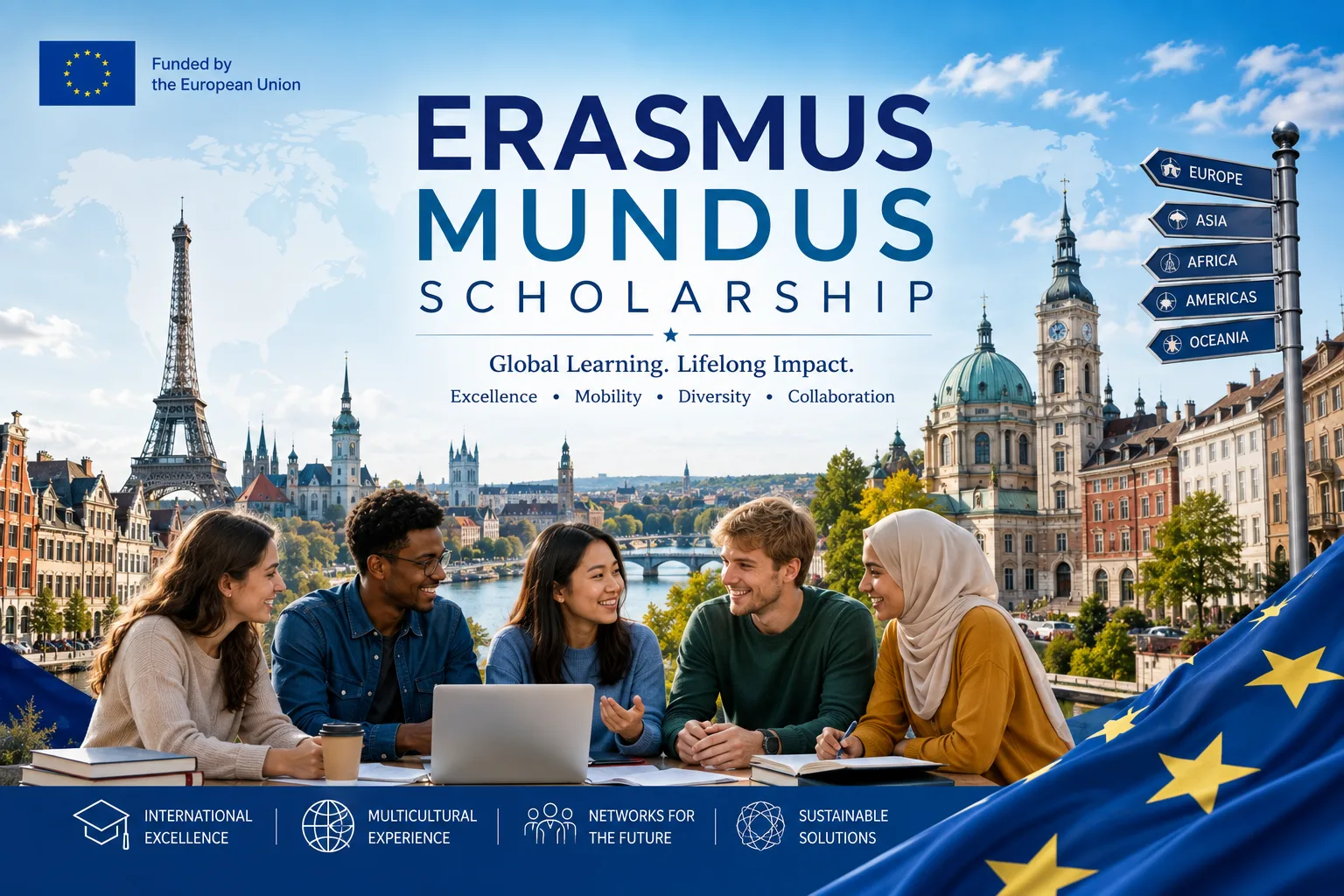
This guide explains the Erasmus Mundus scholarship 2027 opportunity, including eligibility requirements, funding, application procedures, documents, selection tips, deadlines and frequently asked questions for Nigerian students.
Studying for a master’s degree in Europe can be a major financial challenge for many Nigerian students. Tuition fees, accommodation, transportation, visa expenses and living costs can make international education difficult to afford. However, there are fully funded opportunities that can make this dream more achievable for qualified students.
One of the most recognised opportunities is the Erasmus Mundus scholarship, which supports outstanding students who want to study selected joint master’s programmes delivered by universities and higher education institutions in different countries.
Unlike a conventional scholarship attached to one university, Erasmus Mundus Joint Masters are international programmes delivered by a consortium of institutions. Students may study in two or more countries during the programme and can graduate with either a joint degree or multiple degrees, depending on the programme. The European Commission confirms that these programmes normally involve at least three higher education institutions from three different countries.
The 2027 intake is particularly interesting because the European Commission announced in July 2026 that 37 new Erasmus Mundus Joint Masters had been selected. These new programmes are expected to begin opening applications to students in autumn 2026.
What Is the Erasmus Mundus Scholarship?
The Erasmus Mundus scholarship is funding available to selected students admitted into eligible Erasmus Mundus Joint Master programmes under the Erasmus+ programme of the European Union.
It is important to understand that Erasmus Mundus is not one single master’s course. Instead, there are many different joint master’s programmes covering areas such as environmental science, public health, engineering, agriculture, data science, economics, education, development studies, climate change, technology and other academic disciplines.
Each programme is managed by its own consortium of universities and organisations. Therefore, admission requirements, application deadlines, required documents and selection criteria can vary from one programme to another.
The European Commission explains that Erasmus Mundus Joint Masters are high-level integrated master’s programmes delivered by international partnerships of higher education institutions. They normally involve at least three institutions from three different countries.
This structure is one of the main reasons the programme is attractive to international students.
Instead of studying at only one university for the entire duration of the master’s degree, students may move between participating institutions and countries according to the programme’s mobility structure.
Erasmus Mundus Scholarship 2027: Latest Update
The 2027 cycle is expected to provide students with a wide range of programmes.
In July 2026, the European Commission announced that 37 Erasmus Mundus Joint Masters had been selected in the latest call. The Commission stated that these new master’s programmes would begin opening student applications in autumn 2026.
This means prospective applicants should begin preparing before the individual application windows open.
It is also important to understand that there is no single application deadline for every Erasmus Mundus programme.
The official Erasmus+ website explains that, in most cases, students apply between October and January for courses starting in the following academic year. However, every master’s programme has its own website containing the exact deadline and application instructions.
Therefore, Nigerian applicants should not wait for one general Erasmus deadline.
Important Facts at a Glance
| Item | Details |
|---|---|
| Programme | Erasmus Mundus Joint Masters |
| Funding body | European Union through Erasmus+ |
| Study level | Master’s |
| Applicants | Students from around the world |
| Programme duration | 1–2 academic years |
| Study format | Multiple universities/countries |
| Scholarship | Competitive full scholarships available |
| Degree | Joint or multiple degrees |
| Application | Directly to the chosen master’s consortium |
| Typical application period | October–January |
| 2027 preparation | Begin checking programmes from autumn 2026 |
| Nigerian applicants | Eligible to apply where programme requirements are met |
The official Erasmus+ website confirms that students from all over the world can apply for Erasmus Mundus Joint Masters.
Who Can Apply for the Erasmus Mundus Scholarship 2027?
The Erasmus Mundus scholarship is open to students from different parts of the world, including applicants from Nigeria.
The basic academic requirement is that an applicant must have obtained a first higher education degree, such as a bachelor’s degree, or demonstrate an officially recognised equivalent level of learning. Students in the final year of their bachelor’s degree may also apply, provided they graduate before the master’s programme begins.
However, meeting the general Erasmus requirement does not automatically make an applicant eligible for every programme.
Individual Erasmus Mundus master’s programmes establish their own academic requirements.
For example, one programme may require a bachelor’s degree in engineering, while another may accept applicants from several related disciplines.
Therefore, applicants should always check the requirements of the specific programme they want to study.
Academic Requirements
A bachelor’s degree is one of the fundamental requirements for applying to Erasmus Mundus Joint Masters.
For Nigerian students, this generally means having completed an undergraduate programme at a recognised higher education institution.
Applicants should have their academic transcript available because the programme consortium will usually need to assess their academic background.
Depending on the course, selection committees may consider:
- Degree classification.
- Relevant undergraduate courses.
- Academic performance.
- Research experience.
- Professional experience.
- Internships.
- Publications.
- Volunteer activities.
- Leadership experience.
- Motivation.
- International or intercultural experience.
There is no universal CGPA requirement across all Erasmus Mundus programmes.
This is an important point because applicants should not assume that one CGPA automatically qualifies or disqualifies them from every programme.
The most important thing is to identify programmes whose academic requirements match your background.
Can Final-Year Nigerian Students Apply?
Yes.
The official Erasmus+ guidance allows students who are in the final year of their bachelor’s degree to apply, provided they graduate before the master’s programme starts.
For example, if a Nigerian student is completing a bachelor’s degree and expects to graduate before the selected master’s programme begins, that student may be able to apply using the required evidence of expected graduation.
However, the specific programme may request particular documents confirming the applicant’s academic status.
Applicants should therefore read the programme’s admission instructions carefully.
What Does the Erasmus Mundus Scholarship Cover?
One of the major reasons international students apply for Erasmus Mundus Joint Masters is the financial support available to selected scholarship recipients.
The European Commission states that scholarships can cover participation costs and contribute towards travel, visa and living expenses.
Current Erasmus+ programme information also states that the EU scholarship for individuals is €1,400 per month for a maximum of 24 months for eligible Erasmus Mundus Joint Masters.
The exact financial arrangements can depend on the programme and scholarship conditions.
Main Funding Components
| Funding area | What it may cover |
|---|---|
| Participation costs | Programme-related participation costs |
| Living allowance | Monthly financial support |
| Travel | Contribution towards travel |
| Visa | Contribution towards visa-related costs |
| Mobility | Support connected with required mobility |
| Study in multiple countries | Programme structure enables international mobility |
Applicants should carefully read the financial information on their chosen master’s programme’s website.
It is also important not to confuse the scholarship with a general grant that can be used for any university in Europe. The funding is connected to eligible Erasmus Mundus Joint Master programmes.
How Long Does an Erasmus Mundus Master’s Last?
Erasmus Mundus Joint Masters normally last between one and two academic years, corresponding to 60, 90 or 120 ECTS credits.
The duration depends on the programme.
A two-year programme may involve several semesters across different universities and countries.
Students should therefore understand the mobility structure before applying.
The opportunity to study in different countries can be academically rewarding, but it also requires adaptability.
You may need to relocate, learn how to manage different academic environments and adjust to different cultures and educational systems.
Which Countries Can Students Study In?
The countries depend on the selected master’s programme.
Erasmus Mundus Joint Masters are delivered through international consortia involving institutions from different countries.
The programme must include physical mobility, with students studying in at least two countries according to the programme’s approved mobility structure. The Erasmus+ Programme Guide requires at least two study periods in two countries, with at least one being an EU Member State or a third country associated with the Erasmus+ Programme.
This means that students should not select a programme solely because they like the university listed first on its website.
You should study the entire mobility pathway.
For example, your first semester may be in one country, followed by another institution in a different country and a final research or thesis period elsewhere.
Types of Degrees Awarded
At the end of an Erasmus Mundus Joint Master, students may receive either a joint degree or multiple degrees, depending on the programme.
A joint degree means a single degree certificate is issued on behalf of at least two higher education institutions.
Multiple degrees mean that the student receives at least two degree certificates from different institutions in the consortium.
The exact degree structure should be clearly explained by the master’s programme before students enrol.
Popular Fields Available
There is no single list of courses that applies permanently because Erasmus Mundus programmes change as new programmes are selected and existing programmes end.
Students may find programmes in areas such as:
- Environmental science.
- Climate change.
- Renewable energy.
- Agriculture.
- Food science.
- Public health.
- Biotechnology.
- Engineering.
- Computer science.
- Artificial intelligence.
- Data science.
- Economics.
- International development.
- Education.
- Marine science.
- Sustainable development.
- Social sciences.
- Business and management.
The best approach is to search the official Erasmus Mundus catalogue rather than relying on a list published several years ago.
The European Commission states that a new batch of selected master’s programmes is added to the catalogue each year.
How to Find Erasmus Mundus Programmes for 2027
The first step is to use the official Erasmus Mundus catalogue.
Search according to your academic background and career interests.
For example, a Nigerian graduate of Forestry and Wildlife Management may search for master’s programmes related to environmental management, conservation, climate change, biodiversity or sustainable development.
A graduate of Computer Science may search for data science, artificial intelligence, cybersecurity or related programmes.
The goal is to find a programme where your previous academic training matches the admission requirements.
Do not apply simply because a programme offers full funding.
Academic fit is very important.
Erasmus Mundus Scholarship 2027 Application Process
The Erasmus Mundus scholarship application process is different from many government scholarship schemes.
There is no single central application form for students.
The official Erasmus+ website explains that students apply directly to the institution or consortium running their chosen Erasmus Mundus Joint Master.
Step 1: Search the Official Catalogue
Start by identifying programmes that match your academic background.
Step 2: Visit the Programme Website
Once you identify a suitable programme, visit its official website.
Read the admission requirements carefully.
Step 3: Check the Scholarship Availability
Not every student admitted to a programme necessarily receives an EU-funded scholarship.
The scholarship is competitive and awarded to the best-ranked applicants according to the programme’s selection process.
Step 4: Prepare Your Documents
Gather all required academic and supporting documents.
Step 5: Prepare Your Motivation Letter
Your motivation letter should explain why you are applying, why your background fits the programme and how the degree connects with your future plans.
Step 6: Request Recommendation Letters
Select referees who genuinely know your academic or professional work.
Step 7: Submit the Application
Submit the application directly through the programme’s official application system.
Step 8: Monitor Your Email
After submission, regularly check your email for requests for additional information, interview invitations or admission decisions.
Documents Usually Required
There is no universal document list for every programme.
However, applicants may commonly be asked for:
| Document | Purpose |
|---|---|
| Bachelor’s certificate | Confirms academic qualification |
| Academic transcript | Shows academic performance |
| CV | Provides academic and professional history |
| Motivation letter | Explains suitability and goals |
| Recommendation letters | Provides independent assessment |
| Passport/ID | Identification |
| Proof of English proficiency | Demonstrates language ability where required |
| Proof of residence | May be requested for scholarship categorisation |
| Additional documents | Depends on the programme |
Some programmes may request additional documents such as a research proposal, portfolio, writing sample or proof of professional experience.
Never submit a document simply because another Erasmus programme requested it.
Always follow the exact requirements of the programme you are applying to.
English Language Requirements
English-language requirements vary between programmes.
Some master’s programmes may require IELTS, TOEFL or another recognised English-language test.
Others may accept alternative proof of English proficiency under specific conditions.
There is no single English score that applies to every Erasmus Mundus master’s.
Therefore, Nigerian applicants should check the language requirements of each programme.
Do not assume that because Nigeria uses English as an official language, every programme will automatically waive its English test requirement.
How to Write a Strong Motivation Letter
A strong motivation letter can help demonstrate that you are a suitable candidate.
Your letter should answer several questions:
Why this programme?
Explain why the specific master’s degree fits your academic interests.
Why you?
Discuss your academic background, projects, experience and relevant achievements.
Why now?
Explain why the master’s degree is important at this stage of your development.
What are your future plans?
Describe how the knowledge and skills from the programme can contribute to your career.
What can you contribute?
International programmes value diversity and collaboration. Explain what you can bring to the learning community.
Avoid making unrealistic claims.
Instead of saying that you will “change the whole world”, explain a specific problem you want to address and the practical role your education can play.
How Nigerian Students Can Improve Their Chances
The Erasmus Mundus scholarship is highly competitive, so applicants should approach the process strategically.
Choose Programmes Carefully
Do not apply randomly.
Identify programmes that genuinely match your degree and career direction.
Build a Strong Academic Profile
Good grades are useful, especially in subjects related to the master’s programme.
Highlight Relevant Experience
Internships, research projects, final-year projects, employment, volunteering and leadership activities can strengthen an application when they are relevant.
Write an Original Application
Do not copy motivation letters from the internet.
Admissions committees can recognise generic applications.
Demonstrate International Mindset
Erasmus Mundus programmes involve students and institutions from different countries.
Show that you can collaborate with people from different academic and cultural backgrounds.
Prepare Your Documents Early
Obtaining transcripts and recommendation letters can take time.
Do not wait until the final week.
Common Mistakes to Avoid
Applying Without Checking Eligibility
Always confirm that your bachelor’s degree and academic background match the programme.
Applying to the Wrong Course
A programme may look attractive but still be unsuitable for your academic background.
Sending the Same Motivation Letter Everywhere
Each application should be tailored to the specific master’s programme.
Ignoring the Mobility Structure
Understand where you will study during each stage.
Waiting Until the Deadline
Technical problems and missing documents can cause unnecessary stress.
Using False Information
Never falsify academic results, employment history, certificates or other documents.
Paying Scholarship Scammers
Be careful with people who claim they can guarantee a scholarship in exchange for money.
Your application should be made through the official programme website.
Erasmus Mundus Scholarship 2027 Timeline
The timeline differs from one programme to another.
However, the European Commission states that most students should expect to apply between October and January for courses beginning in the following academic year.
For the 2027 cycle, prospective applicants should begin searching for newly selected programmes from autumn 2026 because the European Commission announced that the 37 newly selected master’s programmes would begin opening student applications in that period.
| Period | Expected activity |
|---|---|
| Autumn 2026 | New 2027 programme applications begin appearing |
| October 2026 | Many programmes may begin accepting applications |
| November–December 2026 | Active application period for many courses |
| January 2027 | Many scholarship deadlines may fall around this period |
| 2027 | Selected students begin the relevant master’s programme |
These are general planning periods, not a universal deadline.
Always confirm the exact date on the official website of the programme you intend to apply for.
Is Erasmus Mundus Available to Nigerians?
Yes.
Students from around the world can apply for Erasmus Mundus Joint Masters, provided they satisfy the requirements of the specific programme.
Nigerian applicants are therefore eligible to explore the available master’s programmes.
However, nationality does not guarantee scholarship selection.
The applicant must compete with other qualified candidates from different parts of the world.
The Erasmus+ Programme Guide also explains that scholarship allocation is subject to geographical balance considerations, including a rule concerning the proportion of scholarships awarded to candidates of the same nationality.
This reinforces the importance of submitting a strong, competitive application.
Is Erasmus Mundus Really Fully Funded?
For scholarship recipients, the funding can be substantial and can cover participation costs while contributing towards travel, visa and living expenses.
However, applicants should read the financial terms of their selected programme carefully.
“Fully funded” does not mean that every personal expense imaginable will necessarily be paid.
Students should understand exactly what the scholarship covers, what expenses are reimbursed and whether any costs must initially be paid by the student.
Does Erasmus Mundus Require Work Experience?
There is no universal work-experience requirement across all Erasmus Mundus programmes.
Some programmes may welcome or require professional experience, while others focus more strongly on academic qualifications.
The correct approach is to check the admission requirements of the individual master’s programme.
A fresh Nigerian graduate should therefore not assume that they are automatically ineligible simply because they have limited work experience.
Can I Apply for More Than One Erasmus Mundus Programme?
Applicants should check the rules of the individual programmes they are considering.
Different programmes may have their own restrictions concerning multiple applications.
If you are considering several programmes, make sure you can genuinely meet the requirements of each one and prepare each application carefully.
Quality is more important than submitting poorly prepared applications simply to increase the number of applications.
Why Erasmus Mundus Is Valuable for Nigerian Students
For Nigerian graduates, studying through an Erasmus Mundus Joint Master can provide more than a master’s certificate.
Students can gain exposure to different academic systems, research environments and professional networks.
The compulsory international mobility component also provides experience in adapting to different countries and academic communities.
This can be useful for graduates who plan to pursue careers in international development, research, academia, technology, environmental management, public health, engineering and other internationally connected sectors.
However, applicants should choose a programme based on their actual career goals rather than applying solely because it offers an attractive scholarship.
Frequently Asked Questions About Erasmus Mundus Scholarship 2027
1. What is the Erasmus Mundus Scholarship 2027?
The Erasmus Mundus scholarship is financial support available to selected students admitted to eligible Erasmus Mundus Joint Master programmes. The scholarships can cover participation costs and contribute towards travel, visa and living expenses. (Erasmus Mundus Joint Master)
2. Can Nigerians apply for Erasmus Mundus?
Yes. Nigerian students can apply for eligible Erasmus Mundus Joint Masters provided they satisfy the academic and other requirements of the selected programme.
3. Is Erasmus Mundus fully funded?
Scholarships can provide substantial funding, including participation costs and contributions towards travel, visa and living expenses. The exact financial package should be checked on the individual programme website.
4. How much does Erasmus Mundus pay monthly?
Current Erasmus+ programme information states that the EU scholarship for individuals is €1,400 per month for a maximum of 24 months for eligible Erasmus Mundus Joint Masters.
5. What degree do I need to apply?
Applicants generally need a first higher education degree, such as a bachelor’s degree, or a recognised equivalent level of learning. Final-year bachelor’s students can also apply if they graduate before the master’s programme starts.
6. Is there one application form for Erasmus Mundus?
No. Students apply directly to the institution or consortium running their chosen Erasmus Mundus Joint Master.
7. When should I apply for Erasmus Mundus 2027?
Many programmes accept applications between October and January for courses starting the following academic year, although deadlines vary. The new 2027 programmes selected in 2026 are expected to begin opening applications from autumn 2026.
8. Can final-year students apply?
Yes. Final-year bachelor’s students may apply if they will complete their degree before the master’s programme begins.
9. Do all Erasmus Mundus programmes require IELTS?
No. Language requirements differ between programmes. Applicants should check the official requirements of their selected master’s programme.
10. How long does an Erasmus Mundus master’s last?
Erasmus Mundus Joint Masters normally last between one and two academic years, corresponding to 60, 90 or 120 ECTS credits.
11. Will I study in more than one country?
Yes, Erasmus Mundus Joint Masters include compulsory physical mobility. The programme structure must include study periods in at least two countries according to the approved mobility arrangement.
12. Can I choose any university in Europe?
No. You must select an approved Erasmus Mundus Joint Master and follow the universities included in that programme’s consortium and mobility structure.
13. Is there an age limit?
There is no single general age limit stated for all Erasmus Mundus Joint Masters. Individual programmes may have their own requirements, so applicants should check the specific course.
14. Do I need work experience?
Not necessarily. Work-experience requirements depend on the particular master’s programme.
15. Can I apply without a bachelor’s certificate?
Final-year students can generally apply if they will graduate before the master’s programme begins, but the specific programme will determine what evidence of expected graduation is acceptable.
16. Is the Erasmus Mundus scholarship competitive?
Yes. Scholarships are awarded to the best-ranked students according to the programme’s selection process. The Erasmus+ framework describes EMJM scholarships as being available to the best students worldwide.
Conclusion
The Erasmus Mundus scholarship 2027 offers Nigerian graduates an opportunity to pursue an internationally structured master’s degree while receiving substantial financial support.
The programme is different from a traditional scholarship because students apply directly to individual Erasmus Mundus Joint Masters rather than submitting one general application to the European Union.
The 2027 cycle is also particularly important because the European Commission selected 37 new Erasmus Mundus Joint Masters in July 2026, with those programmes expected to begin opening applications during autumn 2026.
Nigerian students who are interested should therefore start preparing now. Identify programmes that match your bachelor’s degree, review their entry requirements, organise your academic documents, prepare a strong CV and motivation letter, and contact potential referees early.
Do not wait until the application deadline before beginning the process.
Most importantly, applicants should use the official Erasmus+ catalogue and the official website of each selected master’s programme. Application dates, documents, language requirements and scholarship conditions can differ considerably between programmes.
With careful preparation, a relevant academic background and a well-presented application, qualified Nigerian graduates can compete for one of Europe’s leading international master’s scholarship opportunities.