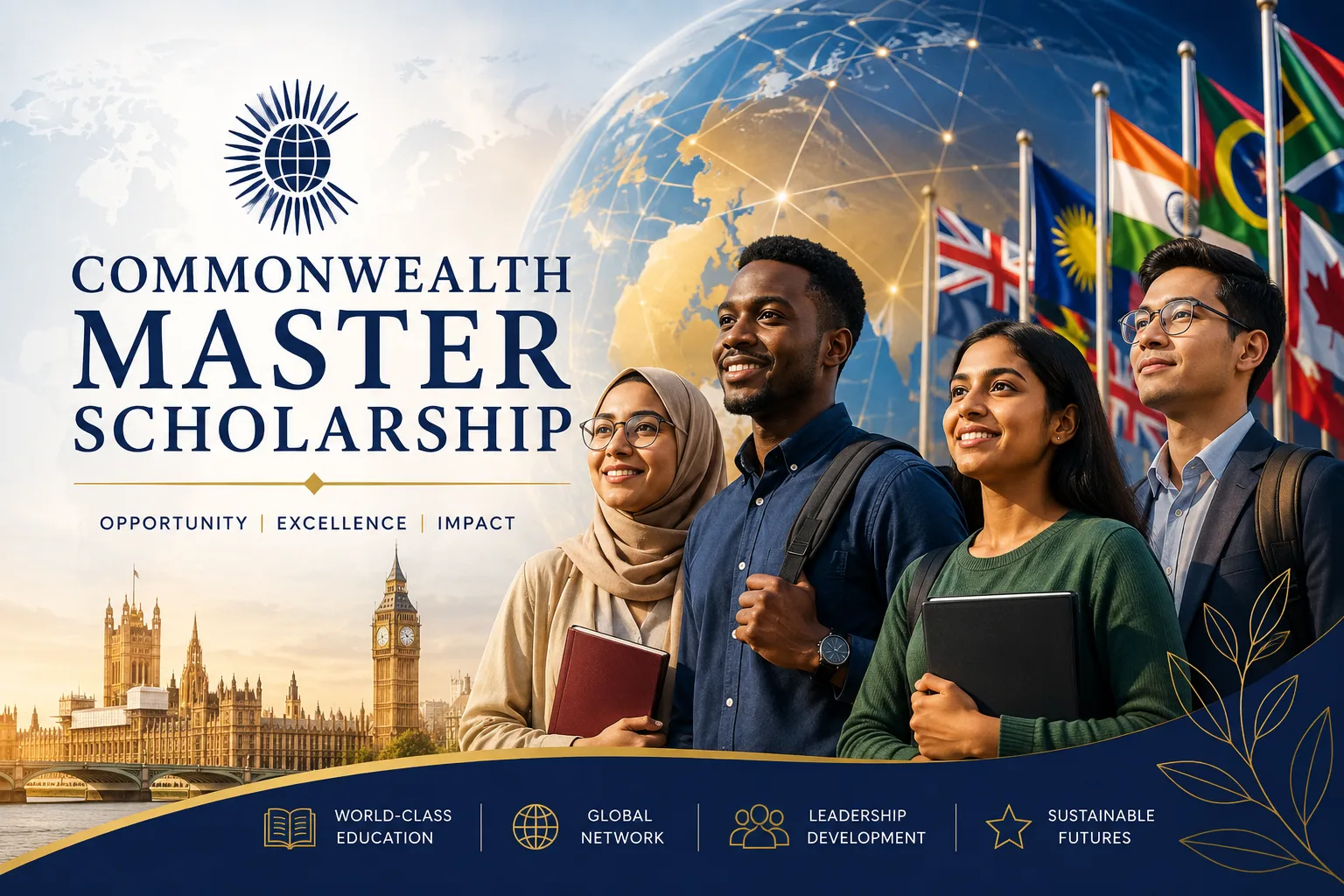
This guide explains the commonwealth masters scholarship 2027 requirements, eligibility, benefits, application process, documents, selection process, important dates and practical tips for Nigerian applicants.
If you are a Nigerian graduate looking for an opportunity to study for a fully supported master’s degree in the United Kingdom, the commonwealth masters scholarship 2027 is one of the opportunities worth considering. The programme is designed for talented candidates from eligible low- and middle-income Commonwealth countries who may not otherwise be able to afford postgraduate study in the UK.
The Commonwealth Scholarship Commission (CSC) has confirmed that applications for the 2027/28 academic year will open on 8 September 2026 and close at 16:00 BST on 20 October 2026. The scholarships are intended for master’s study beginning in September or October 2027.
Nigeria is included among the eligible Commonwealth countries. However, meeting the basic requirements does not automatically guarantee selection because candidates are nominated through approved nominating agencies and then assessed competitively by the CSC.
What Is the Commonwealth Masters Scholarship?
The commonwealth masters scholarship 2027 is a UK-funded postgraduate scholarship programme administered by the Commonwealth Scholarship Commission. It is funded by the UK’s Foreign, Commonwealth & Development Office (FCDO) and is intended to help talented individuals from eligible Commonwealth countries gain knowledge and skills that can contribute to sustainable development in their home countries.
The scholarship is for full-time taught master’s study at a UK university. It is particularly aimed at applicants who demonstrate academic ability, development potential and financial need.
Unlike some university scholarships, applicants do not simply submit an application directly to the CSC and wait for admission. The programme operates through approved nominating agencies, which conduct their own selection processes before putting forward candidates to the CSC.
Therefore, Nigerian applicants should pay attention to both the CSC requirements and any additional requirements or deadlines established by their nominating agency.
Commonwealth Masters Scholarship 2027: Latest Update
For prospective applicants, the 2027/28 cycle has an important confirmed timeline.
| Item | Details |
|---|---|
| Scholarship | Commonwealth Master’s Scholarships |
| Study year | 2027/28 |
| Study location | United Kingdom |
| Study level | Full-time taught Master’s |
| Application opening | 8 September 2026 |
| CSC application deadline | 20 October 2026 at 16:00 BST |
| Expected study start | September/October 2027 |
| Eligible country | Nigeria |
| Application system | CSC Central |
| Selection route | Approved nominating agencies |
| Expected outcome | By July 2027 |
These dates come from the official CSC scholarship page. Nominating agencies can set earlier deadlines, so Nigerian applicants should not wait until the CSC deadline before checking their relevant agency’s requirements.
Who Can Apply for the Commonwealth Masters Scholarship 2027?
The commonwealth masters scholarship 2027 is open to applicants from specific eligible Commonwealth countries, including Nigeria.
According to the CSC, an applicant must generally meet the following conditions:
- Be a citizen of, or have been granted refugee status by, an eligible Commonwealth country, or be a British Protected Person.
- Be permanently resident in an eligible Commonwealth country.
- Be available to start academic studies in the UK by the beginning of the UK academic year in September 2027.
- Hold a first degree of at least upper-second-class (2:1) standard by September 2027.
- Alternatively, applicants with a lower-second-class degree may be considered where they also hold a relevant postgraduate qualification, usually a master’s degree.
- Demonstrate that they cannot afford to study in the UK without the scholarship.
Applicants should remember that these are the general CSC requirements. A nominating agency may introduce additional conditions, documents or an earlier deadline.
Is Nigeria Eligible for the Commonwealth Scholarship?
Yes. Nigeria is listed among the countries eligible for the Commonwealth Master’s Scholarships. Other eligible countries include Ghana, Kenya, Uganda, Tanzania, Sierra Leone, Pakistan, Bangladesh, India, South Africa, Zambia and several other Commonwealth countries.
For Nigerian students, this means that nationality itself does not prevent them from applying. However, candidates still need to satisfy the academic, financial, residency and other conditions applicable to the particular scholarship cycle.
Being Nigerian does not mean that an applicant will automatically receive the scholarship. The programme is competitive, and nomination is not a guarantee of final selection.
Academic Requirements
One of the most important parts of the commonwealth masters scholarship 2027 application is your academic record.
The CSC generally requires applicants to hold a first degree at least equivalent to an upper-second-class honours degree, commonly referred to as a 2:1.
For Nigerian applicants, the exact interpretation of a degree classification may depend on the nominating agency and the relevant academic documentation. Applicants should therefore provide accurate transcripts and certificates and follow the instructions of their nominating agency.
A lower-second-class degree does not necessarily end your chances. The official criteria allow applicants with a lower-second-class degree plus a relevant postgraduate qualification, usually a master’s degree, to be considered.
Do not alter your academic information or exaggerate your grades. Scholarship applications are official documents, and false information can result in disqualification.
Does Work Experience Matter?
Work experience can strengthen an application, but it is important to understand the official position.
The CSC states that employment experience is not a mandatory requirement for Commonwealth Scholarships.
However, relevant employment, volunteering, leadership activities, professional responsibilities and community development work can help you explain how your proposed master’s degree will contribute to development after your studies.
For example, a Nigerian applicant applying for an environmental management course could discuss previous environmental projects, community awareness programmes, research activities or professional experience that demonstrates a clear connection between the proposed degree and development needs in Nigeria.
The important thing is relevance rather than simply having a long CV.
What Does the Scholarship Cover?
One major reason applicants consider the commonwealth masters scholarship 2027 is the financial support attached to the award.
The scholarship is designed to make UK master’s study accessible to talented candidates who would otherwise struggle to finance it. Applicants should, however, carefully review the official award conditions for the specific cycle rather than assuming that every possible personal expense will automatically be covered.
The CSC describes the programme as supporting candidates who could not otherwise afford to study in the UK.
The award can provide substantial financial assistance associated with the approved course and study period. Depending on the official terms for the award, support can include areas such as tuition-related costs and allowances.
Applicants should always rely on the official CSC award information rather than claims made by agents or social media pages.
What Can You Study?
The commonwealth masters scholarship 2027 is connected to six broad CSC development themes.
These themes include:
| Development theme | Examples of relevant areas |
|---|---|
| Science and technology for development | Engineering, technology, environmental science |
| Strengthening health systems and capacity | Public health, health policy, health systems |
| Promoting global prosperity | Economics, development studies, business-related development areas |
| Strengthening global peace, security and governance | Governance, public policy, international development |
| Strengthening resilience and response to crises | Climate resilience, disaster management |
| Access, inclusion and opportunity | Education, social development, inclusion |
The CSC also states that there is no blanket restriction to a particular subject as long as the proposed study relates to the development themes. Applicants are also expected to connect their proposed study and future impact to the UN Sustainable Development Goals.
However, the CSC does not fund MBA programmes or research master’s programmes under this scholarship.
How to Choose the Right UK University
Choosing a university should not be based only on its ranking.
Your proposed university and course should be connected to your academic background, career plans and development goals.
Consider the following:
- Course content
- Entry requirements
- Course duration
- Research or practical components
- University expertise
- Development relevance
- Location
- Admission deadline
- Scholarship eligibility
- Availability of the specific programme
The CSC states that applicants can select up to three institutions in their application, listed in order of preference.
Some UK universities also have funding arrangements with the CSC. The Commission publishes information about participating and part-funding universities, so applicants should always verify university eligibility from official CSC and university sources.
How to Apply for Commonwealth Masters Scholarship 2027
The application process for the commonwealth masters scholarship 2027 requires careful preparation.
Step 1: Confirm Your Eligibility
Before beginning the application, confirm that you meet the nationality, residency, academic and financial requirements.
Do not rely on a blog or social media post alone. Use the official CSC information and the instructions provided by your nominating agency.
Step 2: Research Suitable Master’s Courses
Identify master’s courses that match your academic background and development objectives.
You should be able to clearly explain why the particular course is important to your career and how it can contribute to development in Nigeria.
Step 3: Check the Nominating Agency
The CSC does not accept direct applications for this scholarship in the ordinary sense. Applications are considered through approved nominating agencies.
Each nominating agency can have its own selection procedure and deadline.
This is particularly important for Nigerian applicants because an agency deadline may be earlier than the CSC’s 20 October 2026 deadline.
Step 4: Prepare Your Supporting Documents
Prepare your documents early.
Common documents may include:
- Degree certificate
- Academic transcripts
- Evidence of qualifications
- Passport or other identification documents where required
- Employment information
- Course information
- Personal statements
- Development impact statements
- References
- Other documents requested by the nominating agency
The exact document requirements can vary, so applicants should follow the official application instructions.
Step 5: Complete the CSC Central Application
The CSC uses its online application system, known as CSC Central, for applications. The official 2027/28 application window is scheduled to open on 8 September 2026 and close on 20 October 2026 at 16:00 BST.
Complete every section carefully.
Do not leave important sections until the final day because technical problems, missing documents or poor internet connectivity can create unnecessary pressure.
Step 6: Submit Before the Deadline
After completing the form, check your information several times before submission.
Make sure:
- Your name is correctly entered.
- Your academic information matches your documents.
- Your proposed course is correctly identified.
- Your development objectives are clear.
- Your references are properly handled.
- Required documents are uploaded.
- Your application has been successfully submitted.
Keep evidence of your submission for your records.
How to Write a Strong Scholarship Statement
A strong statement should do more than say that you want to study in Britain.
It should explain:
Where you are now → what problem you want to address → what skills you need → why the proposed course is appropriate → how you will use the knowledge → who will benefit.
For example, instead of writing:
“I want to study in the UK because UK universities are among the best in the world.”
Explain how the proposed programme will provide specific knowledge or skills that are relevant to a development challenge in Nigeria.
A convincing application should demonstrate a realistic connection between your academic background, proposed course and future contribution.
How to Improve Your Chances
There is no guaranteed formula for winning the commonwealth masters scholarship 2027, but applicants can improve the quality of their applications.
1. Demonstrate Academic Strength
Your academic record should be presented accurately and clearly.
2. Show Development Impact
Explain how your proposed master’s degree can contribute to solving a real problem.
3. Connect Your Course to Nigeria
Show why the knowledge is useful in your home country rather than presenting the scholarship simply as a chance to relocate.
4. Be Specific
Avoid vague statements such as “I will change the world.”
Instead, identify the sector, problem, skills and realistic outcomes you intend to pursue.
5. Use Evidence
If you have participated in projects, research, employment, volunteering or leadership activities, explain what you actually did and what resulted from it.
6. Follow Instructions
A brilliant application can still fail if the applicant ignores eligibility requirements, deadlines or document instructions.
Commonwealth Masters Scholarship 2027 Timeline
The following timeline is based on the current official CSC information:
| Stage | Expected date |
|---|---|
| Application opens | 8 September 2026 |
| CSC application closes | 20 October 2026 |
| Nominating agencies submit candidates | By December 2026 |
| Selection period | 2027 |
| Expected outcome | By July 2027 |
| Study begins | September/October 2027 |
The CSC notes that nominating agencies may set their own earlier deadlines. Therefore, applicants should check the relevant agency’s announcement before preparing their final submission.
Important Mistakes to Avoid
When applying for the commonwealth masters scholarship 2027, avoid these common mistakes:
Applying at the Last Minute
Waiting until October to start preparing documents can create problems.
Using False Information
Never falsify grades, employment history, publications or achievements.
Choosing a Course Without a Clear Reason
Your proposed programme should make sense based on your academic and professional direction.
Ignoring the Nominating Agency
The CSC deadline is not necessarily your first deadline. Your nominating agency may close applications earlier.
Paying Unofficial Agents
The CSC warns applicants to be cautious about third-party organisations requesting personal information or supporting documents. The Commission states that supporting documents should be submitted through official systems and warns about organisations falsely presenting themselves as scholarship partners.
Submitting a Generic Statement
Scholarship assessors need to understand your individual experience, goals and potential impact.
Is the Commonwealth Masters Scholarship Fully Funded?
The commonwealth masters scholarship 2027 is designed as a major financial support programme for eligible candidates who could not otherwise afford UK study.
However, applicants should avoid assuming that every expense they may encounter will automatically be covered. The exact award conditions and allowances should be checked against the official CSC information applicable to the relevant scholarship cycle.
This is important because scholarship funding terms can change, and unofficial websites sometimes describe scholarships as “fully funded” without explaining the actual conditions.
Can Nigerian Students Apply Without a Master’s Degree?
Yes. The scholarship is specifically for master’s-level study, so applicants do not normally need to already possess a master’s degree.
The standard academic requirement is a first degree at the required level. The CSC also allows consideration of candidates with a lower-second-class degree plus a relevant postgraduate qualification, usually a master’s degree.
Therefore, Nigerian graduates with a strong bachelor’s degree can be eligible without having completed a previous master’s programme.
Can You Apply Without Work Experience?
Yes.
The CSC’s official FAQ confirms that employment experience is not a mandatory requirement for Commonwealth Scholarships.
However, applicants who have relevant professional, volunteer, leadership or community-development experience can use that experience to strengthen their case, particularly when demonstrating potential development impact.
Frequently Asked Questions About Commonwealth Masters Scholarship 2027
1. When will the Commonwealth Masters Scholarship 2027 application open?
The official application window for the 2027/28 academic year is scheduled to open on 8 September 2026.
2. What is the deadline for the Commonwealth Masters Scholarship 2027?
The CSC deadline is 16:00 BST on 20 October 2026. However, your nominating agency may have an earlier deadline.
3. Can Nigerians apply for the scholarship?
Yes. Nigeria is included in the CSC’s list of eligible countries for the master’s scholarship.
4. Is the scholarship for undergraduate students?
No. The programme is intended for full-time taught master’s study in the UK.
5. Can someone with a second-class lower apply?
Yes, under the stated CSC criteria, a lower-second-class degree can be considered when accompanied by a relevant postgraduate qualification, usually a master’s degree. Applicants should also check their nominating agency’s requirements.
6. Is work experience compulsory?
No. The CSC confirms that employment experience is not a mandatory requirement for Commonwealth Scholarships.
7. Can I apply to more than one university?
Applicants to the master’s scholarship can select up to three institutions in their application, in order of preference.
8. Does the CSC accept direct applications?
The Commonwealth Master’s Scholarship operates through approved nominating agencies. Candidates must follow the nomination process and the CSC application requirements.
9. Can I study an MBA with the scholarship?
No. The CSC states that it does not fund MBA programmes under the Commonwealth Scholarships.
10. Can I study a research master’s programme?
The CSC states that Commonwealth Scholarships do not fund research master’s programmes. The master’s scholarship is intended for taught master’s study.
11. Do I need admission before applying for the scholarship?
Applicants are strongly advised to seek admission to their proposed UK university at the time of, or as soon as possible after, submitting the CSC application. The university may have its own admissions process and deadline.
12. Does nomination guarantee the scholarship?
No. Being nominated does not guarantee final selection. Candidates are assessed from the pool of nominations by the CSC. (CSC UK)
13. When will successful applicants know the result?
For the 2027/28 cycle, applicants can expect to hear the outcome by July 2027, according to the
14. Where should applicants get official information?
Applicants should use the official Commonwealth Scholarship Commission website and their recognised nominating agency. The CSC specifically warns applicants to be cautious with third-party organisations requesting personal information or supporting documents.
Conclusion
The commonwealth masters scholarship 2027 presents a valuable opportunity for qualified Nigerian graduates who want to pursue master’s-level education in the UK while building skills that can contribute to development at home.
However, applicants should approach the process strategically. Academic qualifications matter, but so do the relevance of your proposed programme, development objectives, personal experience and ability to explain how your studies can create meaningful impact.
The most important step is to begin preparing early. Gather your academic documents, research suitable UK master’s programmes, understand the requirements of your nominating agency and prepare a strong, evidence-based application before the official deadline.
Most importantly, use the official CSC website as your primary source of information. Scholarship dates, eligibility conditions and procedures can change, so applicants should verify all information before submitting an application.
With careful preparation, accurate documentation and a clear development-focused study plan, eligible Nigerian graduates can put forward a competitive application for the 2027/28 Commonwealth Master’s Scholarship cycle.