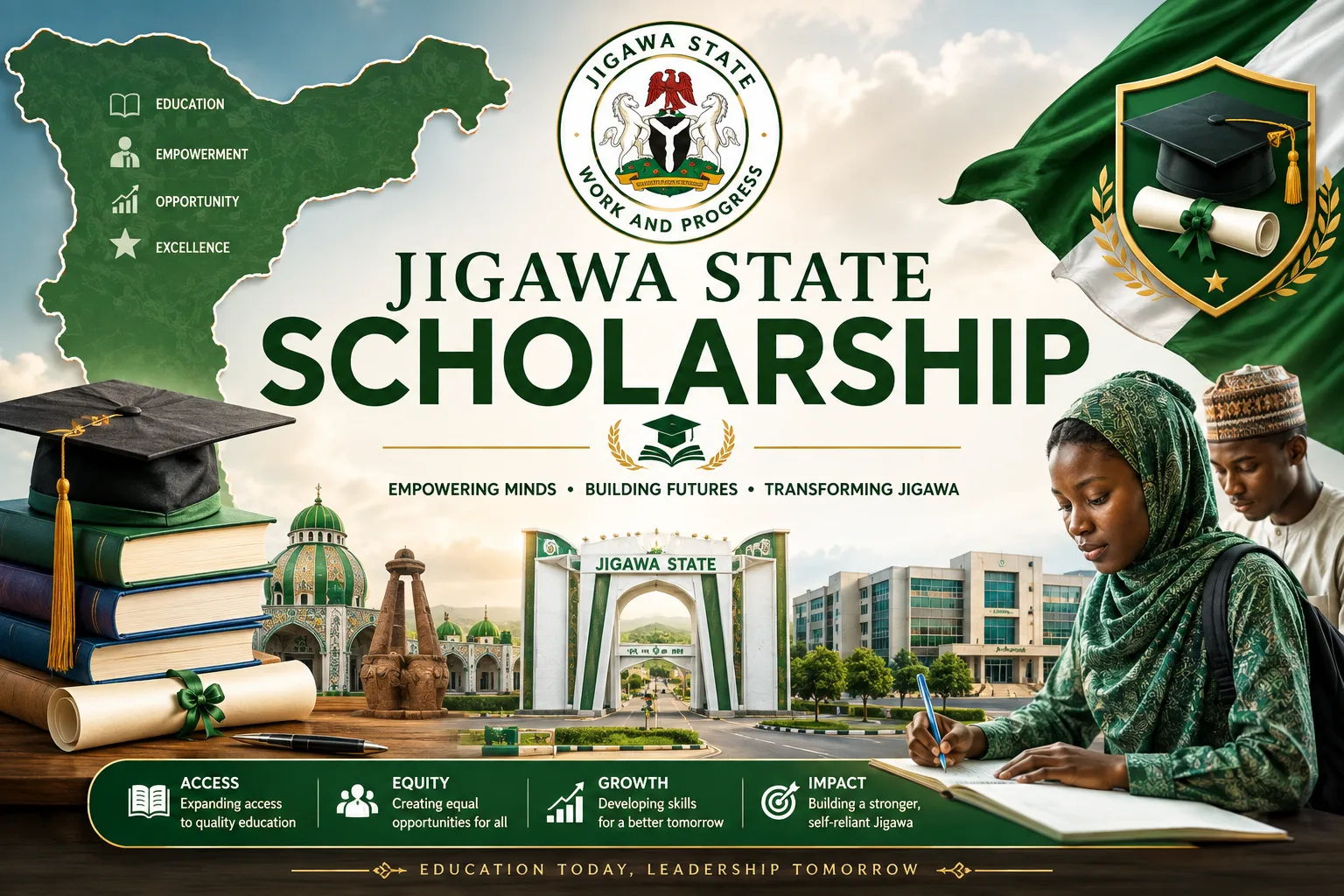
The Jigawa State Scholarship Board (JSSB) is one of the oldest education-support institutions in Northern Nigeria, and it has continued to serve as a dependable source of financial relief for indigent and brilliant students of the state. This article has been carefully researched from publicly available information to give you a trustworthy, up-to-date picture of what the award offers and how you can key into it.
If you are an indigene of Jigawa State looking for clear, accurate information on how to benefit from the Jigawa State scholarship scheme, this guide was written specifically for you. It covers everything from eligibility, required documents, application steps, benefits, and deadlines, to the most frequently asked questions presented in plain, simple Nigerian English so that every student, parent and guardian can follow along without stress.
What Is the Jigawa State Scholarship?
This scholarship scheme is a government-funded financial support programme administered by the Jigawa State Scholarship Board, an agency established by an edict in 1995 and later revised in 1998. The Board was set up to promote access to quality education by offering bursaries and full scholarships to eligible indigenes of the state who are pursuing their studies at various levels, both within and outside Nigeria.
Over the years, the scheme has grown to cover undergraduate, postgraduate, and in some cases, foreign scholarships awarded through bilateral agreements between the state government and partner countries or the Federal Government of Nigeria. The core objective behind the scheme remains the same: to lighten the financial burden of education for citizens of the state and to encourage academic excellence among its youths.
Quick Facts Table: Jigawa State Scholarship
| Detail | Information |
|---|---|
| Scheme name | Jigawa State Scholarship Board (JSSB) |
| Established | By edict in 1995, revised in 1998 |
| Governing body | Jigawa State Government |
| Official portals | jigawastate.gov.ng, jssb.ng, and applicant.safapply.com/jssb |
| Who can apply | Genuine indigenes of Jigawa State in tertiary institutions, within or outside Nigeria |
| Levels covered | Undergraduate and postgraduate, with some foreign scholarships available |
| Application cost | Free |
| Application mode | Mostly online, though some cycles have used an offline/paper-based format |
| Typical award value | Up to ₦400,000, depending on category and year |
| Deadlines | Vary by cycle — previous windows have closed in May and in December |
(Table compiled from publicly available Jigawa State Government and Scholarship Board information. Always confirm current figures on the official portal, since amounts and dates can change from one session to another.)
Categories of the Jigawa State Scholarship
Like most state-run education intervention schemes in Nigeria, this programme is not limited to a single award type. Based on how the Board has historically structured its offerings, applicants can generally expect the following categories:
| Category | Who It Targets | Typical Coverage |
|---|---|---|
| Undergraduate Bursary/Scholarship | Jigawa indigenes studying in Nigerian universities, polytechnics, and colleges of education | Part or full tuition support |
| Postgraduate Scholarship | Indigenes pursuing master’s or doctoral programmes | Tuition and related academic support |
| Full/Bilateral Scholarship | Students placed through agreements between the state and foreign governments or the Federal Government | Full tuition, and in some cases upkeep |
| Professional/Specialised Institution Scholarship | Students in law school, maritime institutions, colleges of aviation, and colleges of health | Tuition support specific to the institution |
It is worth noting that eligible candidates must be enrolled in approved federal or state institutions, including universities, polytechnics, colleges of education, law school, maritime institutions, colleges of aviation, and colleges of health, for them to benefit from this scheme.
Who Is Eligible for the Jigawa State Scholarship?
To qualify, an applicant must generally meet the following conditions:
- Must be a genuine indigene of Jigawa State, with evidence such as a Certificate of Origin or a Local Government Identification Letter.
- Must be enrolled as a full-time student in a tertiary institution recognised by the Nigerian Government, whether within or outside the state.
- Must possess the required academic qualifications, such as at least five credits in SSCE, including English Language and Mathematics, where applicable.
- Must provide an admission letter or proof of admission into the institution being attended.
- Must satisfy any additional institutional or academic requirement specified by the Board for that particular application cycle.
Because eligibility conditions can be adjusted slightly from session to session, it is always advisable for interested applicants to check the latest guidelines published on the official portal before applying.
Documents Required to Apply
Applicants are typically required to prepare and submit the following documents:
- Certificate of Origin or Local Government Identification Letter, to confirm Jigawa State indigene status.
- Admission letter from the institution of study.
- Recent academic results (SSCE/WAEC/NECO, and where applicable, JAMB result).
- First School Leaving Certificate.
- Birth Certificate or a sworn Declaration of Age.
- A valid student identification card.
- A completed application form, filled with accurate personal and academic details.
- A recent passport photograph, where specified.
It is advisable to prepare clear scanned copies of all documents ahead of the application window, so that the process does not stall due to missing or poor-quality files.
How to Apply for the Jigawa State Scholarship
The exact application procedure can vary slightly from year to year — some cycles have been conducted fully online, while others have required applicants to obtain and submit paper forms from designated centres. Below is a general step-by-step approach that applies to most recent cycles:
- Visit the official portal. Go to the Jigawa State Government’s official website or the Scholarship Board’s dedicated application platform. Avoid clicking random third-party links shared on social media, as this can expose you to scam websites.
- Create an account or log in. New applicants are usually required to register with a valid email address and phone number.
- Complete your profile. Fill in personal information, state of origin, course of study, institution, and other academic details accurately.
- Select your category. Choose the scholarship category that matches your level of study: undergraduate, postgraduate, or any other open category.
- Upload the required documents. Ensure every document meets the stated format and file-size requirements.
- Review your application. Go through every field carefully before submitting, since corrections may not be possible after submission.
- Submit before the deadline. Pay close attention to the closing date announced for that particular cycle, as late submissions are usually not accepted.
- Save your confirmation. Keep a copy of your acknowledgment slip or confirmation message for future reference.
For cycles where the application is conducted offline, applicants should obtain the official form from the designated centres announced by the Board, fill it correctly, and return it alongside the required documents before the stated deadline.
Why the Jigawa State Scholarship Matters
Education financing remains a major concern for many families across Northern Nigeria, and Jigawa State is no exception. This intervention gives indigent but hardworking students a genuine opportunity to pursue higher education without the constant worry of how to raise tuition fees, buy textbooks, or cover other academic expenses.
Beyond individual relief, the scheme also plays a role in building the state’s human capital, since graduates who benefit from it often go on to contribute meaningfully to their communities and to the state’s development. This is part of the reason the Board has remained active for close to three decades, surviving several administrations and policy reviews.
Benefits of the Award
- Financial support that can cover tuition fees and, in some categories, textbooks and other academic materials.
- Awards of up to ₦400,000, depending on the category and the particular application year.
- Opportunities for postgraduate and, in some cases, foreign studies through bilateral arrangements.
- A transparent, free application process that does not require payment of any kind.
- Support for students across a wide range of institutions, including universities, polytechnics, colleges of education, law school, maritime institutions, colleges of aviation, and colleges of health.
Tips to Improve Your Chances
- Apply early. Do not wait until the final days of the application window, as portals often experience heavy traffic close to the deadline.
- Double-check your Certificate of Origin. Errors or inconsistencies here are one of the most common reasons applications get rejected.
- Keep your documents consistent. Make sure your name and details match across your Certificate of Origin, admission letter, and academic results.
- Read the category requirements carefully before applying, so that you do not apply under a category you do not qualify for.
- Submit only one application. Multiple or duplicate applications can cause unnecessary delays or disqualification.
- Follow only official channels for updates, rather than relying on unverified social media pages.
A Word of Caution
Because scholarship application periods often attract fraudsters, applicants should never pay money to any individual or agent who claims to guarantee selection. The application process, as consistently stated by the Board, is completely free. Anyone demanding payment for a “fast-tracked” application or a guaranteed award should be treated as a red flag and reported to the appropriate authority.
This article is written for general informational purposes based on publicly available information about the scheme. It is not sponsored by the Jigawa State Government, the Jigawa State Scholarship Board, or any third party, and readers are strongly encouraged to verify current application dates, requirements and procedures directly from the official portal, since these details are reviewed and updated by the managing authorities from time to time.
Frequently Asked Questions (FAQs)
1. What is the Jigawa State Scholarship? It is a government-funded financial support programme administered by the Jigawa State Scholarship Board, established by edict in 1995 and revised in 1998, to assist eligible indigenes of Jigawa State in pursuing higher education.
2. Who is eligible to apply? Any genuine indigene of Jigawa State who is a full-time student in a tertiary institution recognised by the Nigerian Government, and who meets the specific academic and documentary requirements for that application cycle.
3. Is the Jigawa State Scholarship application free? Yes. Applying does not require any payment. Applicants should never pay anyone to apply on their behalf or to guarantee a positive outcome.
4. Where can I apply? Applications are submitted through the official Jigawa State Government website or the dedicated Scholarship Board portal. It is advisable to always confirm the exact web address from an official government source.
5. What documents do I need to apply? Commonly required documents include a Certificate of Origin, admission letter, recent academic results, First School Leaving Certificate, Birth Certificate or Declaration of Age, and a valid student ID.
6. How much is the Jigawa State Scholarship worth? Previous cycles have offered awards of up to ₦400,000, though the exact amount can vary depending on the category and the particular academic session.
7. Does the scheme cover postgraduate students? Yes. In addition to undergraduate support, the Board also provides scholarships for postgraduate students, and in some cases, full scholarships through bilateral agreements with foreign countries.
8. What institutions are covered? Eligible candidates must be enrolled in approved federal or state institutions, including universities, polytechnics, colleges of education, law school, maritime institutions, colleges of aviation, and colleges of health.
9. Is the application process online or offline? It depends on the cycle. Some application periods have been conducted fully online, while others have required applicants to collect and submit physical forms from designated centres.
10. When does the Jigawa State Scholarship application open and close? Deadlines vary from year to year. Previous cycles have closed as early as May and as late as December, so applicants should regularly check the official portal for the current session’s exact dates.
11. What happens if I submit an incomplete application? Incomplete applications, or those with missing documents, are typically disqualified during the screening stage. Applicants are advised to review every section carefully before final submission.
12. How will I know if my application was successful? Successful applicants are usually notified through the official portal or through announcements published on the Jigawa State Government’s official communication channels. It is advisable to keep checking the portal after the application window closes.
Conclusion
The Jigawa State scholarship remains an important lifeline for students across the state, offering a structured and free pathway to financial support for undergraduate, postgraduate, and in some cases, foreign education. Because deadlines and requirements can change from one cycle to another, eligible indigenes are advised to regularly check the official Jigawa State Government website or the Scholarship Board’s portal, gather the correct documents early, and apply promptly whenever a new application window opens.
As with any government-run scheme, this guide should be used alongside the latest official announcements for the most accurate and current information on the Jigawa State scholarship.