In this guide, we explain in simple term GKS Scholarship, who can apply from Nigeria, what you will receive, the documents you need and the steps to follow. We also point out the common mistakes that make candidates lose their chance. Please read to the end, because small details often decide who gets selected.
Every year, thousands of Nigerian students and graduates search for a fully funded way to study abroad. School fees keep rising and many foreign scholarships are more competitive than ever. It is natural to look for an offer that covers tuition, accommodation and living costs. One of the best is the GKS scholarship, offered by the Government of South Korea.
What Is the GKS Scholarship?
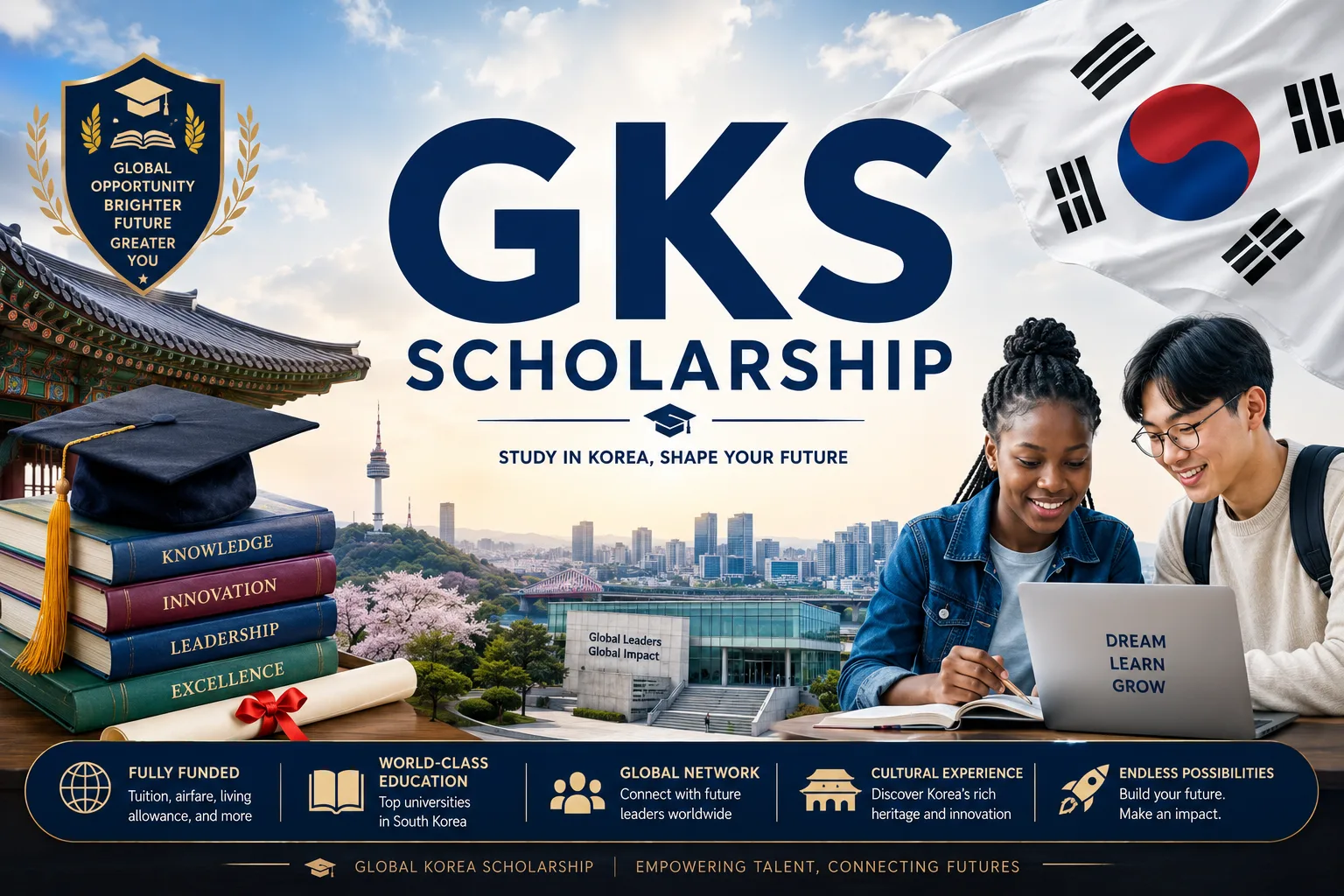
GKS stands for Global Korea Scholarship. It is a fully funded programme of the Korean government, managed by the National Institute for International Education (NIIED), for international students who want to study at Korean universities. It was formerly called the Korean Government Scholarship Program (KGSP). If you see “KGSP” online, it refers to the same programme. The GKS scholarship is open to students from many countries, and Nigeria is one of the partner countries.
| Item | Details |
|---|---|
| Full name | Global Korea Scholarship (GKS), formerly KGSP |
| Organiser | Government of the Republic of Korea, through NIIED |
| Levels available | Undergraduate (bachelor’s) and Graduate (master’s, PhD, research) |
| Type of funding | Fully funded |
| Nigeria quota (Undergraduate, 2027 intake) | 4 places (2 General and 2 R-GKS) |
| Official application website | www.studyinkorea.go.kr |
| Application fee | None |
Why Nigerian Students Should Consider It
Nigerian students who win the GKS scholarship get a chance to study in a country known for technology, engineering, medicine, business and research. Korean universities rank among the best in Asia. The programme also includes a year of Korean language training, so you do not need to speak Korean before you go.
Beyond the money, you gain international exposure. You will study with students from all over the world and build a network that can help your career in Nigeria or abroad. Many scholars return home with skills that employers value highly.
Two Levels of the Programme
The programme is split into two levels. Choose the one that matches your current qualification.
| Feature | Undergraduate (GKS-U) | Graduate (GKS-G) |
|---|---|---|
| Who it is for | Secondary school graduates | Bachelor’s or master’s degree holders |
| Degree you will study | Bachelor’s degree (4 years) | Master’s, PhD or research programme |
| Korean language training | 1 year | 1 year (unless exempted) |
| Typical application window | September to October | Early in the year, usually February to March |
| Nigeria quota | 4 (2027 guidelines) | 7 Embassy Track, 7 University Track (most recent guidelines reviewed) |
Note that anyone who already holds a bachelor’s degree cannot apply for the undergraduate level, even for a different course. If you have a degree, go for the graduate level.
Embassy Track and University Track
There are two ways to apply, and you must choose one.
- Embassy Track: You apply through the Korean Embassy in your country. For Nigerians, this means the Embassy of the Republic of Korea in Abuja. You apply online and the embassy handles the first-round selection. You can usually list more than one Korean university.
- University Track: You apply directly to a Korean university that participates in the programme. Each university sets its own dates and requirements, and you can normally name only one university and one department.
The “R-GKS” quota you may see in the guidelines is for scholars placed in universities outside the Korean capital region. The “General” quota is the standard one. Read the current guidelines carefully to understand which one fits your choice of university.
Eligibility for the GKS Scholarship (Undergraduate)
Based on the 2027 guidelines, you should meet these conditions:
- You must be a Nigerian citizen, and neither of your parents should be a Korean citizen.
- You must have been born after 1 March 2002, according to the guidelines we reviewed.
- You must have graduated from secondary school, or be expected to graduate by 31 December 2026. A school year that ends in February or March 2027 does not qualify.
- You must have a strong academic record. The guidelines set a minimum grade requirement, usually around 80% or its equivalent, so check the exact rule.
- You must be in good health to study in Korea.
- You must not already hold a bachelor’s degree.
Please confirm each condition in the official guidelines, because NIIED can change age limits and cut-off dates from one year to another.
Eligibility for Graduate Applicants
For the graduate level, the requirements generally include:
- Nigerian citizenship, with neither parent being a Korean citizen.
- Age under 40 on 1 September of the application year.
- A bachelor’s degree for master’s applicants, or a master’s degree for PhD applicants. Final-year students who will graduate before the programme starts can also apply.
- A good academic record, usually 80% or equivalent.
- Good health.
What You Receive: Benefits Table
The GKS scholarship covers much more than tuition. The table below summarises the main benefits. Amounts are in Korean won and can change, so confirm them in the latest guidelines.
| Benefit | What it covers |
|---|---|
| Airfare | Economy-class return ticket to Korea and back |
| Tuition | Full tuition fees paid by the programme |
| Monthly living allowance | About 800,000 won (undergraduate) and about 1,000,000 won (graduate) |
| Korean language training | One year, with tuition covered |
| Settlement allowance | One-time payment when you arrive |
| Medical insurance | Monthly support for health insurance |
| Research or book allowance | Support for academic materials and research |
| Language proficiency incentive | Extra monthly support for scholars with high TOPIK levels |
Scholars are still expected to manage their money well, because Korean cities can be expensive. Most Nigerian students report that the allowance is enough for a simple, careful lifestyle.
Nigeria Quota: How Competitive Is It?
The number of places under the GKS scholarship is small compared with the number of applicants.
| Level and track | Nigeria quota |
|---|---|
| Undergraduate 2027 (General) | 2 |
| Undergraduate 2027 (R-GKS) | 2 |
| Undergraduate 2027 (Total) | 4 |
| Graduate Embassy Track (most recent guidelines reviewed) | 7 |
| Graduate University Track (General 2, R-GKS 5) | 7 |
This does not mean you should lose hope. It means you must prepare very well. A neat, complete and honest application with strong academic proof can stand out.
Application Timeline for the 2027 Intake
| Stage | Date or period |
|---|---|
| 2027 undergraduate guidelines released | September 2026 |
| Embassy Track online application | 15 September to 30 September 2026 |
| University Track application | Around September to November 2026 (varies by university) |
| Final result announcement | Expected around 7 January 2027 |
| Graduate application (next cycle) | Usually February to March 2027, announced separately |
As at the date of this article, the Embassy Track window for the undergraduate level has closed. However, the University Track dates differ by school, so some applicants may still have time. If you are a graduate-level candidate, begin preparing now, because the next cycle usually opens early in the year. Also check the Korean Embassy in Abuja and the official portal for updates.
Documents You Will Need
Required documents differ slightly between undergraduate and graduate levels and between tracks. In general, prepare these:
| Document | Notes |
|---|---|
| Application form | Completed online (Embassy Track) or on the university form |
| Personal statement | Explain your goals and why you want to study in Korea |
| Study plan | A clear plan of what you will study and why |
| Academic transcripts | Official copies from your school |
| Graduation certificate or proof of expected graduation | WAEC or NECO result for secondary school graduates; degree certificate for graduate applicants |
| Letter of recommendation | From a teacher, lecturer or supervisor |
| Copy of passport | Valid passport with enough remaining validity |
| Applicant agreement form | Signed by hand if you pass the first round |
| Medical or health documents | Requested at a later stage |
| Apostilled documents | Required for selected scholars; Nigerian documents are apostilled through the appropriate government office |
Start collecting documents early. Getting transcripts and apostilles in Nigeria can take time, and delays are a common reason for missed deadlines.
Step-by-Step: How to Apply
To apply for the GKS scholarship, follow these steps.
- Read the official guidelines. Download the current guidelines for your level from the Study in Korea website and read every page.
- Choose your track. Decide between the Embassy Track and the University Track.
- Check your eligibility. Confirm your age, certificates, grades and parents’ citizenship.
- Choose your universities and course. Select programmes that match your background. Use the university information file attached to the guidelines.
- Create an account. Register on www.studyinkorea.go.kr for the Embassy Track, or on the university’s own portal for the University Track.
- Complete the forms. Fill in the application form, personal statement and study plan carefully.
- Upload your documents. Make sure every scan is clear and complete.
- Submit before the deadline. Do not wait for the last day, as websites can be slow near closing time.
- Attend the interview or screening. If you pass the first round, you will be told what to submit and when.
- Wait for the final result. NIIED announces final results, and selected scholars are then guided on travel and enrolment.
Tips to Improve Your Chances
Winning the GKS scholarship needs more than good grades. These practical tips can help:
- Write your personal statement yourself. Selectors read many applications and can tell when a statement is copied. Be specific about your goals and how Korea fits into your plan.
- Show a clear link between your studies and your future. Explain how you will use your knowledge to contribute to Nigeria or your field.
- Get strong recommendation letters. Choose referees who know you well, and give them enough time.
- Begin learning basic Korean. It is not compulsory before you apply, but it shows commitment and helps you settle faster.
- Keep your academic record strong. Grades are one of the main selection factors.
- Prepare for the interview. Practise explaining your plan clearly and calmly.
- Keep digital and paper copies of everything. You may be asked for documents more than once.
Common Mistakes to Avoid
- Applying under the wrong level, for example, applying for undergraduate when you already have a degree.
- Missing the deadline because of slow internet or last-minute document problems.
- Submitting unclear scans or incomplete forms.
- Choosing a course that does not match your certificates.
- Ignoring the track rules, such as listing too many universities where only one is allowed.
- Paying money to “agents” who promise guaranteed selection.
Beware of Scams
Fraudsters often use well-known scholarships to cheat students. It costs nothing to apply for the GKS scholarship, and no agent can guarantee selection. Do not pay anyone for a “slot”, “admission letter” or “sure win”. Use only official sources, such as the Study in Korea website, NIIED and the Korean Embassy in Abuja. If a message asks for money or your passport details through social media, treat it as suspicious.
Advantages and Challenges of the GKS Scholarship
| Advantages | Challenges |
|---|---|
| Fully funded study with allowance | Very small quota for Nigeria |
| Study at respected Korean universities | Strict deadlines and document rules |
| One year of Korean language training | Need to adjust to a new language and culture |
| International exposure and networking | Cost of living in Korean cities can be high |
| Chance to build a global career | Scholars must keep good grades to stay on the programme |
Life as a GKS Scholar
Scholars begin with a year of Korean language training. After that, they move to their degree courses. Many universities have international student offices that help with housing, visas and orientation. Food, weather and culture will feel different from home, but many Nigerian students find communities of fellow Africans and international students who support one another.
You must also maintain good academic performance. Scholarships can be reviewed or withdrawn if a scholar fails to meet academic or conduct requirements, so take your studies seriously.
Frequently Asked Questions (FAQs)
1. What is the GKS scholarship?
It is the Global Korea Scholarship, a fully funded programme of the Korean government for international students. It is managed by NIIED and covers undergraduate and graduate study in Korea. It was formerly known as KGSP.
2. Can Nigerians apply for the GKS scholarship?
Yes. Nigeria is a partner country, with a specific quota for each level. For the 2027 undergraduate intake, Nigeria has four places.
3. Who can apply for the undergraduate level?
Nigerian secondary school graduates, or those expected to graduate by the date stated in the guidelines, who meet the age and grade requirements and do not already hold a bachelor’s degree.
4. Can I apply if I already have a bachelor’s degree?
Not for the undergraduate level. You should apply for the graduate level (master’s or research) instead.
5. Is there an application fee?
No. The application is free. Anyone who asks you to pay for a slot or guarantee of selection is likely a scammer.
6. Does the programme cover flight tickets?
Yes. Selected scholars receive an economy-class return airfare, under the conditions in the guidelines.
7. Do I need to speak Korean before applying?
No. Selected scholars attend one year of Korean language training. However, basic knowledge can help your application and your settling-in.
8. Where do I submit my application?
For the Embassy Track, apply online through www.studyinkorea.go.kr. For the University Track, apply directly through the chosen Korean university, following its instructions.
9. When does the graduate application usually open?
It usually opens early in the year, around February to March. The exact dates are announced in the guidelines for each cycle.
10. How many Nigerians get the GKS scholarship every year?
The number depends on the yearly quota. For the 2027 undergraduate intake, Nigeria has four places. The graduate quota in the most recent guidelines reviewed was seven for each track.
11. Do I need IELTS or TOEFL?
Language requirements depend on your course and university. Many English-taught programmes ask for proof of English ability. Check the university information file for your chosen school.
12. Can I change my course or university after selection?
Changes are generally not allowed, or are allowed only in special cases approved by NIIED. Choose your course and university carefully before applying.
13. What happens if I fail the first round?
You can improve your application and try again in a future cycle, as long as you still meet the eligibility rules.
14. Can I work while studying in Korea?
Student visa holders may be allowed part-time work under Korean immigration rules, but scholars should focus on their studies. Check the rules for your visa type.
Conclusion
The GKS scholarship is a rare chance to receive a world-class education at no tuition cost. The quota for Nigeria is small, so success depends on early preparation, honest and well-written documents, and careful attention to the official guidelines. Check your eligibility, choose the right track, avoid scams and apply before the deadline. If this year’s window has closed for you, use the time to improve your grades, language skills and documents for the next cycle.