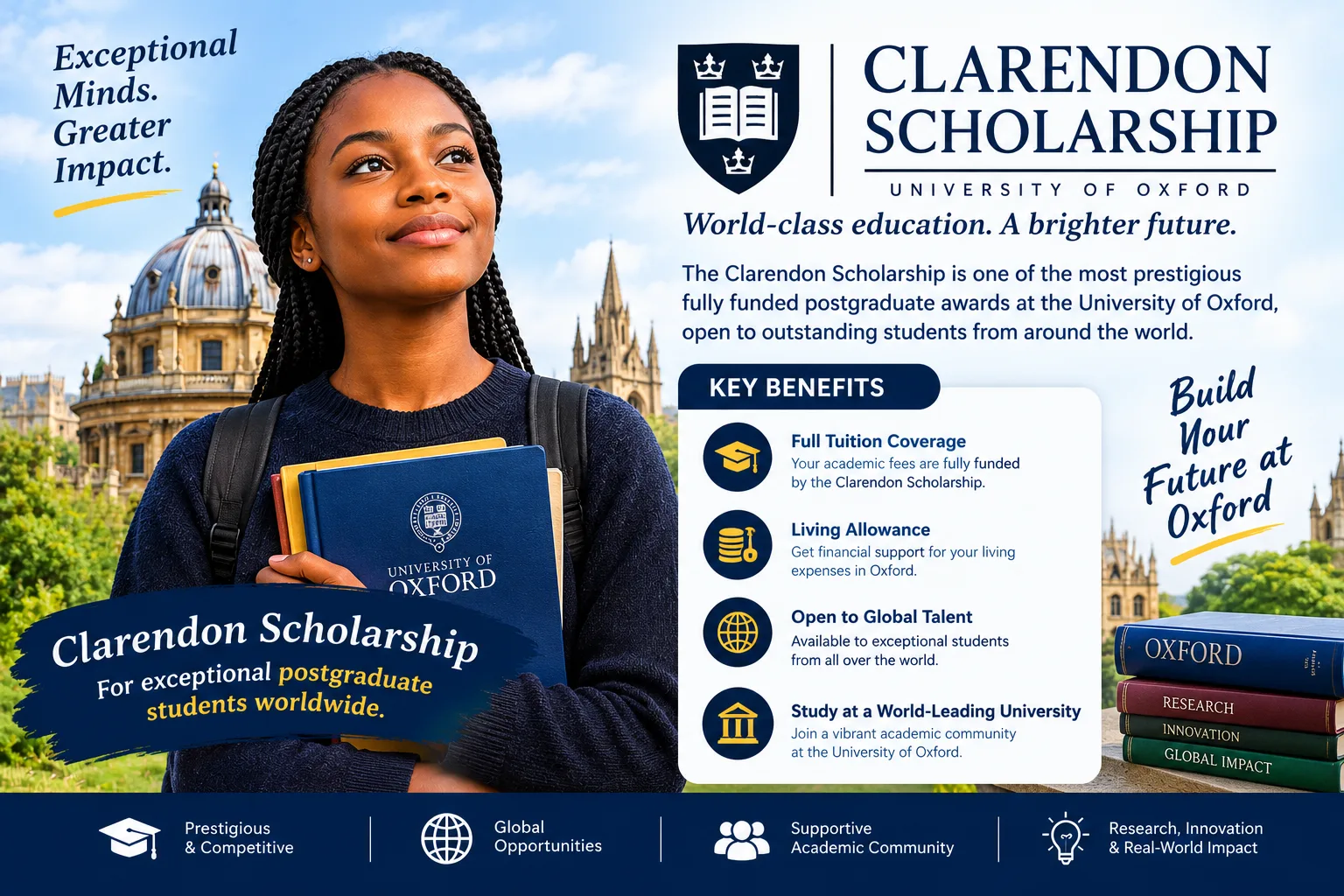
This guide explains everything in simple language: what the Clarendon scholarship is, what it pays for, who can be considered, the deadlines to watch, and the practical steps a Nigerian graduate can take to build a strong application. Every key fact here was checked against Oxford’s official pages in October 2026. Because deadlines and amounts can change, please confirm all details on Oxford’s website before you submit anything.
Many brilliant Nigerian graduates dream of studying at the University of Oxford, but the cost of fees and living expenses in the United Kingdom makes them give up before they even start. The good news is that Oxford runs one of the biggest fully funded graduate funding schemes in the world. The Clarendon scholarship pays course fees and gives a living grant to outstanding students from all over the world, and Nigeria is among the countries its scholars come from.
Important: Applications for 2027/28 entry fall due in December 2026 or January 2027, depending on your course. If you are reading this in October, you still have time, but you must start preparing now.
Clarendon Scholarship at a Glance
| Item | Details |
|---|---|
| Awarding body | Clarendon scholarship Fund, University of Oxford |
| Level of study | Master’s and DPhil (full-time or part-time) |
| Number of awards | Over 200 new scholarships each year, according to Oxford |
| Subjects | All subjects; no restriction on field of study |
| Nationality | No restriction, so Nigerians are eligible |
| Separate application form | None; you are considered automatically |
| Deadline | The December or January funding deadline for your chosen course |
| What it pays | Course fees in full plus a grant for living expenses |
| Basis of selection | Academic merit and potential |
| Official website | ox.ac.uk/clarendon |
What Is the Clarendon Scholarship?
The Clarendon scholarship Fund was set up in 2001 to support academically outstanding graduate students at Oxford. It is financed through Oxford University Press, working together with Oxford colleges and departments. Since 2012, the scheme has also covered students from the UK and the European Union, so today it supports students of every fee status. Oxford says about 700 Clarendon scholars are currently on course, which makes it the university’s largest scholarship scheme. The 2025/26 academic year marked its 25th intake of scholars.
In plain words, the Clarendon scholarship is a merit-based award. You do not write a special scholarship essay for it, and you do not fill a separate form. If you apply for an eligible Oxford graduate course before the correct deadline, the university considers you automatically. Oxford itself describes these awards as highly competitive, so the quality of your whole application matters a great deal.
What Does the Clarendon Scholarship Cover?
The package is generous, but it is important to understand exactly what is included and what is not.
| Benefit | Details |
|---|---|
| Course fees | Paid in full |
| Living expenses | An annual grant of at least the UKRI minimum doctoral stipend rate for full-time scholars. Oxford says this is normally enough for a single student living in Oxford. |
| Length of funding | Normally the scholar’s period of fee liability, which is the period for which you must pay course fees to the university |
| Part-time scholars | A study support grant instead of the full living grant. Third-party sources reported figures of £2,502 (DPhil) and £5,003 (Master’s) for 2025/26, so confirm current amounts with Oxford. |
| Continuation charges | Not paid by the Clarendon Fund |
| Other costs | Items such as flights, visa fees and support for family members are generally not part of the award. Check your funding letter for exact terms. |
The living grant follows the UKRI minimum doctoral stipend, which is reviewed every year. For example, a third-party source quoted £15,009 for 2025/26. Because the 2027/28 figure may not yet be final, do not rely on any single number from a blog. Always check Oxford’s applicant pages.
One more detail worth knowing: your funding is not only for the first year. Once you accept an offer, your funding is secure for the normal fee-liability period, provided you meet the conditions of your offer of a place at Oxford.
Who Is Eligible?
Oxford states that there are no restrictions on nationality, ordinary residence or field of study. All full-time and part-time DPhil and Master’s courses are eligible. A Nigerian graduate who meets the conditions below can be considered for the Clarendon scholarship without any special quota or country limit.
| Requirement | What it means for you |
|---|---|
| New course | You must be applying to start a new Master’s or DPhil. Current Oxford students who will continue the same degree next year are not eligible. |
| No deferred offer | Applicants who hold a deferred graduate offer cannot be considered. |
| Correct deadline | Your complete application must reach Oxford by the December or January funding deadline for your course. |
| Academic excellence | You must show outstanding academic results and potential. |
| English language | You must meet Oxford’s English language requirement for your course. |
Note that applying to Oxford does not mean you will be admitted, and being admitted does not mean you will receive funding. The university first decides whether to offer you a place, and the funding decision follows through its own process.
Deadlines: The Part Many Applicants Get Wrong
There is no single deadline for every applicant. Each graduate course has its own date, and these dates are listed on the course pages of Oxford’s graduate admissions website. Some courses close in early December, while many others close in January. For 2027/28 entry, this means December 2026 or January 2027.
The most common and costly mistake is applying in a later round, for example in March, and assuming funding will still be available. If you miss the funding deadline for your course, you will not be considered for the Clarendon scholarship, even if Oxford still accepts your application for admission.
| Situation | Result |
|---|---|
| Complete application submitted by the December or January funding deadline | Automatically considered |
| Application submitted after the funding deadline | Not considered |
| Application incomplete, for example references missing | Risk of being left out, so submit all parts early |
| Holding a deferred offer | Not eligible |
Benefits of the Clarendon Scholarship
The programme offers financial support to help successful applicants concentrate on their academic work. The exact funding arrangements depend on the course, study mode and individual award.
1. Full payment of course fees
Successful scholars receive funding for their eligible course fees. This applies to students with both Home and Overseas fee status, so Nigerian applicants are not excluded because they are international students.
Oxford’s postgraduate fees vary by programme. Consequently, the value of this benefit depends on the tuition fees for the particular course.
2. Living-cost support
Full-time scholars receive an annual grant for living expenses. For the 2025–2026 academic year, Oxford states that this grant is at least £20,780. This is a historical reference amount, not a confirmed rate for 2027–2028. Applicants should check the official website for the rate applicable to their entry year.
Living-cost support can help with expenses such as accommodation, feeding, local transportation and other everyday needs. However, the amount a student spends will depend on personal circumstances and living arrangements.
3. Support throughout the eligible study period
The award normally covers the period during which the scholar is liable to pay course fees, subject to the programme’s funding rules.
This means that a student should check the duration of the proposed course and its fee liability before making financial plans. Certain modular programmes have specific funding conditions, including limits on the modules or years covered.
4. Opportunities to join an international academic community
Clarendon scholars become part of a diverse community of postgraduate students. This can provide opportunities to interact with researchers from different countries, exchange ideas and build academic and professional relationships.
These connections may be valuable for future research collaborations, career development and professional networking.
5. Access to postgraduate education across different disciplines
The fund supports eligible master’s and DPhil courses across Oxford’s academic areas. Applicants can pursue a subject that matches their qualifications, academic interests and future plans rather than being limited to one specific discipline.
It is still important to check that the exact course is eligible and that the application is submitted by the correct deadline.
Who Is Eligible for the Clarendon Scholarship?
The scholarship is open to applicants from different countries, but there are important conditions to understand before applying.
Nationality and country of residence
There is no nationality or ordinary-residence restriction for the general Clarendon Fund. Nigerian citizens can apply, and applicants do not need to be residents of the United Kingdom to qualify.
Academic qualifications
Applicants must satisfy the entry requirements for their selected Oxford graduate programme. These vary by department and course.
A strong academic record is particularly important. Oxford explains that most successful scholars have a first-class undergraduate degree or its equivalent. It also notes that outstanding master’s-level performance can help compensate for a less exceptional undergraduate result. The university gives a GPA of around 3.7 out of 4 as an illustrative benchmark, not a universal minimum for every grading system or programme.
For Nigerian applicants, this means that the university will assess the academic qualifications in the context of the programme and the grading system concerned. There is no guarantee that a particular CGPA will result in a scholarship.
Eligible study programmes
The scheme covers eligible new master’s and DPhil programmes, including full-time and part-time study. The official course page and scholarship rules should be checked before applying.
Applicants seeking a postgraduate diploma or certificate should not assume that the scheme covers their programme. Such courses are generally outside the standard eligibility rules for these graduate scholarships.
New students and current Oxford students
The fund is intended for eligible applicants starting a new graduate course. Someone already studying for a master’s at Oxford may be considered when applying for a new DPhil or another eligible master’s course, subject to the rules.
However, a student continuing on the same Oxford degree in the following year is not eligible for a new Clarendon award under the standard rules. Applicants with deferred offers should also check the restrictions carefully.
Summary of Eligibility Requirements
| Requirement | What applicants should know |
|---|---|
| Nationality | Applicants worldwide, including Nigerians, may apply |
| Academic performance | Excellent academic record and strong potential |
| Study level | Eligible master’s and DPhil programmes |
| University | University of Oxford |
| Course admission | Must meet the specific programme’s entry requirements |
| Application deadline | Relevant December or January deadline |
| Separate scholarship form | Not required for the general Clarendon Fund |
| Selection | Competitive, based on academic merit and potential |
| Continuing students | Not eligible when continuing on the same degree |
| Deferred offers | Generally ineligible under the standard rules |
How to Apply for the Clarendon Scholarship from Nigeria
The application process is straightforward in one respect: there is no separate scholarship application for the general Clarendon Fund. Your main task is to submit a strong and complete application for an eligible Oxford graduate programme by its relevant funding deadline.
Step 1: Choose an eligible postgraduate course
Visit the official Oxford graduate courses directory and identify a master’s or DPhil programme that fits your academic background.
Read the course description carefully. Check the entry requirements, duration, tuition fees, application deadline and supporting documents. Do not select a course simply because it appears prestigious; ensure it supports your academic interests and career objectives.
Step 2: Check the course deadline
Oxford’s graduate application deadlines vary by programme. Many fall in December or January, but the exact date differs.
Use the official graduate application deadline guide to confirm the deadline for your course.
For the 2027–2028 academic year, do not assume that every programme shares one universal closing date. The deadline published on the course page is the one to follow. Applying after the relevant funding deadline can make you ineligible for the scholarship even if the course remains open to applications.
Step 3: Prepare your academic documents
Gather the documents required by your selected programme. Depending on the course, these may include:
-
Academic transcripts.
-
Degree certificates or other proof of qualifications.
-
Curriculum vitae (CV), where required.
-
Personal statement or statement of purpose.
-
Research proposal for programmes that require one.
-
Academic references.
-
Evidence of English-language proficiency, if required.
Not every programme requires all these documents, and additional requirements may apply. Always use the official course page as your checklist.
Step 4: Write a strong personal statement
Your statement should explain why you want to study the chosen subject, what academic questions interest you, and how the programme relates to your future plans.
Avoid vague claims such as wanting to study at Oxford solely because it is a famous university. Instead, explain why the specific course suits your academic goals, which skills or knowledge you intend to develop, and what you hope to contribute to your field.
Be truthful about your achievements. Do not invent leadership positions, research experience, awards or publications.
Step 5: Arrange strong academic references
Choose referees who can discuss your academic performance, intellectual ability, research skills and readiness for postgraduate study.
A detailed reference from a lecturer or supervisor who knows your work well may be more useful than a generic recommendation from someone who barely knows you.
Give your referees sufficient time to prepare and submit their references before the deadline.
Step 6: Submit your Oxford graduate application
Apply through the university’s official graduate admissions system. Complete the form accurately and upload the required documents.
Review your application before submission. Confirm that your educational history, personal details, references and supporting documents are correct.
Where possible, submit at least two weeks before the deadline. Oxford itself recommends applying early enough to resolve document or technical issues.
Step 7: Receive automatic scholarship consideration
If your course and application meet the relevant conditions, you will automatically be considered for the Clarendon Fund. There is no separate Clarendon scholarship form to complete.
Automatic consideration does not mean automatic funding. Academic departments assess applications and nominate candidates for scholarship consideration, after which the relevant university divisions undertake further selection.
Step 8: Monitor your email and application portal
Check your email regularly for communications from Oxford. Successful scholarship applicants are notified by email, and scholarship decisions may be communicated separately from the admission decision.
Do not make irreversible financial commitments based only on an expectation that you will receive funding.
Important Documents for Nigerian Applicants
Although the documents required depend on the course, preparing early can make the application process easier.
| Document | Purpose |
|---|---|
| Academic transcript | Shows courses taken and academic performance |
| Degree certificate | Confirms completed qualifications |
| Personal statement | Explains academic interests and motivation |
| Research proposal | Outlines proposed research, where required |
| Academic references | Provide independent evidence of academic ability |
| CV | Summarises relevant academic and professional experience, where requested |
| English-language evidence | Demonstrates proficiency when the course requires it |
| Identification documents | Supplied where requested by the admissions process |
Applicants should not upload unnecessary documents simply to make their application appear longer. Follow the instructions for the specific course and submit the documents requested by the university.
How Competitive Is the Clarendon Scholarship?
The scholarship is highly competitive because it attracts outstanding graduate applicants from around the world. Oxford reports that it offers more than 200 new fully funded awards in a typical year, with over 230 new scholarships reported for 2025–2026. These figures describe previous award levels and should not be interpreted as a guaranteed number for 2027–2028.
There is no single published CGPA that guarantees selection. Academic performance is important, but the assessment also considers the applicant’s potential, motivation and suitability for the proposed course.
Applicants should therefore focus on presenting a complete and convincing academic profile rather than relying on one examination result.
What does Oxford look for in successful applicants?
The university identifies three broad areas of assessment.
1. Outstanding academic record
Your transcripts, examination results, academic prizes and other relevant achievements can demonstrate your ability to succeed at a demanding graduate level.
2. Future potential and aptitude
Your application should show that you can develop your academic interests and contribute to your field. For research degrees, a well-developed proposal and strong references can help demonstrate your readiness for independent research.
3. Student motivation
Your personal statement and references should provide credible evidence of your commitment to the course and explain why the proposed study is appropriate for you.
Selection criteria can vary by subject and between taught and research programmes. No single document or achievement guarantees an award.
Tips for Nigerian Students Applying for the Scholarship
Applicants from Nigeria should treat the scholarship application as a serious academic project. The following practical steps can improve the quality of an application, although none can guarantee selection.
1. Start preparing several months early
Do not wait until the end of the year to begin looking for a suitable course. Research programmes early, identify the documents required and contact referees well in advance.
This is particularly useful if you need to obtain transcripts, replace a missing certificate or prepare a research proposal.
2. Understand how your grades will be assessed
Do not assume that a Nigerian CGPA will be converted using a simple formula to determine scholarship eligibility. Oxford assesses qualifications in the context of the programme and its academic requirements.
If you are uncertain whether your degree classification or CGPA meets the requirements, consult the official course page or contact the relevant admissions department.
3. Select a course that matches your academic background
A convincing application establishes a clear relationship between your previous education and the proposed postgraduate course.
For example, an applicant interested in environmental research should explain the academic questions they want to investigate and how the chosen programme will help them develop the necessary expertise.
4. Make your research proposal specific
If the programme requires a proposal, identify the research problem, explain why it matters, outline your intended approach and demonstrate familiarity with relevant academic literature.
Avoid choosing a topic simply because it sounds impressive. A focused, feasible proposal is more useful than a broad topic that cannot be investigated properly.
5. Explain your motivation clearly
Discuss your academic interests, relevant experience and future objectives. If you hope to apply your training to a challenge in Nigeria, explain the connection realistically.
For example, a student interested in public health might explain how advanced training could support research into disease prevention, health systems or community-level interventions.
6. Proofread every document
Check spelling, grammar, dates, names and consistency across the application. Ensure that your personal statement accurately represents your experience and that your referees have the correct submission instructions.
7. Consider other funding opportunities
Even strong candidates may not receive the award. Research other scholarships offered by Oxford, external funding organisations and relevant government or institutional programmes.
Oxford’s fees, funding and scholarship search is a useful starting point.
Clarendon Scholarship Application Timeline
The following table gives a general guide for applicants targeting entry in 2027. It is not a substitute for the deadlines on your chosen course page.
| Period | Recommended action |
|---|---|
| October–November 2026 | Research suitable courses and review requirements |
| November–December 2026 | Prepare transcripts, statements, proposals and references |
| December 2026–January 2027 | Submit before the applicable course deadline |
| February–March 2027 | Scholarship nominations and divisional selection generally take place |
| April–June 2027 | Scholarship decisions and funding arrangements may be communicated |
| Before enrolment | Meet offer conditions and complete visa and enrolment requirements |
The exact schedule varies. Oxford states that scholarship offers are generally communicated between late February and June, and successful Clarendon candidates are usually contacted by email.
For the most reliable information, check the official Clarendon applicant information page before submitting your application.
Is the Scholarship Fully Funded?
Yes, the general Clarendon award is described as fully funded because it covers eligible course fees and provides living-cost support for full-time scholars, subject to the award terms.
However, students should read their individual funding letters carefully. They should not automatically assume that every expense connected with international study will be paid separately.
For instance, personal spending, certain travel costs, visa-related expenses or other costs not included in the award may require separate budgeting. The university’s funding information and the conditions of the individual award should be used to determine precisely what is covered.
Part-time scholars receive a study support grant to assist with non-fee costs, and the amount may differ from the living-cost grant awarded to full-time scholars.
How to Avoid Scholarship Scams
Students searching online for international scholarships may encounter websites or individuals claiming to guarantee awards in exchange for money.
Be careful of anyone who promises automatic selection, asks for your password or claims that paying a private agent will secure a Clarendon award.
Remember these important points:
-
The general Clarendon scholarship fund does not require a separate scholarship application form.
-
You must apply for an eligible graduate course through Oxford’s official admissions process.
-
Meeting the deadline makes you eligible for consideration; it does not guarantee selection.
-
Verify scholarship information through official Oxford webpages.
-
Do not provide banking passwords, one-time verification codes or other confidential account details to an unverified person.
You can use the university’s official website to check the funding arrangements and contact the appropriate admissions team if you have questions.
Frequently Asked Questions About the Clarendon Scholarship
1. Is the Clarendon Scholarship open to Nigerian students?
Yes. Nigerian students are eligible to apply because the scholarship has no nationality restrictions. Applicants must still satisfy the academic and application requirements for their chosen Oxford graduate course.
2. Is the Clarendon Scholarship fully funded?
Yes. The award covers eligible course fees and provides living-cost support for full-time scholars. Part-time scholars receive a study support grant, subject to the award terms.
3. What is the minimum CGPA required?
There is no single CGPA that guarantees eligibility or selection across all courses. Oxford states that most successful scholars have a first-class degree or equivalent, while an outstanding master’s result may strengthen an applicant’s academic profile. Always check the entry requirements for your chosen course.
4. Can I apply for the scholarship without first applying to Oxford?
No. You must apply for an eligible master’s or DPhil programme at Oxford. The scholarship consideration is linked to your graduate course application.
5. Do I need a separate scholarship application form?
No. Eligible applicants who submit their course applications by the relevant December or January funding deadline are automatically considered. No separate application form is required for the general Clarendon scholarship fund.
6. Can undergraduate students apply?
The programme is intended for eligible graduate study, not undergraduate degrees. Students completing their undergraduate education may apply for an eligible master’s course if they meet its entry requirements.
7. Can I apply for a PhD under the scholarship?
Yes. Oxford calls its doctoral research degree a DPhil, and eligible DPhil programmes are covered by the fund. Applicants must meet the relevant admission and funding deadlines.
8. When is the application deadline for 2027 entry?
There is no single deadline for every programme. Many Oxford graduate courses have deadlines in December 2026 or January 2027 for entry in 2027, but you must confirm the exact date on your chosen course page.
9. When will successful applicants be notified?
Oxford generally communicates Clarendon scholarship awards between late February and June. Successful candidates are contacted by email, and the timing can vary across academic divisions.
10. How many scholarships are awarded each year?
Oxford reports more than 200 new Clarendon scholarship awards in a typical year. It reported over 230 new scholarships for 2025–2026. The number awarded in any future year is not guaranteed.
11. Can I apply if I already study at Oxford?
You may be eligible if you are applying to start a new qualifying graduate course, such as a DPhil after a master’s degree. However, continuing on the same degree does not qualify you for a new award under the standard rules.
12. Does the scholarship cover accommodation and feeding?
The living-cost grant for full-time scholars is intended to help meet everyday living expenses, which can include accommodation and feeding. It is a grant rather than a promise to pay every individual bill directly.
13. Can I apply if I have a second-class upper degree?
You should review the entry requirements for your chosen course. A second-class upper degree does not automatically establish that you will qualify for the scholarship. Academic departments assess applications in context, and competition is strong.
14. Is IELTS compulsory for Nigerian applicants?
Not necessarily. English-language requirements depend on the course and Oxford’s applicable rules. Check whether your programme requires an English-language test or whether you qualify for an exemption. Do not assume that every Nigerian applicant is automatically exempt.
15. Where can I apply for the scholarship?
Begin with the official University of Oxford graduate admissions website. Select your course, review its requirements and deadline, and submit the application through the university’s official admissions system.
Conclusion
The Clarendon Scholarship is a valuable opportunity for academically outstanding students who want to pursue postgraduate education at the University of Oxford. Its combination of eligible course-fee coverage, living-cost support for full-time scholars and an international academic community makes it an attractive option for qualified applicants from Nigeria and other countries.
The most important step is to prepare a strong application for a suitable graduate programme and submit it before the relevant funding deadline. Excellent academic performance, a clear statement of purpose, strong references and a well-prepared research proposal where required can help demonstrate your readiness for postgraduate study.
Remember that automatic consideration is not a guarantee of funding. Begin your preparations early, use official university information to verify every requirement and explore alternative funding opportunities while waiting for a decision.