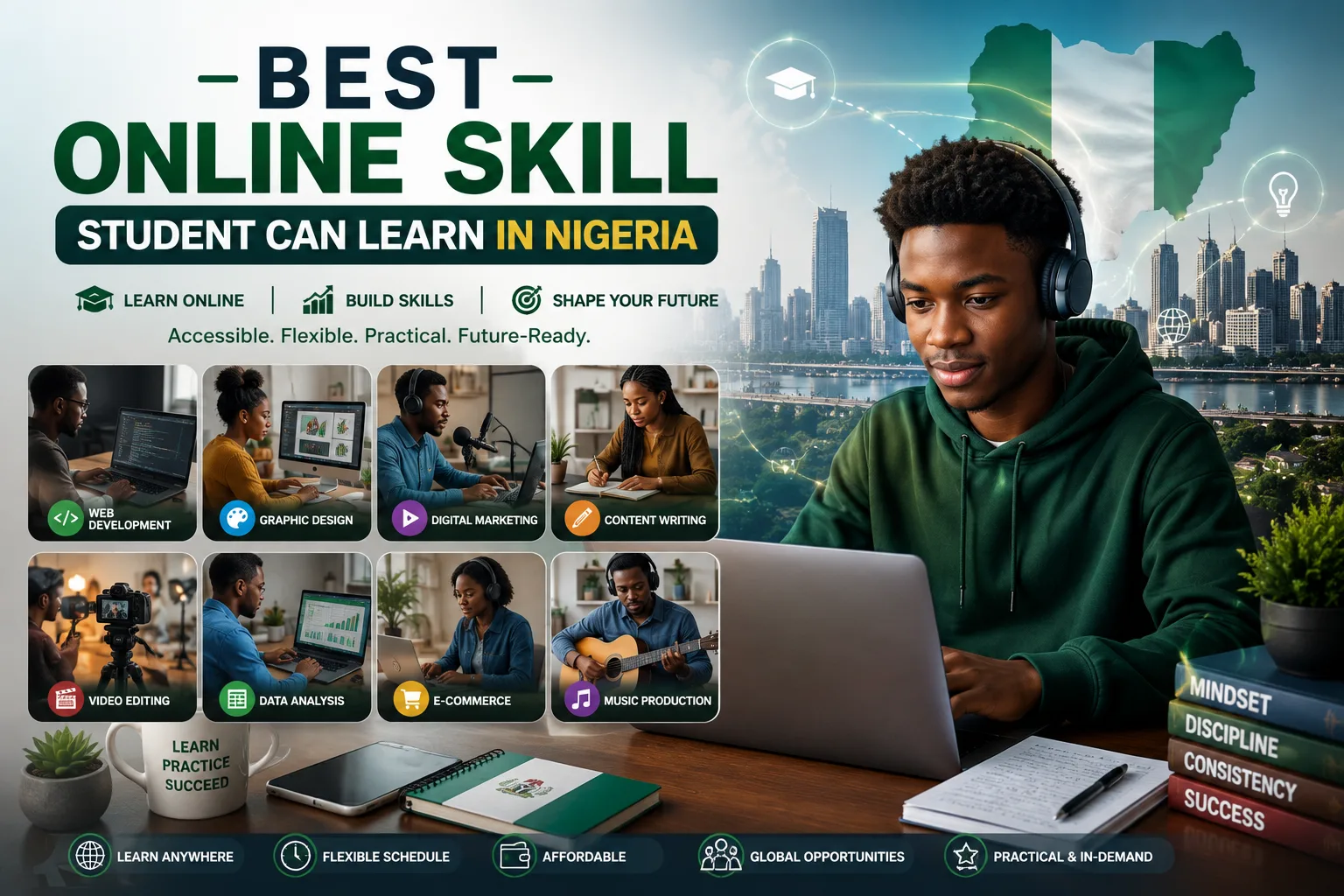
In this article, we will discuss the best online skills students can learn in Nigeria, how to choose the right skill, where to learn, how long it may take to become competent, and how students can eventually turn their skills into income.
Being a university or polytechnic student in Nigeria is no longer only about attending lectures, writing examinations and obtaining a certificate. While academic qualifications remain important, students are increasingly expected to have practical skills that can help them compete for jobs, internships, freelance opportunities and business opportunities.
The internet has made it possible for Nigerian students to learn valuable skills without waiting until graduation. With a smartphone or computer, an internet connection and consistent practice, a student can learn a marketable skill from home, develop a portfolio and eventually use that skill to earn income.
This is particularly important because the demand for digital skills continues to grow. A World Bank report on digital skills in Nigeria estimates that approximately 28 million workers will need digital skills by 2030, with about 45% of jobs expected to require some level of digital capability.
For students, this presents an opportunity to start preparing for the labour market while still in school.
Why Should Nigerian Students Learn Online Skills?
University education provides important academic knowledge, but practical skills can complement what students learn in the classroom.
Learning an online skill can help a student to:
- Build practical experience before graduation.
- Improve their CV.
- Develop a portfolio.
- Apply for internships.
- Work with clients remotely.
- Start a small online business.
- Become more employable after graduation.
- Explore entrepreneurship.
- Develop confidence with technology.
- Create additional income opportunities.
The World Bank’s recent assessment of Nigerian youth also highlights education, skills development, employment and digital inclusion as important areas affecting young people’s opportunities.
This does not mean every student must become a freelancer or abandon their academic programme. Rather, an online skill can complement a student’s education and provide another useful form of experience.
15 Best Online Skills Students Can Learn in Nigeria
There are many skills available online, but students should focus on skills that have practical applications and can be demonstrated through projects or portfolios.
Here are some of the best options.
1. Graphic Design
Graphic design is one of the easiest creative skills for students to explore online.
Graphic designers create visual materials such as:
- Business flyers
- Social media posts
- Logos
- Posters
- Event designs
- YouTube thumbnails
- Presentation slides
- Brand materials
- Advertisements
- Infographics
Students can begin with simple tools such as Canva before progressing to more advanced software such as Adobe Photoshop, Illustrator or other professional design applications.
Why graphic design is useful
Almost every business needs visual content. Small businesses, churches, schools, event organisers, restaurants, influencers and organisations regularly need designs for online promotion.
A student can start by creating sample designs for imaginary businesses or redesigning existing concepts for practice.
How to start
Begin by learning:
- Colour theory.
- Typography.
- Layout.
- Branding.
- Image selection.
- Design principles.
- Social media design.
After learning the basics, create at least 10–20 sample designs and organise them into a portfolio.
2. Web Design and Development
Web development is another valuable online skill students can learn.
Web developers build and maintain websites for individuals, businesses and organisations.
A beginner can start with:
- HTML
- CSS
- JavaScript
After gaining a foundation, students can explore:
- WordPress
- React
- PHP
- Python
- Databases
- APIs
- Git and GitHub
Students do not necessarily need to learn everything at once.
A beginner could start by learning how to build a simple website with HTML and CSS, then gradually introduce JavaScript and other technologies.
What can you do with web development?
You could eventually build:
- Business websites
- Personal portfolios
- School websites
- Blogs
- Landing pages
- E-commerce websites
- Web applications
Web development can be particularly useful for students studying computer science, information technology, engineering or related fields, but students from other disciplines can learn it as well.
3. Content Writing
Content writing is an excellent skill for students who enjoy reading, researching and writing.
Content writers produce written material for websites, blogs, businesses and other platforms.
Common forms include:
- Blog articles
- Website content
- Product descriptions
- Newsletters
- Educational content
- Guides
- Social media content
- SEO articles
A student studying English, mass communication, education, law, social sciences or humanities may find content writing particularly useful, although the skill is open to students from every discipline.
Skills needed for content writing
You should learn:
- Grammar.
- Research.
- Article structure.
- Editing.
- Search engine optimisation.
- Fact-checking.
- Headline writing.
- Clear communication.
The most important thing is to write regularly.
Create sample articles around topics you understand and gradually improve your writing.
4. Search Engine Optimisation (SEO)
Search Engine Optimisation, commonly called SEO, involves improving online content so that it can be discovered more effectively through search engines.
SEO is useful for:
- Bloggers
- Website owners
- Businesses
- Digital marketers
- Content writers
- E-commerce businesses
Students who learn SEO can combine it with content writing, web design or digital marketing.
Important areas include:
- Keyword research
- Search intent
- On-page SEO
- Technical SEO
- Internal linking
- Content structure
- Website speed
- Search performance analysis
SEO is not simply about repeating keywords. Effective SEO involves creating useful content that satisfies what users are actually searching for.
5. Digital Marketing
Digital marketing is another strong option for students.
Businesses increasingly use the internet to promote their products and services, creating demand for people who understand online marketing.
Digital marketing includes areas such as:
- Social media marketing
- Email marketing
- Content marketing
- SEO
- Search advertising
- Online branding
- Analytics
- Influencer marketing
A student does not need to master every area immediately.
You can specialise in one area first and expand your knowledge as you gain experience.
Example
A student could help a small fashion business manage its Instagram content, create promotional graphics, write captions and analyse engagement.
That student would be building practical experience while still in school.
6. Social Media Management
Many Nigerian businesses have social media accounts but struggle to manage them consistently.
A social media manager helps businesses plan, create and publish content while monitoring audience engagement.
Typical responsibilities include:
- Content planning
- Caption writing
- Graphic coordination
- Scheduling posts
- Responding to comments
- Monitoring analytics
- Developing content ideas
- Maintaining brand consistency
Students can practise by managing a personal page or helping a small business, student organisation or campus initiative.
7. Video Editing
Video content has become an important part of online communication.
Students can learn video editing using mobile applications before moving to professional desktop software.
Beginner-friendly options include tools such as:
- CapCut
- Canva
- VN
More advanced editors can explore software such as Adobe Premiere Pro, DaVinci Resolve and similar professional tools.
Video editors can work on:
- YouTube videos
- TikTok videos
- Instagram Reels
- Advertisements
- Interviews
- Educational videos
- Event videos
- Documentary projects
For students with limited resources, mobile video editing provides a practical starting point.
8. Data Analysis
Data analysis is a highly useful skill for students who enjoy numbers, research and problem-solving.
A beginner can start with:
- Microsoft Excel
- Google Sheets
Then progress to:
- SQL
- Power BI
- Tableau
- Python
- R
Data analysts help organisations understand information and make better decisions.
Why students should consider data analysis
Data is used in many industries, including:
- Banking
- Education
- Healthcare
- Agriculture
- Telecommunications
- Government
- Marketing
- Manufacturing
- Research
Students studying economics, statistics, mathematics, computer science, business administration and social sciences may find data analysis particularly relevant.
However, students from other disciplines can learn it as well.
9. Programming and Software Development
Programming is one of the most powerful technical skills a student can learn.
Beginners can start with languages such as:
- Python
- JavaScript
- Java
- C++
- C#
The right language depends on your goals.
For example, Python can be useful for automation, data analysis, artificial intelligence and backend development. JavaScript is important for web development.
The key is to avoid trying to learn several programming languages simultaneously when you are still a beginner.
Choose one and practise consistently.
How to learn programming effectively
Do not spend all your time watching tutorials.
Use the following approach:
Learn → Practise → Build → Make mistakes → Fix → Build again.
Projects are particularly important because they demonstrate what you can actually do.
10. UI/UX Design
UI means User Interface, while UX means User Experience.
UI/UX designers work on how digital products look, feel and function.
They may design:
- Mobile applications
- Websites
- Dashboards
- Digital platforms
- Online forms
- E-commerce interfaces
Students can start with tools such as Figma and learn basic principles of user research, wireframing, prototyping, usability and interface design.
This skill can be particularly attractive to creative students who also enjoy technology.
11. Virtual Assistance
Virtual assistance is another online skill that students can learn.
A virtual assistant provides administrative or operational support remotely.
Tasks can include:
- Email management
- Calendar management
- Internet research
- Data entry
- Document organisation
- Customer support
- Scheduling
- Basic social media management
Good communication, organisation and time-management skills are important.
Students can use this skill to gain experience in remote work while developing professional communication habits.
12. Copywriting
Copywriting is different from ordinary content writing.
While content writing often focuses on informing or educating readers, copywriting is frequently designed to persuade readers to take an action.
For example:
- Buy a product.
- Register for an event.
- Subscribe to a service.
- Download an application.
- Contact a business.
Copywriters create:
- Advertisements
- Sales pages
- Product descriptions
- Email campaigns
- Social media advertisements
- Marketing messages
Students who enjoy psychology, communication and persuasive writing may enjoy this field.
13. Online Tutoring
If you are academically strong in a particular subject, online tutoring can be an option.
You could tutor students in subjects such as:
- Mathematics
- English
- Physics
- Chemistry
- Biology
- Economics
- Accounting
- Computer studies
Students can use video calls, messaging platforms and online learning tools to teach.
However, tutors should be honest about their qualifications and only teach subjects they understand well.
14. Mobile App Development
Mobile app development involves creating applications for smartphones and other devices.
Students can explore technologies such as:
- Flutter
- React Native
- Kotlin
- Swift
Beginners may find mobile development more challenging than graphic design or content writing, but it can be highly rewarding for students interested in technology.
Start with simple projects such as:
- Calculator apps
- To-do applications
- Note-taking apps
- Student timetable applications
- Simple budgeting applications
Building small projects is a better learning strategy than trying to create a complicated application immediately.
15. Artificial Intelligence and AI Tools
Artificial intelligence is becoming increasingly relevant across different industries.
Students do not necessarily need to become AI researchers to benefit from AI.
They can learn practical AI skills such as:
- Using AI responsibly for research
- AI-assisted content creation
- Prompt writing
- AI workflow automation
- Data analysis with AI tools
- AI-assisted programming
- AI image generation
- AI research support
However, students should learn to verify AI-generated information instead of blindly copying it.
AI should be used as a productivity tool, not as a replacement for independent thinking or academic integrity.
Best Online Skills for Students Based on Their Interests
Not every skill is suitable for every student.
Use the table below as a starting point.
| Student interest | Recommended online skills |
|---|---|
| Writing | Content writing, copywriting, SEO |
| Creativity | Graphic design, video editing, UI/UX |
| Technology | Programming, web development, app development |
| Mathematics | Data analysis, programming |
| Business | Digital marketing, SEO, copywriting |
| Communication | Social media management, virtual assistance |
| Teaching | Online tutoring |
| Research | Data analysis, content writing |
| Technology + creativity | UI/UX, web design |
| Entrepreneurship | Digital marketing, e-commerce, content creation |
Best Online Skills for Students Who Want to Make Money
If your main objective is to eventually earn from your skill, do not choose a skill simply because someone on social media claims that it is profitable.
Instead, consider three factors:
- Demand: Do individuals or organisations need the service?
- Ability: Can you realistically become good at it?
- Access: Can you learn and practise it with the equipment and internet access available to you?
Skills such as graphic design, content writing, social media management, video editing, web development, digital marketing, virtual assistance and data analysis can all provide potential pathways to freelance or employment opportunities.
However, learning a skill does not guarantee income.
Income usually comes after you develop competence, build a portfolio, communicate professionally and find people who need your services.
How Long Does It Take to Learn an Online Skill?
There is no fixed period.
A student may learn the basics of a skill within a few weeks but require several months of consistent practice to become competent.
A rough learning framework could look like this:
| Stage | Approximate period | Main goal |
|---|---|---|
| Beginner | 2–4 weeks | Understand the fundamentals |
| Foundation | 1–3 months | Complete simple projects |
| Developing | 3–6 months | Build a portfolio |
| Intermediate | 6–12 months | Handle real projects confidently |
| Advanced | 1 year+ | Develop specialised expertise |
These periods are only guidelines. Your progress will depend on the complexity of the skill, the amount of time you practise and the quality of your learning resources.
How to Learn Online Skills as a Nigerian Student
You do not need to wait until you have expensive equipment before starting.
Step 1: Choose One Skill
Do not attempt to learn graphic design, programming, SEO, video editing, data analysis and digital marketing at the same time.
Choose one skill and focus on it.
Step 2: Find Quality Learning Resources
You can learn through:
- Online courses
- YouTube tutorials
- Documentation
- E-books
- Online communities
- Practical projects
- Workshops
- University technology clubs
Do not judge a course solely by the number of students enrolled or the claims made by its instructor.
Step 3: Practise Every Week
Learning without practice will not produce strong results.
Set aside specific hours each week for practice.
For example:
Monday: Learn a new concept.
Tuesday: Practise the concept.
Wednesday: Work on a small project.
Thursday: Study another lesson.
Friday: Improve your project.
Saturday: Build something independently.
Sunday: Review what you learned.
You can adjust this schedule around your lectures and other responsibilities.
Step 4: Build a Portfolio
A portfolio is evidence of your ability.
Instead of saying:
“I am a graphic designer.”
Show your designs.
Instead of saying:
“I am a web developer.”
Show the websites you built.
Instead of saying:
“I am a writer.”
Show your published articles or writing samples.
Your portfolio can make your skill easier for potential employers or clients to evaluate.
Can Students Learn Online Skills With Only a Smartphone?
Yes, although the type of skill you can comfortably learn will depend on the device and software required.
A smartphone can be enough to start learning:
- Graphic design
- Social media management
- Basic video editing
- Content creation
- Content writing
- Digital marketing
- Online tutoring
- Basic AI tools
A laptop becomes increasingly useful for:
- Programming
- Web development
- Advanced video editing
- Data analysis
- UI/UX design
- Professional graphic design
If you only have a smartphone, start with a skill that you can practise effectively on that device rather than waiting indefinitely for a laptop.
How Much Internet Data Do Students Need?
There is no universal amount because usage depends on the learning method.
Watching high-resolution video tutorials can consume much more data than reading articles or downloading course materials.
Students trying to save data can:
- Download lessons when connected to affordable Wi-Fi.
- Watch videos at lower resolutions.
- Use text-based tutorials.
- Download documentation.
- Take notes offline.
- Practise without being connected to the internet.
- Avoid unnecessarily streaming the same lesson repeatedly.
Internet access remains an important challenge for digital skills development in Nigeria. World Bank research has highlighted limitations in computer ownership and internet access, particularly among disadvantaged and rural populations.
Free Online Skills Students Can Learn
Students with limited funds can begin with free resources.
Some useful free learning sources include:
- YouTube educational channels
- FreeCodeCamp
- Google learning resources
- Microsoft Learn
- HubSpot Academy
- Canva tutorials
- Meta learning resources
- Official software documentation
- University resources
- Open educational materials
Always check the quality and credibility of the source before relying on it.
Free does not automatically mean poor quality, and expensive does not automatically mean good quality.
Should Students Pay for Online Courses?
Not necessarily.
Before paying for a course, ask:
- Does the instructor have relevant experience?
- Does the course have a clear curriculum?
- Are practical projects included?
- Are there credible reviews?
- Does it teach the skill you actually want?
- Is there support for students?
- Can you learn the basics from free resources first?
Avoid courses that promise guaranteed wealth, instant employment or unrealistic income.
A legitimate skill normally requires time, practice and continuous improvement.
How to Turn an Online Skill Into Income
Learning the skill is only the first stage.
Once you become competent, you can consider several routes.
Freelancing
You can offer your service to clients locally or internationally through appropriate freelance platforms and professional networks.
Local Businesses
Many small Nigerian businesses need affordable digital services.
You could approach businesses that need:
- Flyers
- Websites
- Social media management
- Product photography or editing
- Video editing
- Digital marketing
- Copywriting
Internships
An internship can give you real-world experience and help you understand how professional organisations operate.
Remote Jobs
Some organisations recruit people who can work remotely.
Your portfolio, CV, communication skills and practical experience can help you compete for these opportunities.
Personal Business
You can also use your skill to promote your own business or build a digital product.
For example, a student who learns web development could build websites for businesses, while a student who learns graphic design could create branded materials for small businesses.
How Students Can Balance Online Skills With University Education
One of the biggest mistakes students make is allowing a new skill or online business to interfere with their studies.
Your academic programme should not automatically be abandoned because you discover a digital skill.
Instead:
Create a timetable
Set specific hours for learning and client work.
Start small
Do not accept more work than you can handle.
Protect examination periods
Reduce your freelance workload when examinations are approaching.
Use weekends effectively
Weekends can provide additional time for practice and portfolio development.
Set realistic goals
Instead of saying:
“I will become a professional programmer in one month.”
Set a measurable goal such as:
“I will complete three beginner programming projects within three months.”
Common Mistakes Students Should Avoid
1. Learning Too Many Skills at Once
Trying to learn everything usually results in mastering nothing.
Start with one.
2. Chasing Every Trending Skill
A skill should not be selected simply because it is trending on social media.
Consider whether it matches your interests and long-term goals.
3. Watching Tutorials Without Practising
Tutorials provide information. Practice develops ability.
4. Expecting Immediate Income
It can take time to become competent and find paying clients.
5. Copying Other People’s Work
Use other people’s work for inspiration and learning, but do not present someone else’s work as your own.
6. Ignoring Communication Skills
A technically talented person can still lose opportunities because of poor communication.
Learn how to:
- Write professional messages.
- Meet deadlines.
- Explain your work.
- Ask useful questions.
- Receive feedback.
- Treat clients respectfully.
7. Paying for Fake Opportunities
Students should be cautious about online schemes that promise guaranteed jobs or income in exchange for suspicious fees.
Research opportunities carefully before sending money or personal information.
Frequently Asked Questions
1. What is the best online skill for students in Nigeria?
There is no single best skill for everyone. Graphic design, programming, web development, content writing, SEO, digital marketing, video editing, data analysis and virtual assistance are among the useful options students can explore.
2. Which online skill can I learn with my phone?
You can start learning graphic design, content writing, social media management, digital marketing, basic video editing and some AI-related skills with a smartphone.
3. Can Nigerian students make money from online skills?
Yes, students can potentially earn from skills through freelancing, local clients, internships, remote work, tutoring or personal businesses. However, income is not guaranteed and usually requires competence, experience and consistent effort.
4. What is the easiest online skill to learn?
The answer depends on your background and interests. Content writing, basic graphic design and social media management may be easier starting points for some beginners, while programming and data analysis generally require more technical learning.
5. How long does it take to learn an online skill?
Basic knowledge may take several weeks, while becoming professionally competent can take several months or longer. The amount of practice you put in matters greatly.
6. Can I learn an online skill while studying at university?
Yes. In fact, university can be a good time to develop additional skills because you can gradually build experience before graduation.
7. Do I need a laptop to learn online skills?
Not always. Some skills can be started with a smartphone, but a laptop is strongly recommended for areas such as programming, web development, data analysis and advanced design.
8. Which skill is best for a computer science student?
Programming, web development, software development, cybersecurity, data analysis, cloud computing and UI/UX are possible choices. The best option depends on the student’s interests.
9. Which online skill is good for an arts student?
Arts students can explore content writing, copywriting, graphic design, social media management, digital marketing, video editing and UI/UX design.
10. Which online skill is good for science students?
Science students can consider programming, data analysis, research skills, scientific communication, statistical analysis, data visualisation and relevant technical software.
11. Can I learn an online skill for free?
Yes. Many high-quality learning resources are available for free. You can start with free tutorials and documentation before deciding whether you need a paid course.
12. Should I learn more than one skill?
Yes, but it is usually better to develop one strong core skill before adding complementary skills.
For example:
Content writing + SEO
or
Graphic design + social media marketing
or
Web development + UI/UX
Combining related skills can make your overall service more valuable.
13. What should I put in my portfolio?
Include your best practical projects. Explain what you did, which tools you used and what problem the project solved. Avoid filling your portfolio with too many weak examples.
14. Is digital marketing a good skill for students?
Yes. Students can use digital marketing knowledge for internships, employment, freelancing and their own businesses. It also combines well with content writing, SEO and social media management.
15. Is learning AI useful for Nigerian students?
Yes. AI tools are becoming increasingly relevant to education and work. Students should learn how to use AI responsibly for productivity while maintaining independent thinking, originality and academic integrity.
16. Can I learn an online skill without studying computer science?
Absolutely. Many online skills do not require a computer science degree. Graphic design, writing, digital marketing, video editing, social media management, virtual assistance and many other skills can be learned by students from different academic backgrounds.
17. What is the most important skill besides technical knowledge?
Communication is one of the most important complementary skills. Being able to communicate clearly with lecturers, employers, clients and colleagues can significantly improve your professional opportunities.
Conclusion
The best online skills students can learn in Nigeria are not necessarily the skills that are trending the most on social media. The best choice is a skill that matches your interests, can be practised consistently, has practical applications and can support your long-term academic or career goals.
Students can explore graphic design, web development, programming, content writing, SEO, digital marketing, video editing, data analysis, UI/UX design, virtual assistance, online tutoring and other digital skills.
You do not need to master everything.
Choose one skill, learn the fundamentals, practise regularly, build real projects and gradually develop a portfolio. Once you become competent, you can explore internships, freelance work, employment opportunities or entrepreneurship.
Most importantly, do not allow the pursuit of an online income to make you neglect your education. Your degree and your practical skills can work together. The combination of academic knowledge, technical ability, communication and real-world experience can give you a stronger foundation for life after university.
For Nigerian students, the opportunity is not simply to learn a skill online. It is to use the internet as a tool for learning, practising, building, connecting and creating opportunities.
As Nigeria’s labour market becomes increasingly influenced by technology and digital capabilities, developing these skills early can give students a useful advantage. The World Bank has noted both the growing need for digital skills and the importance of improving access to digital learning opportunities in Nigeria.