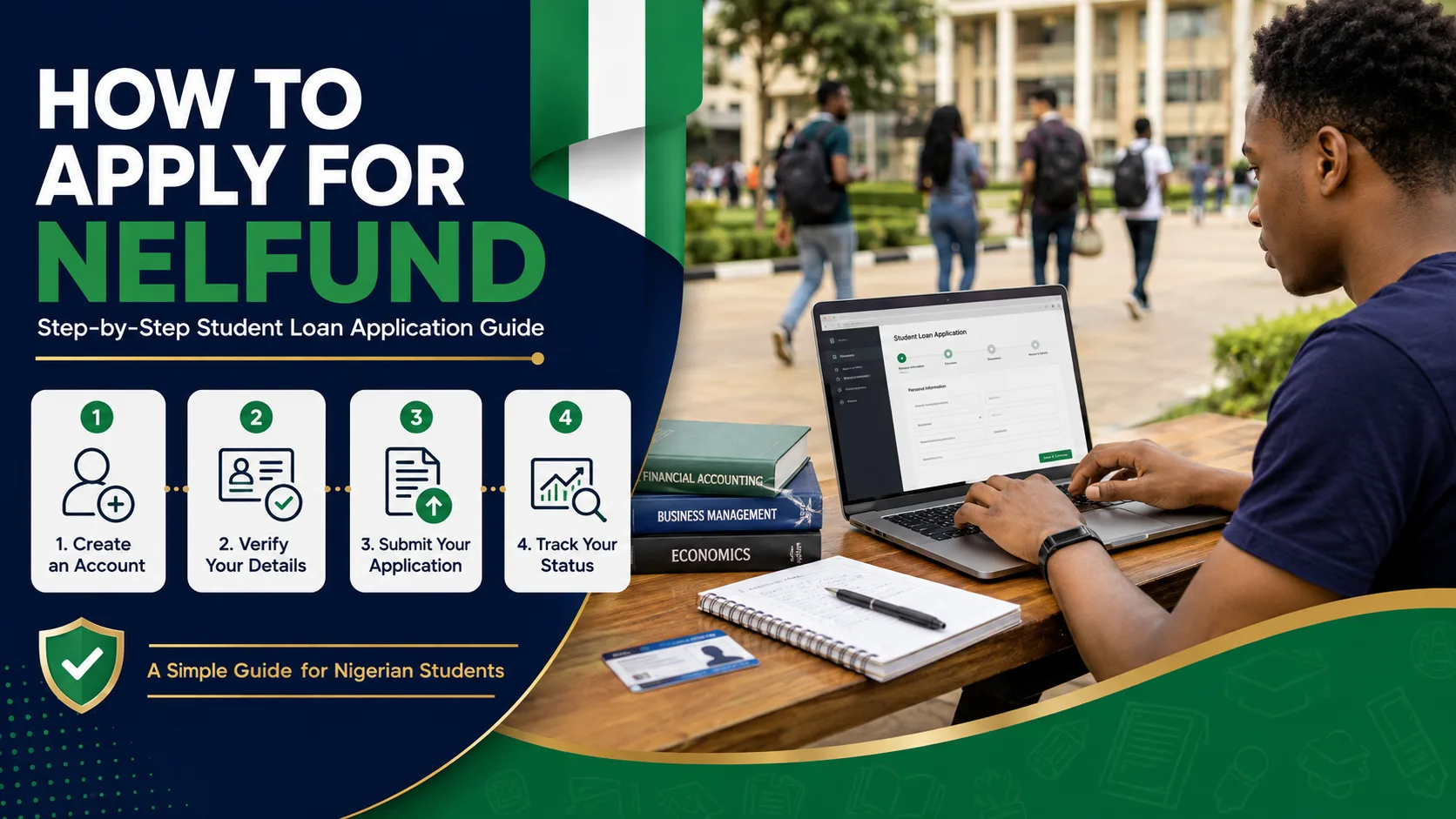
This guide explains, in simple language, how to apply for NELFUND, who can apply, the documents and details you need, common mistakes to avoid, and how repayment works. Read to the end, because the small details are what decide whether an application goes through smoothly.
Paying school fees is one of the biggest worries for many Nigerian students and their families. The Nigerian Education Loan Fund (NELFUND) was created to make this easier. It gives interest-free loans to eligible students in public tertiary institutions, so that lack of money does not stop them from finishing their studies.
Quick note before you start: NELFUND rules, deadlines and portal steps can change from one academic session to another. Always confirm the latest details on the official NELFUND website (nelf.gov.ng) before you apply.
What Is NELFUND?
NELFUND stands for Nigerian Education Loan Fund. It is the federal government agency that manages student loans for Nigerians in approved tertiary institutions. It was set up under the Student Loans (Access to Higher Education) Act, which President Bola Tinubu signed into law in 2024, and the loan portal opened to students later that year.
The main idea is simple: the government lends you money to study, you do not pay interest, and you only start to repay after you have finished school, done NYSC and started earning.
What the loan can cover
| Type of support | What it means for you |
|---|---|
| Institutional charges (tuition/school fees) | The money is paid directly to your school, not to you. |
| Upkeep/stipend | A monthly allowance paid to your bank account to help with living costs. At the time of writing, this is ₦20,000 per month. |
One important point: if you want the upkeep loan, you must first apply for the institutional charges loan. According to a recent Vanguard report on the process, an upkeep stipend loan requires you to apply for the institutional charges loan as well.
Who Can Apply for NELFUND?
Different websites list the requirements slightly differently, so use the official portal as your final guide. In general, you must:
- Be a Nigerian citizen.
- Be admitted into and currently enrolled in a public tertiary institution (university, polytechnic, college of education, or other approved institution).
- Have a valid National Identification Number (NIN).
- Have a Bank Verification Number (BVN).
- Have a valid JAMB registration number (for those who entered through JAMB).
- Have a matriculation number from your school.
- Have an active email address and phone number.
- Have a bank account (needed especially for the upkeep payment).
The school must be on the system too
This is the part many students miss. Your school must be registered with NELFUND and must have uploaded your student records to the NELFUND verification system. If your name is not there, your application will not go through, no matter how correctly you fill the form. So before you do anything else, ask your school’s bursary, student affairs office or your departmental officers whether student records have been submitted.
What about fresh students?
Newly admitted students usually cannot apply until they have accepted admission, completed school registration and received a matriculation number. If you are a fresh student, complete your school’s clearance and registration first, then check the portal.
What You Need Before You Start
Get these ready before opening the portal. This will save you time and stress, especially if the network is slow.
| Item | Why you need it |
|---|---|
| NIN | For identity verification |
| BVN | Linked to your bank account and profile |
| JAMB registration number | To confirm your admission record |
| Matriculation number | To match your school record |
| Active email address | For account creation and the verification link |
| Working phone number | For updates and verification |
| Bank account details | For upkeep payments |
| Passport photograph or valid ID (if requested) | For profile and document upload |
| Proof of admission or student status (if requested) | To confirm you are a genuine student |
Tip: Make sure the name on your NIN, BVN, JAMB record and school record is the same. Even a small spelling difference can cause a verification error.
How to Apply for NELFUND: Step-by-Step
The steps below follow the current general process, as reported by Vanguard and other education sources. The portal layout may change slightly, but the flow stays the same.
Step 1: Visit the official NELFUND website
Go to the official NELFUND website and click “Apply Now” or “Student Portal.” Only use the official site. Some other websites copy the design of the real portal, so check the web address carefully before typing in your details.
Step 2: Verify your details
Enter your NIN and JAMB registration number. Then select your public tertiary institution, enter your matriculation number, and confirm your date of birth. The system checks these against your school records.
Step 3: Create your account
Enter your email address, create a strong password, and submit. A verification link will be sent to your email. Open it and click the link to confirm your account. If you do not see the email, check your spam or junk folder.
Step 4: Log in and complete your profile
Log in to your new account and fill in your personal information. This includes your phone number, residential address, BVN and bank details. An incomplete profile can stop you from continuing, so take your time.
Step 5: Click “Request for Student Loan”
On your dashboard, select “Request for Student Loan.” Choose institutional charges first. If you also want help with living costs, apply for the upkeep loan as well.
Step 6: Review and accept the terms
Read the loan details and the terms and conditions carefully. Many students skip this, but you should understand what you are agreeing to, especially the repayment terms.
Step 7: Submit and keep proof
Submit your application. Take a screenshot of the confirmation page and save any emails or reference numbers. Keep these safe in case you need to follow up later.
Step 8: Track your application
Log in from time to time to check the status of your request. Approval and payment are handled in batches, so do not panic if you do not get feedback immediately.
How Approval and Payment Work
After you apply, the process generally goes like this:
- Your school confirms that you are a genuine, enrolled student.
- NELFUND reviews your request.
- If approved, the tuition part is paid directly to your school.
- The upkeep part is paid into your bank account, usually monthly, if you applied for it.
Because payments are processed in batches, some students may be paid before others. Applying early and making sure your school has uploaded your records will help you avoid unnecessary delays.
Repayment: What Happens After School?
NELFUND is a loan, not a grant, so you will pay it back. The good news is that repayment is designed to be gentle.
- The loan is interest-free.
- Repayment starts after you finish school and complete NYSC, and only when you have a source of income.
- Repayment is capped at 10 per cent of your gross monthly income, according to the Vanguard report on NELFUND.
Simply put, if you earn nothing, you are not expected to pay from nothing. If you later earn a salary, a small percentage goes toward the loan until it is cleared. Always confirm the current repayment rules on the official portal, as the details may be updated.
Common Mistakes That Can Delay Your Application
Many failed or delayed applications come down to simple errors. Avoid these:
- Mismatched names. Your NIN, BVN, JAMB and school records should show the same name spelling.
- Wrong matric number. Enter it exactly as your school issued it.
- Not checking if your school has uploaded records. If the school has not done its part, the system cannot verify you.
- Using an email you cannot access. You will not be able to confirm your account.
- Rushing through the profile. Missing or wrong bank details can delay upkeep payments.
- Waiting until the last minute. Portals get slow and crowded near deadlines.
- Trusting random “agents.” More on this below.
Beware of Scams
Whenever there is a government benefit, fraudsters follow. Please remember:
- Applying for NELFUND is not something you should pay a stranger to do. If someone asks for money to “speed up” your approval or “guarantee” your loan, walk away.
- Never share your password, BVN, or OTP with anyone on WhatsApp, Telegram, Facebook or any social media page.
- Use only the official NELFUND website and official social media pages.
- If a website looks strange or asks for payment for something that should be free, do not continue.
Protecting your personal details is as important as completing the application.
Practical Tips to Improve Your Chances
- Apply early in the application window.
- Talk to your school first. Ask your departmental or faculty officers or the bursary whether student records have been uploaded.
- Update your details. If your NIN or BVN has errors, fix them before applying.
- Keep your documents together in one folder on your phone, including screenshots of your submission.
- Follow official updates for new sessions, deadlines or portal changes.
- Be patient. Batch payments mean not everyone is paid on the same day.
NELFUND for the 2026/2027 Session
At the time of writing, reports say that applications and payments for the 2025/2026 session were still being processed, and that a new window for 2026/2027 was expected later in the year. Since dates and rules can change, do not rely on any blog (including this one) for the exact opening or closing date. Check the official NELFUND website and your school notice board for the latest announcement.
Frequently Asked Questions (FAQs)
1. Is NELFUND free to apply for?
Yes. There is no official fee for you to apply online. Do not pay anyone claiming they can get you the loan.
2. Is NELFUND interest-free?
Yes. The loan is interest-free. You repay only what you borrowed, under the repayment terms set by NELFUND.
3. Can I apply if I attend a private university?
The scheme is mainly for students in public tertiary institutions. Check the official portal for any change to this.
4. Will the money be paid to me or to my school?
The institutional charges (tuition) part is paid directly to your school. The upkeep part, if approved, is paid to your bank account.
5. Can I get only the upkeep loan without the tuition loan?
No. You must apply for the institutional charges loan first before you can apply for the upkeep loan.
6. Can a fresh student apply without a matric number?
Usually not. You should complete admission acceptance and school registration first so your school can issue your matric number and upload your record.
7. What if my school is not on the portal?
Speak to your school’s management, student affairs unit or bursary. NELFUND can only verify students whose schools have submitted their records.
8. When do I start repaying?
Repayment begins after you complete your studies and NYSC, and once you have income. It is capped at a percentage of your gross monthly income.
9. What if I made a mistake in my application?
Log in and check whether you can edit your profile. If not, contact NELFUND through its official support channels and keep your reference number and screenshots ready.
10. How do I know my application was successful?
Check your dashboard status and your email. Confirmation and payment updates are handled through the portal.
Conclusion
NELFUND can make a real difference for students who struggle to pay fees and cover daily needs. The application is simple if you prepare well: get your NIN, BVN, JAMB number and matric number ready, confirm that your school has uploaded your record, apply through the official portal, and keep proof of everything you submit.
Take your time, avoid shortcuts, and stay away from anyone asking you to pay for what should be free. If you follow these steps, you will be in a much better position to get the support you need to complete your education.
Share this guide with a friend who needs it, and keep visiting MyEduWise.com.ng for more accurate, student-friendly updates on admissions, scholarships and education funding in Nigeria.