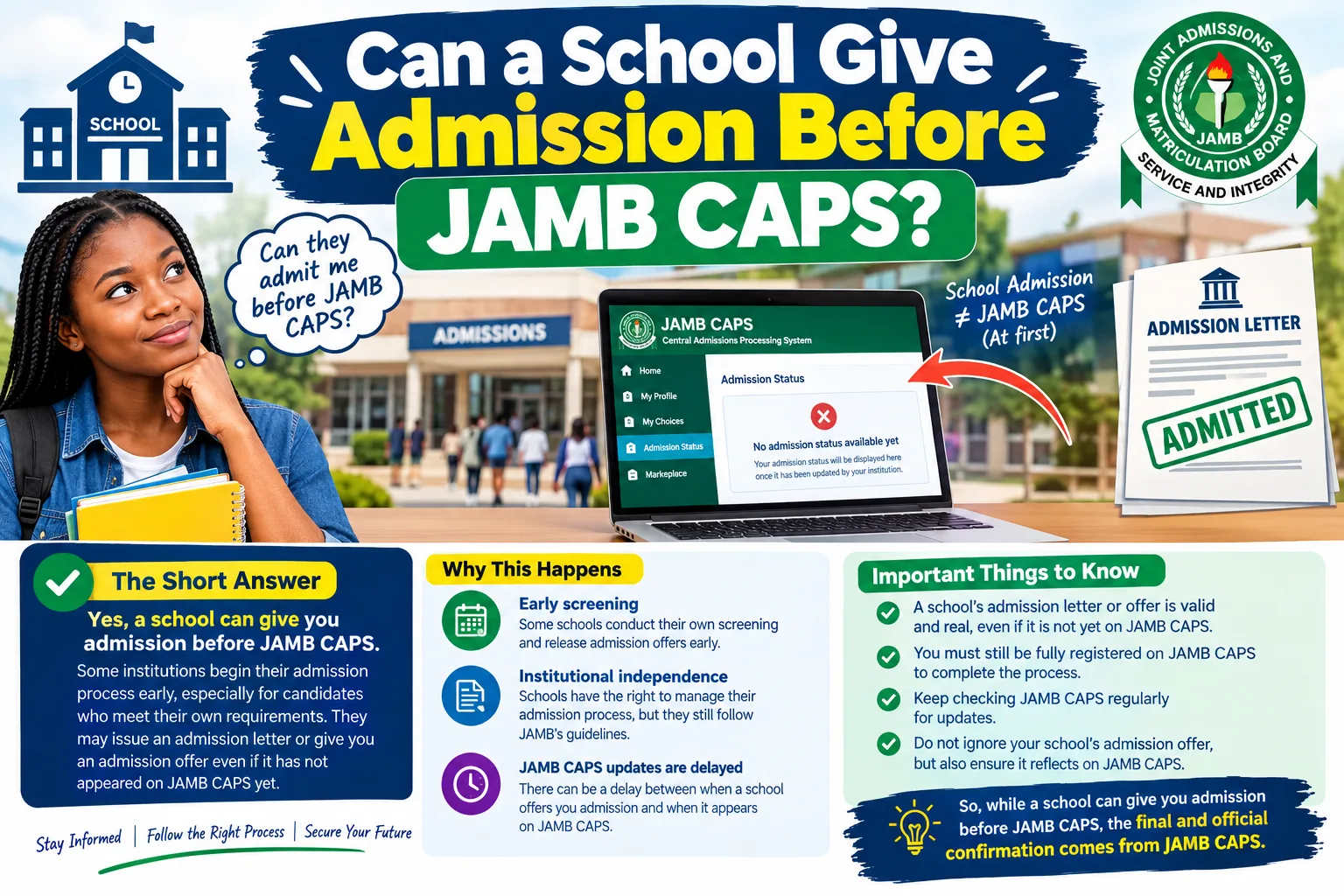
In this article, we explain why some school give admission before jamb caps, what you risk if you accept such an offer, and how to protect yourself before the 31 October 2026 deadline for public universities.
You wrote UTME, passed your screening, and your dream school has just released a list with your name on it. Your phone is buzzing with congratulations, and the school is already asking for an acceptance fee. But when you log in to your JAMB profile, nothing has changed. So the big question many candidates and parents ask is this: can a school give admission before JAMB CAPS?
The short answer for the 2026/2027 session is no. JAMB, the Federal Ministry of Education and the NUC have all said, again and again this year, that any admission given outside the Central Admissions Processing System (CAPS) is illegal and will not be recognised.
Everything here was checked against recent reports of JAMB’s 2026 Policy Meeting and official JAMB announcements up to mid-October 2026. Where sources disagree, we say so clearly.
Quick Answer: Can a School Give Admission Before JAMB CAPS?
| Question | Short answer |
|---|---|
| Can a school give admission before JAMB CAPS approves it? | No. An admission is valid only when it is processed through CAPS. |
| Is a school’s own admission list enough? | No. Your name must appear and be approved on CAPS. |
| Can I pay acceptance fee based on the school’s list alone? | Not safely. JAMB has warned candidates against this. |
| Will JAMB help if a school admits me outside CAPS? | JAMB said in April 2026 that it will no longer entertain complaints from such admissions. |
| What proves I am duly admitted? | Approval on CAPS, your acceptance, and your printed JAMB admission letter. |
What Is JAMB CAPS and Why Does It Matter?
CAPS stands for Central Admissions Processing System. JAMB introduced it in 2017 to regulate admission procedures and remove human interference. Before CAPS, schools mostly chose who they wanted, and many deserving candidates lost their places to people with money or connections.
With CAPS, the process is now more open. Institutions recommend candidates on the platform, JAMB approves within the school’s approved capacity, and candidates log in to accept or reject the offer. JAMB’s Registrar, Prof. Ishaq Oloyede, has also explained that CAPS lets candidates see how competitive they are, compare scores, and make better choices of school and course.
CAPS also feeds the National Matriculation List, which is the official record of students who are legally admitted. If your name is not on that list, your admission is not recognised, no matter what the school tells you.
The Official Position in 2026: Admissions Outside CAPS Are Illegal
The message in 2026 has been consistent and strong. Here is what the major statements say, in our own words:
- At the 2026 Policy Meeting on Admissions (11 May 2026, Abuja): The Minister of Education, Dr Tunji Alausa, said without any doubt that admissions conducted outside CAPS are illegal and will not be recognised. He also said the era of schools running parallel admission systems must end.
- Same meeting: Prof. Oloyede said some institutions were still issuing admission letters to candidates not approved on CAPS. He added that disciplinary action had started against some of them and that a case involving 11 universities over alleged illegal admissions was in court.
- April 2026: JAMB said it would no longer consider or process complaints from candidates whose admissions were secured outside CAPS. Candidates who proceed with such offers, it said, do so at their own risk and lose the right to seek redress.
- July 2026: JAMB again warned candidates that to be regarded as duly admitted, you must be able to print your JAMB admission letter. It also gave the example that if a programme is approved to admit 50 students, a 51st student is an illegal admission because the name will not appear on the matriculation list.
So when you ask, can a school give admission before JAMB CAPS?, the official answer is clear. A school can recommend you on CAPS, but it cannot lawfully admit you until the process is completed there.
How Admission Is Supposed to Work on CAPS
Understanding the correct order helps you spot when something is wrong. This is the general flow:
| Step | What happens | Who acts |
|---|---|---|
| 1 | You write UTME and choose your institution and course | Candidate |
| 2 | The school screens candidates (post-UTME, screening or other approved methods) | Institution |
| 3 | The school recommends qualified candidates on CAPS | Institution |
| 4 | JAMB checks the recommendation against the approved quota and rules, then approves | JAMB |
| 5 | You see the offer on your CAPS profile and accept or reject it | Candidate |
| 6 | You print your JAMB admission letter | Candidate |
| 7 | The school registers you as a student | Institution |
Notice that the school’s own list is not a step that replaces any of this. A school can announce that screening is over or that it has uploaded names, but the admission is only real after JAMB’s approval and your acceptance.
In September 2026, JAMB also explained what the “Admission in Progress” status means. It simply shows that your application is still being processed, so candidates were told not to panic and to keep checking their CAPS profile.
Screening, Post-UTME and School Lists: Are They Admission?
This is where most confusion comes from, so let us break it down.
Screening or post-UTME is not admission. It is a step used by schools to decide who they will recommend. Passing it means you may be recommended, not that you are already admitted.
“Admission list” or “merit list” from the school website may be provisional. Some schools publish names of candidates they plan to recommend. Until those names are approved by JAMB and you accept on CAPS, the list is not final proof of admission.
“Admission letter” from the school alone is not enough. The letter that counts for JAMB purposes is the one you print after accepting on CAPS.
| Document or event | Is it admission? | What to do |
|---|---|---|
| Post-UTME or screening result | No | Wait for the school to recommend you on CAPS |
| School’s merit or provisional list | Not yet | Check your CAPS profile for approval |
| School-issued offer letter (before CAPS approval) | Not valid on its own | Do not pay big fees until CAPS shows approval |
| CAPS offer approved by JAMB | Yes, once you accept | Accept within the time allowed |
| Printed JAMB admission letter | Yes | Keep it safe; upload it when your school asks |
Why Do Some Schools Still Give Admission Before CAPS?
If the rule is so clear, why does it still happen? Based on JAMB’s own public statements and past reports, the main reasons are these:
- Pressure to fill spaces. Schools may want students quickly, especially when JAMB’s system is slow or down. In September 2026, CAPS had a temporary disruption before JAMB announced on 28 September that it was fully restored.
- Going above the approved quota. JAMB approves how many students a programme can take. Admitting extra students means those extra names will never appear on the matriculation list.
- Money. JAMB has previously warned that asking candidates to pay acceptance fees for admissions not processed on CAPS is illegal.
- Old habits. In 2021, JAMB said more than 700,000 illegal admissions had been carried out by 366 institutions. It told those schools to regularise the cases, with each affected candidate paying a N5,000 fine. By 2024, JAMB had also given schools a one-month ultimatum to disclose admissions done outside CAPS before 2017, and it made clear that it would no longer simply approve illegal admissions after the fact.
None of these reasons protects the candidate. If anything goes wrong, the student is the one who suffers.
The Risks of Accepting Admission Outside CAPS
Some candidates think, “The school gave me admission, so I am safe.” That is a dangerous assumption. Here are the real risks:
| Risk | What can happen to you |
|---|---|
| Not recognised | Your name may not be on the National Matriculation List, so you are not a legal student. |
| No help from JAMB | JAMB has said it will not handle complaints about admissions obtained outside CAPS. |
| Wasted money | You may have paid acceptance fees, school fees and other charges for an admission that is later rejected. |
| Problems at NYSC and with certificates | An unrecognised admission can cause trouble when you need a certificate or mobilisation later. Confirm directly with the relevant bodies if you are in doubt. |
| Lost time | You may study for a year and still be asked to leave or start again. |
| Lost chance elsewhere | While you hold a doubtful offer, you may miss a genuine admission somewhere else. |
The Federal Government has also said it wants stricter penalties. JAMB’s Registrar said the NUC will visit universities after matriculation to confirm that schools did not exceed their approved quotas, and that stronger sanctions are being considered through proposed changes to the NUC Act. A July 2025 report also said the Government planned to revoke the licences of institutions engaged in illegal admissions.
How to Know Whether Your Admission Is Genuine
Use this simple checklist before you pay anything:
| Check | Genuine sign | Warning sign |
|---|---|---|
| CAPS profile | Shows an admission offer from your school and course | Shows nothing, or only “Not Admitted” |
| Offer origin | Offer appears on your own CAPS profile | School says “CAPS will be updated later” |
| Payment pressure | You are given reasonable time to accept | You are told to pay now or lose the place within hours |
| Agent involvement | You deal only with official school channels | An “agent” or staff member asks for private payment |
| JAMB admission letter | You can print it after accepting | You are told you do not need it |
| Quota | The school is within its approved numbers | Extra “special” or “spill-over” admissions are offered |
If you see any warning sign, stop and verify with the school’s admissions office and with JAMB through official channels.
Key 2026/2027 Admission Facts at a Glance
These facts come from the 2026 Policy Meeting and JAMB’s announcements since then.
| Item | 2026/2027 position |
|---|---|
| Minimum admissible score, universities | 150 |
| Minimum admissible score, colleges of nursing | 150 |
| Minimum admissible score, polytechnics and monotechnics | 100 |
| Can schools set higher cut-off marks? | Yes, but not lower than the national minimum |
| Minimum age for admission | 16 years (retained for 2026) |
| Public universities: admission deadline | 31 October 2026 |
| Private universities: admission deadline | 30 November 2026 |
| Polytechnics, monotechnics and colleges of education | 31 December 2026 |
| Time to accept an admission offer | Four weeks, after which the offer may be withdrawn |
| Admission outside CAPS | Illegal and not recognised |
A note on conflicting reports about deadlines. Most reports, including JAMB’s 28 September 2026 update, give 31 October 2026 for public universities. One news report gave a different date for public universities. Because JAMB extended the public university deadline to 17 November in 2025, deadlines can change, so always confirm on JAMB’s official channels before you rely on any date.
What to Do If Your School Says You Are Admitted but CAPS Shows Nothing
This is one of the most common situations, and panic is the worst response. Follow these steps:
- Log in to your JAMB profile and open CAPS. Check the “Check Admission Status” section for the right exam year.
- Read the status properly. “Admission in Progress” means processing is not finished. It does not mean you have been rejected.
- Do not rush to pay large fees. Ask the school in writing whether your name has been recommended on CAPS.
- Make sure your details are correct. Candidates have raised issues in 2026 about O’level uploads and name mismatches, so confirm that your results are uploaded and your names match.
- Watch the dates. If the offer later appears on CAPS, you have four weeks to accept, according to the 2026 policy.
- Use official channels only. Follow JAMB’s verified pages and website, not rumours from social media groups.
- Keep a back-up plan. Consider other schools, change of institution when the portal is open, or other routes such as Direct Entry or pre-degree programmes if it fits your situation.
For a guide on the correct way to accept an offer once it appears, read our article on how to accept admission on JAMB CAPS. If you want a different course, see how to change course on the JAMB portal.
What Schools Risk When They Admit Outside CAPS
Schools are not safe either. According to the 2026 reports, JAMB has already started disciplinary processes against some institutions, and a matter involving 11 universities is before the court. The minister said schools that continue to bypass CAPS will face serious consequences. Their extra students can also be left out of the matriculation list, which creates a big problem for the school and the students.
In short, a school that gives admission before CAPS is taking risks with your future as well as its own reputation.
Special Cases Candidates Often Ask About
Direct Entry. Direct Entry candidates also apply through JAMB and are processed on CAPS. Some schools open their own registration or screening for them, but the final admission still needs to follow the same system. If you are unsure, check our Direct Entry guides and confirm with your school.
Candidates exempted from UTME. At the 2026 policy meeting, it was announced that candidates for Education programmes and non-engineering Agriculture programmes are now exempted from UTME in the affected institutions. That change is about the exam requirement. It did not give schools permission to run admissions outside CAPS, because the minister’s warning applied to all admissions.
Underage candidates. The minimum age remains 16 years. JAMB has said that releasing the results of underage candidates carries no automatic right to admission.
Pre-degree, JUPEB and other foundation programmes. These are different programmes with their own rules. They are not the same as a degree admission through CAPS, so ask your school to explain exactly what you are paying for and what happens after the programme.
Practical Tips for Candidates and Parents
- Treat your CAPS profile as the final judge, not WhatsApp messages or school lists.
- Keep screenshots and receipts of every payment and communication.
- Pay only through the official channels listed on the school’s website.
- Never pay anyone who promises to “push” or “fix” your admission on CAPS.
- Respond promptly to any CAPS notification. JAMB has introduced a feature that allows schools to send admission-related notifications to candidates by SMS, so keep your registered phone number active and secure.
- If something looks wrong, report it through JAMB’s official complaint channels early, not after the deadline has passed.
Frequently Asked Questions (FAQs)
1. Can a school give admission before JAMB CAPS in 2026/2027?
No. For the 2026/2027 session, JAMB and the Ministry of Education have said that any admission given outside CAPS is illegal and will not be recognised. A school may recommend you on CAPS, but the admission is valid only after JAMB approves it and you accept it.
2. Is a school admission list the same as JAMB admission?
No. A school list may show the candidates the school wants to recommend. It does not replace JAMB approval on CAPS. Always confirm on your own CAPS profile.
3. Can I pay acceptance fee before my admission appears on CAPS?
It is risky. JAMB has warned candidates against paying acceptance fees for admissions that were not processed through CAPS. Ask the school whether you have been recommended, and wait until your CAPS profile shows the offer before making big payments.
4. What should I do if my school admitted me but JAMB CAPS shows “Not Admitted”?
First, confirm that your UTME and O’level details are correct and uploaded. Then ask the school in writing whether you were recommended on CAPS. If the school cannot show that, do not assume your admission is safe. Look at other options while you wait for an official update.
5. What does “Admission in Progress” mean on CAPS?
JAMB explained in September 2026 that the status means your application is still being processed. It is not a rejection, but it is also not the final approval. Keep checking your profile.
6. Will JAMB help me if I accepted admission outside CAPS?
JAMB said in April 2026 that it will no longer consider or process complaints from admissions obtained outside CAPS and that candidates who take such offers do so at their own risk.
7. Can my school change my admission later if CAPS did not approve it?
If the admission is not approved on CAPS, it is not recognised, and your name may be missing from the matriculation list. That is why you should confirm approval early instead of waiting until the end of the session.
8. How long do I have to accept my admission offer on CAPS?
Under the 2026 policy, candidates have four weeks after an offer is issued to accept it. Failure to accept in that time may lead to the offer being withdrawn.
9. What is the 2026/2027 admission deadline?
According to JAMB’s updates, public universities are to conclude admissions by 31 October 2026, private universities by 30 November 2026, and polytechnics, monotechnics and colleges of education by 31 December 2026. Always check JAMB’s official channels, because deadlines have been extended in the past.
10. What are the 2026 minimum cut-off marks?
The national minimum is 150 for universities and colleges of nursing and 100 for polytechnics and monotechnics. Schools can set higher cut-off marks for their courses, but not lower ones.
11. Does post-UTME or screening mean I am admitted?
No. Screening is only a step used by the school to choose candidates to recommend. You are admitted only after the school’s recommendation is approved on CAPS and you accept the offer.
12. Can a school admit more students than its approved quota?
No. JAMB’s Registrar gave an example that if a programme is approved for 50 students, the 51st is an illegal admission. The NUC is expected to check quotas after matriculation.
13. Are Direct Entry admissions also done on CAPS?
Yes, Direct Entry candidates are also processed through JAMB. Follow your school’s instructions, but confirm that your admission will be processed on CAPS before paying large fees.
14. Where can I get correct information?
Use the official JAMB website and verified social media pages, your CAPS profile, and your school’s official portal. Avoid agents and unverified groups.
Conclusion
So, can a school give admission before JAMB CAPS? Not lawfully. In 2026/2027, the position of JAMB, the Minister of Education and the NUC is clear: all admissions must pass through CAPS, and anything else is illegal and may not be recognised. A school’s list, an offer letter or a WhatsApp message can give you hope, but only an approved offer on your CAPS profile, followed by your acceptance and your printed JAMB admission letter, gives you real security.
Protect yourself by checking your CAPS profile often, paying only through official channels, keeping your records, and acting within the four-week acceptance window. With the 31 October 2026 deadline for public universities close, do not wait until the last minute to confirm your status.