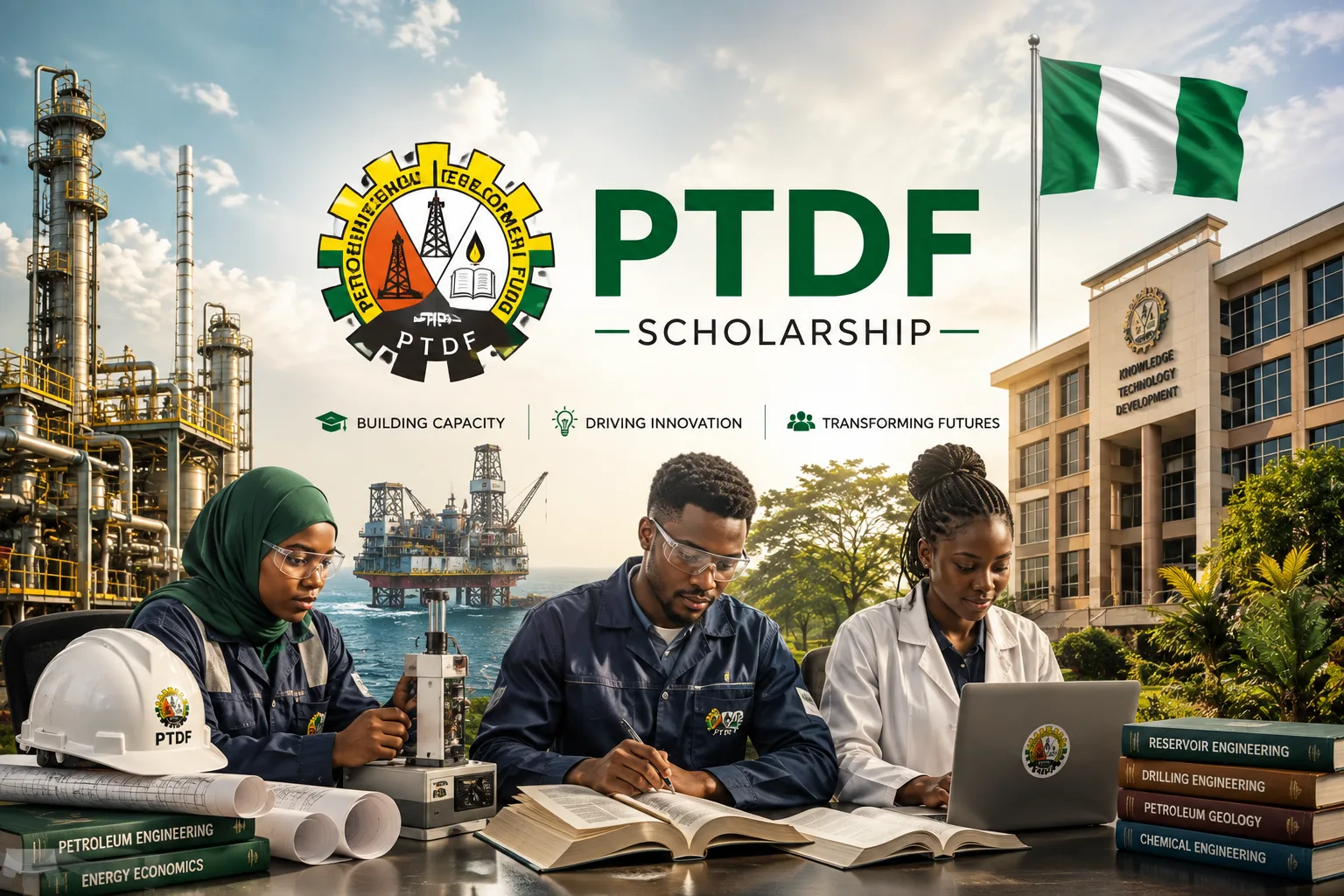
This guide explains what you need to know about the PTDF Scholarship, including eligibility requirements, available study categories, documents, application procedures, selection criteria, mistakes to avoid and frequently asked questions.
If you are a Nigerian student or graduate looking for financial support to study an oil and gas-related course, the PTDF Scholarship is one of the major scholarship opportunities worth considering. The programme is designed by the Petroleum Technology Development Fund (PTDF) to develop skilled Nigerian professionals and strengthen human capacity in areas relevant to the energy and petroleum industry.
The scholarship supports different categories of applicants, including undergraduate and postgraduate students under the in-country scheme, as well as Master’s and PhD candidates under selected overseas programmes. Depending on the specific scholarship scheme and year, successful candidates may receive support for tuition, living expenses, accommodation and other approved educational costs.
For the 2026/27 academic session, PTDF opened its In-Country Scholarship Scheme for undergraduate, Master’s and PhD studies in Nigerian public universities. The 2026 Overseas Postgraduate Scholarship Scheme also covered selected partner universities in the United Kingdom, Germany, France and Malaysia.
What Is PTDF Scholarship?
The PTDF Scholarship is an educational funding programme administered by the Petroleum Technology Development Fund, a Federal Government agency responsible for developing indigenous human capacity and petroleum technology for Nigeria’s oil and gas industry.
The programme is intended to help qualified Nigerians acquire knowledge and professional skills that can contribute to the development of the country’s energy sector.
The scholarship is not limited to petroleum engineering alone. Approved programmes can cover areas such as engineering, sciences, information technology, environmental disciplines, renewable energy and selected management-related fields.
For the 2026/27 In-Country Scholarship Scheme, PTDF listed undergraduate, Master’s and PhD opportunities in Nigerian public universities. The approved fields included engineering, science, environmental science, renewable energy and selected management disciplines.
Why Is the PTDF Scholarship Important?
The scholarship is important because the energy sector requires professionals with strong technical, scientific, managerial and research skills.
Rather than simply providing financial assistance, PTDF uses its scholarship programmes as part of its wider human-capacity development mandate.
Some of the major benefits include:
- Financial support for approved studies.
- Opportunities to develop specialised technical knowledge.
- Access to recognised universities and academic institutions.
- Exposure to advanced research and professional training.
- Development of skills relevant to Nigeria’s energy sector.
- Opportunities for postgraduate research.
- International academic exposure for successful overseas candidates.
For the 2026 overseas scheme, PTDF stated that scholarship benefits included return flight tickets, health insurance, tuition and bench fees where applicable, as well as accommodation and living allowances.
PTDF Scholarship Categories
The available categories depend on the particular application cycle. Applicants should always check the current official announcement because PTDF can modify participating universities, courses, requirements and application dates.
| Scholarship category | Study location | Typical level |
|---|---|---|
| In-Country Scholarship Scheme | Nigeria | Undergraduate |
| In-Country Scholarship Scheme | Nigeria | Master’s |
| In-Country Scholarship Scheme | Nigeria | PhD |
| Overseas Scholarship Scheme | Selected foreign universities | Master’s |
| Overseas Scholarship Scheme | Selected foreign universities | PhD |
The 2026/27 in-country announcement specifically invited applications for undergraduate, Master’s and PhD awards in Nigerian public universities.
The 2026 overseas programme was restricted to selected PTDF partner universities in the UK, Germany, France and Malaysia.
PTDF Scholarship Eligibility Requirements
Eligibility requirements vary according to the category you are applying for. Therefore, applicants should not assume that meeting the requirements for an undergraduate award automatically qualifies them for an MSc or PhD award.
Undergraduate Applicants
For undergraduate candidates, the applicable requirements should be checked directly from the current PTDF application guidelines when the undergraduate application window opens.
Applicants should generally ensure that they:
- Are Nigerian citizens.
- Meet the academic requirements stated in the current call for applications.
- Are applying for an approved course.
- Have the required supporting documents.
- Meet the institution and programme requirements.
- Provide valid identification information where required.
Applicants should also understand that admission into a university does not automatically guarantee a PTDF award. Scholarship selection is a separate process.
Master’s Applicants
The requirements for postgraduate applicants are more detailed.
For the 2026 overseas MSc scheme, PTDF required applicants to have at least a Second Class Upper (2:1) degree, although candidates with a Second Class Lower (2:2) could qualify where they had relevant industry experience. Applicants were also required to have completed NYSC, be computer literate and possess five O’Level credits including English Language and Mathematics.
For the 2026/27 in-country postgraduate scheme, PTDF also considered academic merit, professional qualifications, relevant publications, professional memberships and the quality of the proposed study or research.
PhD Applicants
PhD applicants normally face additional academic and research requirements.
For the 2026 overseas scheme, applicants needed at least a Second Class Lower (2:2) first degree and a good postgraduate degree. They were also required to complete NYSC, possess five O’Level credits including English and Mathematics, and submit a research proposal relevant to the oil and gas industry.
For the 2026/27 in-country PhD scheme, PTDF required a full-time admission letter into a public university, a minimum of Second Class Lower in an oil and gas/management-related field, a minimum of Merit in a relevant second degree, relevant O’Level results, NYSC documentation and a research area relevant to the oil and gas industry.
Courses Sponsored by PTDF
One common misconception is that the scholarship is exclusively for petroleum engineering students.
That is not correct.
PTDF’s approved courses can cover several disciplines connected to its human-capacity development objectives.
Examples listed under the 2026/27 in-country scheme include:
Engineering
- Chemical Engineering
- Civil Engineering
- Computer Engineering
- Electrical Engineering
- Mechanical Engineering
- Petroleum Engineering
- Mechatronics Engineering
- Production Engineering
- Structural Engineering
- Systems Engineering
- Software Engineering
- Telecommunication Engineering
- Water Resources and Environmental Engineering
Science
- Applied Geology
- Applied Geophysics
- Chemistry
- Computer Science
- Mathematics
- Microbiology
- Physics
- Statistics
- Cyber Security
- Industrial Chemistry
- Toxicology
Environmental and Related Fields
- Environmental Management Technology
- Survey and Geo-Informatics
- Remote Sensing and Geo-Science Information
- Geographic Information System
- Industrial Design
Renewable Energy
- Renewable Energy
- Renewable Energy Physics
- Renewable Energy and Environmental
- Mechanical Engineering with Energy and Power options
Management
Selected management-related courses also appeared on the 2026/27 approved list, including:
- Business Administration
- Accounting
- Economics
- Law
- Marketing
- Banking and Finance
- Entrepreneurship
- Purchasing and Supply
- Taxation
These courses are examples from the 2026/27 in-country approved list. The available courses can change, so applicants should always check the current PTDF list before applying.
Documents Needed for PTDF Scholarship Application
Preparing your documents early can make the application process easier.
For the 2026/27 in-country postgraduate application, PTDF listed documents such as first-degree certificates or statements of result, NYSC certificates or exemption letters, WAEC/GCE/SSCE/NECO results, admission letters, personal statements and certificates of indigeneship. PhD candidates were additionally required to submit second-degree documents and research proposals.
The 2026 overseas application similarly required academic certificates, NYSC documentation, O’Level results, passport photographs and other supporting documents, with additional requirements for PhD applicants.
| Document | MSc | PhD |
|---|---|---|
| First degree certificate/result | Yes | Yes |
| NYSC certificate | Yes | Yes |
| O’Level result | Yes | Yes |
| Admission-related document | Where applicable | Where applicable |
| Master’s certificate | No | Yes |
| Personal statement | Depending on scheme | Usually research-focused |
| Research proposal | No | Yes |
| Indigeneship document | Depending on scheme | Depending on scheme |
| Professional membership evidence | Where applicable | Where applicable |
Make sure every document is genuine, readable and correctly uploaded. PTDF has warned that falsified or illegible documents can lead to disqualification.
How to Apply for PTDF Scholarship
The application process is completed online through the official PTDF scholarship platform.
Step 1: Visit the Official Portal
Applicants should use the official PTDF Scholarship Management Portal rather than third-party websites.
PTDF Scholarship Management Portal
The portal provides application instructions, scholarship guidelines and updates from PTDF.
Step 2: Read the Current Guidelines
Before creating an application, carefully read the requirements for your specific category.
Pay attention to:
- Academic qualifications
- Approved courses
- Approved universities
- Required documents
- NIN requirements
- Application deadline
- Statement of purpose requirements
- Research proposal requirements
- Interview requirements
Step 3: Create an Account
Create an applicant account on the official scholarship portal and provide accurate information.
Use your correct name and personal details as they appear on your official documents.
Step 4: Complete the Application Form
Enter your academic and personal information carefully.
Do not rush this stage. An incorrect grade, certificate number or personal detail can create problems during verification.
Step 5: Upload Your Documents
Upload the required documents according to the instructions provided by PTDF.
For the 2026/27 in-country scheme, postgraduate documents were required in PDF format and had to be legible and within the specified file-size limits, except for passport photographs.
Step 6: Review Your Application
Before submitting, check every section.
Confirm that:
- Your name is correct.
- Your academic information is accurate.
- Your uploaded documents are readable.
- Your course is approved.
- Your university is eligible.
- Your statement or proposal meets the required format.
- Your contact details are correct.
Step 7: Submit the Application
Submit your application before the stated deadline.
Do not wait until the final day because technical problems, network issues or incomplete documents can affect your submission.
PTDF Scholarship Statement of Purpose
For applicants who are required to submit a statement of purpose, this document can be an important part of the selection process.
The statement should clearly explain:
- Why you want to study the proposed course.
- Why the course is relevant to your career.
- How the programme relates to the energy or oil and gas industry.
- What skills you expect to acquire.
- How your proposed study can contribute to Nigeria.
For the 2026 overseas MSc scheme, PTDF required a statement of purpose of not more than 500 words covering the rationale for the proposed study, relevance to the oil and gas industry and expected contribution to national development.
For the 2026/27 in-country MSc application, PTDF also requested a personal statement of at least 1,000 words explaining why the applicant wanted to undertake the course and its relevance to industry and national development.
This shows why applicants should always follow the instructions for their specific application cycle rather than copying requirements from previous years.
PTDF PhD Research Proposal
PhD applicants should take their research proposal seriously.
A strong proposal should demonstrate that you understand the research problem and can explain how the study could contribute to knowledge or the energy sector.
For the 2026 overseas scheme, PTDF required a research proposal of not more than five pages covering the topic, background, objectives, methodology and data collection approach.
For the 2026/27 in-country scheme, the PhD proposal was limited to six pages and applicants were directed to use the template available through their portal profile.
How PTDF Selects Successful Applicants
The PTDF Scholarship is highly competitive.
Selection is not simply based on submitting an application. PTDF assesses candidates according to the requirements and criteria established for the relevant scheme.
Factors can include:
- Academic performance.
- Quality of academic transcripts.
- Professional qualifications.
- Relevant work or industry experience.
- Professional memberships.
- Publications for applicable postgraduate candidates.
- Study plan.
- Research proposal.
- Relevance of the proposed course to PTDF’s mandate.
- Interview performance.
For the 2026 overseas programme, PTDF stated that shortlisted applicants from each category and state could be invited for interviews, where a selection committee assessed academic merit, publications, professional memberships, study plans and relevance to the oil and gas industry.
The 2026/27 in-country scheme similarly emphasised academic merit, study/research viability and the relevance of the proposed study.
PTDF Scholarship Interview
If you are shortlisted for an interview, prepare properly.
Questions may focus on:
- Your academic background.
- Your proposed course.
- Your research interests.
- Your career plans.
- Why you selected the programme.
- The relevance of your course to Nigeria’s energy sector.
- Your understanding of the research problem.
- How your proposed study could contribute to national development.
Do not memorise complicated answers simply to impress the interview panel. Instead, understand your course, research proposal and career objectives.
Candidates should also have their academic transcripts available when required. PTDF specifically advised shortlisted overseas candidates to make transcripts available in advance.
PTDF Scholarship Application Deadline
Application deadlines vary according to the scholarship category and academic year.
For example, the 2026/27 In-Country Scholarship Scheme opened on 27 April 2026 and closed on 5 June 2026.
The 2026 Overseas Postgraduate Scholarship Scheme opened in January 2026 and had a closing date of 27 February 2026.
Therefore, applicants should not rely on an old deadline found on social media or an unofficial blog.
Always check the current PTDF announcement and official scholarship portal.
Is PTDF Scholarship Free?
Applicants should be careful when dealing with people who claim they can secure a scholarship slot for a fee.
PTDF has publicly warned that it does not allocate scholarship slots to individuals or third parties and that claims that someone can secure a slot in exchange for payment are false and unauthorised.
This is particularly important because scholarship scams often target students who are desperate for funding.
Use the official PTDF channels for application information and verification.
The official scholarship portal also provides support contacts for applicants.
Common Mistakes to Avoid
Applicants can improve their chances of submitting a strong application by avoiding common mistakes.
1. Applying for an Unapproved Course
Do not assume that every course at an eligible university qualifies.
Check the current sponsored-course list.
2. Submitting False Documents
Never alter certificates, transcripts or examination results.
False documents can result in disqualification.
3. Using an Old Application Guide
Requirements can change from one academic session to another.
Always use the latest official guidelines.
4. Ignoring the Statement Requirements
If PTDF asks for a specific word limit or structure, follow it carefully.
5. Submitting an Unclear Document
Scanned documents should be readable.
Poor-quality documents can make verification difficult.
6. Applying Multiple Times
The 2026 overseas guidelines stated that multiple applications would result in automatic disqualification.
7. Paying Unauthorised Agents
Do not pay someone who claims to have scholarship slots.
PTDF has specifically warned applicants about such claims.
Tips for Improving Your PTDF Scholarship Application
There is no guaranteed method of winning a competitive scholarship, but you can make your application stronger by presenting accurate and relevant information.
Maintain Strong Academic Records
Academic merit is an important selection factor. Keep your transcripts and certificates organised.
Choose a Relevant Programme
Your proposed programme should have a clear connection with the scholarship’s objectives.
Prepare a Strong Personal Statement
Explain your academic background, motivation and future plans clearly.
Develop a Clear Research Proposal
PhD candidates should ensure their research problem, objectives and methodology are logical and relevant.
Prepare for the Interview
If shortlisted, understand your course and be able to explain why it matters to Nigeria’s energy sector.
Apply Early
Early preparation gives you enough time to correct errors and obtain missing documents.
Latest PTDF Scholarship Updates
PTDF continues to publish scholarship announcements and award information through its official channels.
For example, PTDF published information on the award of 2026/2027 UK split-site and Germany, France and Malaysia strategic partnership scholarships in May 2026.
The official scholarship portal remains the best place to check active application opportunities, guidelines and announcements.
Applicants should therefore avoid relying entirely on WhatsApp messages, Facebook posts or forwarded screenshots when verifying scholarship information.
Frequently Asked Questions About PTDF Scholarship
1. What is PTDF Scholarship?
The PTDF Scholarship is a scholarship programme provided by the Petroleum Technology Development Fund to support qualified Nigerians studying approved programmes relevant to the energy and petroleum sector.
2. Who can apply for PTDF Scholarship?
Eligible Nigerians can apply depending on the category and requirements announced for a particular academic year. Available categories can include undergraduate, Master’s and PhD awards.
3. Does PTDF sponsor undergraduate students?
Yes. The 2026/27 In-Country Scholarship Scheme included undergraduate awards in Nigerian public universities.
4. Does PTDF sponsor Master’s students?
Yes. PTDF offers Master’s opportunities under applicable in-country and overseas schemes, subject to the requirements and approved programmes for the relevant application cycle.
5. Does PTDF sponsor PhD students?
Yes. PhD opportunities are available under applicable PTDF scholarship schemes. However, applicants must meet additional academic and research requirements.
6. Can I apply for any course I want?
No. You should apply only for courses listed as eligible under the particular PTDF scholarship scheme.
7. Can a Second Class Lower graduate apply?
It depends on the specific category. For example, the 2026 overseas MSc guidelines accepted a 2:2 with relevant industry experience, while PhD applicants had different requirements.
8. Is NYSC required?
For the 2026 overseas postgraduate scheme, applicants were required to have completed the mandatory NYSC. Requirements can differ by scholarship category, so applicants should check the current guidelines.
9. Do I need a NIN?
Yes, the 2026 PTDF schemes required applicants to have a NIN and, where specified, complete verification before application.
10. Can I apply through an agent?
Applicants should be very cautious. PTDF does not authorise individuals to sell scholarship slots, and it has warned the public against people demanding payment in exchange for securing scholarship opportunities.
11. Where can I apply for PTDF Scholarship?
Applications are made through the official PTDF Scholarship Management Portal when an application window is open.
Official PTDF Scholarship Portal
12. Does PTDF pay tuition fees?
Benefits depend on the scholarship category. For the 2026 overseas scheme, PTDF listed tuition and bench fees where applicable, alongside other approved benefits.
13. Can I apply for PTDF more than once?
Applicants must follow the rules of the particular scheme. For the 2026 overseas programme, multiple applications resulted in automatic disqualification.
14. How competitive is PTDF Scholarship?
It is highly competitive. PTDF states that candidates are assessed based on merit and suitability, including academic qualifications and other relevant criteria.
15. Where can I get the latest PTDF Scholarship information?
The safest option is to check the official PTDF website and scholarship portal for current announcements, requirements, deadlines and application instructions.
Conclusion
The PTDF Scholarship provides an important opportunity for Nigerian students and professionals who want to develop skills that can contribute to the country’s energy and petroleum industry. However, getting the award requires more than simply completing an online form.
Applicants should carefully study the official requirements, select an approved programme, prepare accurate documents and present a convincing academic or research case. Postgraduate applicants should pay particular attention to their statement of purpose, study plan, research proposal and academic records.
Most importantly, do not pay unofficial agents who promise to secure a scholarship slot. PTDF has clearly stated that scholarship slots are not sold to applicants or allocated through third parties.
Because scholarship requirements and deadlines can change, prospective applicants should always verify the latest information on the official PTDF Scholarship Management Portal before taking any action.